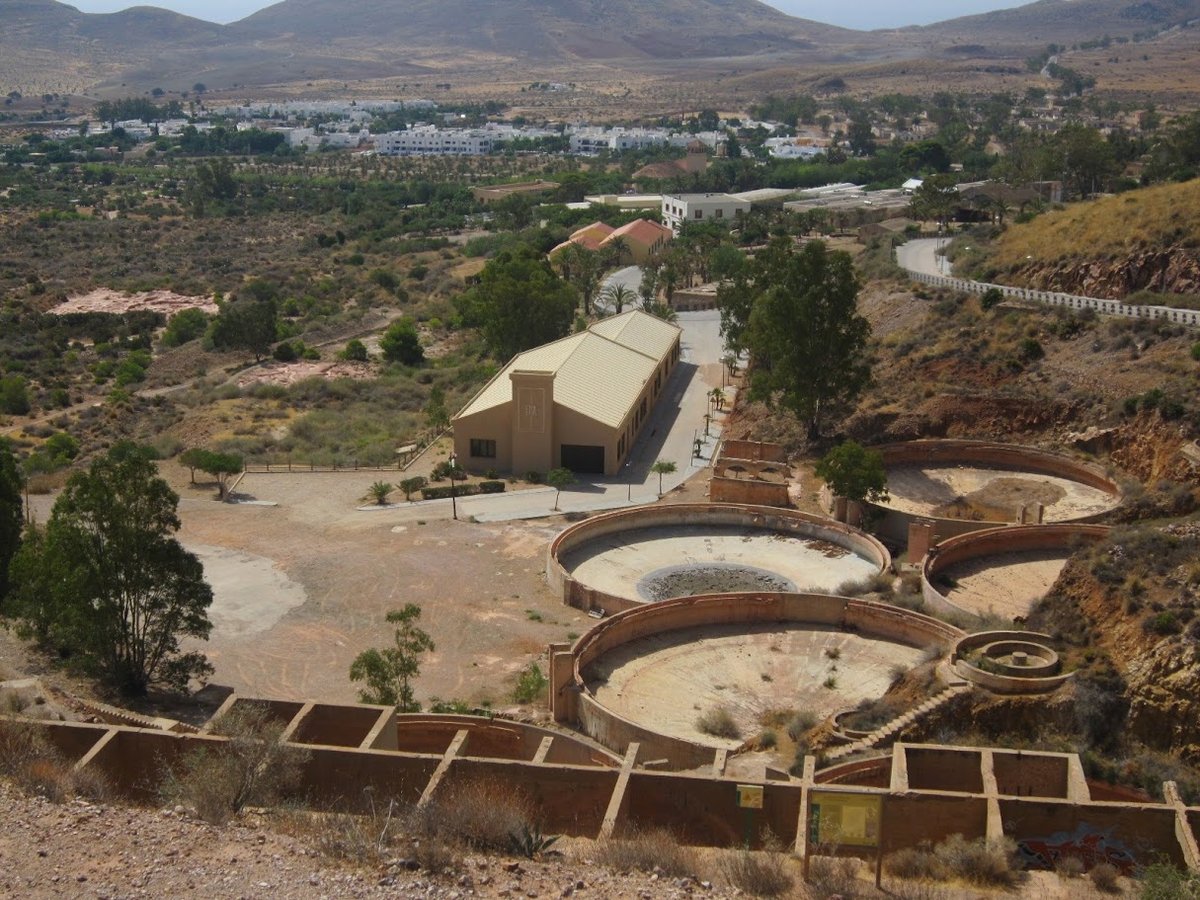

Rodalquilar is a small village located in the municipality of Níjar, in the province of Almería, Spain. Its history is marked by the discovery of various minerals, including gold, lead, silver, zinc, alum, and the locally named mineral rodalquilarite. Mines for lapis lazuli were in operation from 1445 until 1520, during which lapis lazuli was extracted. In 1509, Francisco de Vargas, a Royal Counselor, was granted the concession to exploit the lapis lazuli mines in Rodalquilar.
Pirate attacks were common, and in one of them, the entire old village of Los Alumbres was kidnapped. To protect the village, the Renaissance castle of Torre de los Alumbres was built. The torre de los Alumbres is featured in the spaghetti-western La muerte tenía un precio (1965) by Sergio Leone. The alum mines in Rodalquilar were abandoned from 1520 due to unknown reasons. In the 19th century, modern gold mining began in Rodalquilar, related to the depletion of local lead-silver ore deposits.
The gold mining boom in Rodalquilar started in the 1880s, with various companies and individuals from different parts of the world participating in the gold mining. In 1933, Rodalquilar had around 1000 inhabitants, making it the second most populous settlement in Níjar. The closure of the gold mines in 1966 led to a significant drop in Rodalquilar's population to just 79 inhabitants in 1986. Two main gold mining phases can be distinguished in Rodalquilar.
The first phase is associated with the extraction of lead, while the second phase is associated with gold extraction from 1931. The mining company for the extraction of gold in the mine 'Las Niñas' was one of the most important in the 19th century. The mining company for the extraction of gold in the mine 'Las Niñas' also owned the mines 'Demasía de las Niñas' and 'Potosí'. Galena argentiferous ore was extracted and sent to Murcian foundries in ships.
The problem for the extraction of gold was that it was disseminated in the rock and required a technology for its extraction that was not available in Rodalquilar. Contracts were signed for the provision of these rocks, whose gold was used as a fundent for the extraction of lead; the ingots were then sent to different points in Europe, especially Antwerp, for the separation of the two metals. Ore was discovered in the mine 'María Josefa' in 1915.
Two local miner-owned companies attempted the gold beneficiation in 1925 and 1929-1930, respectively. A mining company called 'Minas de Rodalquilar S.A. was created in Madrid in 1928, headed by Fernando María de Ybarra, the Marquis of Arriluce de Ybarra, although the company was controlled by British capital. The mining company 'Minas de Rodalquilar S.A. achieved the extraction of gold from Rodalquilar by cyanuration in 1931. The complex known as Planta Dorr was built, including tanks with agitators and counter-current wash and the building P.A.F.
Mantained the exploration with success until it was incarcerated by syndicalists during the Spanish Civil War in 1936. The mine 'California' was held under concession for the extraction of gold. The gold mines of Rodalquilar were incarcerated by Franco in 1942 and placed under the control of the Instituto Nacional de Industria (INI). In 1942, the INI created the company Adaro for the exploration of the Rodalquilar gold mines. The mines were amplified in 1956 with the construction of the Denver plant.
Franco and Juan Antonio Suances, the minister of Industry and the president of the INI, believed that the gold of Rodalquilar, the Spanish gold, was the savings of the economy. The gold of Rodalquilar did not save the Spanish economy but caused a significant waste of public resources. The losses accrued year after year as the production was never enough to cover the production costs, including the enormous investment amortization. Adaro closed in 1966 due to the low profitability of extraction.
The closure of the complete mining complex was due to the low profitability of extraction. The concentration of gold in the rock extracted was too low to make the work profitable.
Sources: Wikipedia, OpenStreetMap, Wikidata, Wikimedia Commons
Written by Nicolo Ciampini
Discuss this with the author and others
No comments yet. Be the first to start the conversation.