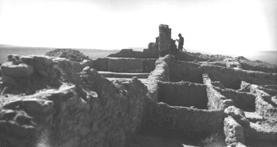

Tucked away in the heart of northeastern Arizona, the Awatovi Ruins, known today as Awat'ovi, bear the uncanny likeness of a ghostly epic of the Hopi people. These dwelling remnants, a part of the Hopi Reservation, serve as a haunting monument to a bygone era. Here lies the fragments of a 500-year-old pueblo and a sixteenth-century mission, residue of a village that thrived and then fell. Historians assert it was frequented by the legendary exploration party of Francisco Vázquez de Coronado during the 16th century.
The village of Awatovi was established after 1300, as attested by the ceramics uncovered during excavations. This booming settlement grew to be the most influential village within the Hopi region, with the Bow Clan settling within its walls. It was also the largest settlement on Antelope Mesa. Recent studies propose that Awatovi was the hub of a macro-cluster that encompassed villages on Antelope Mesa, First Mesa, and Homol'ovi on the Little Colorado River, about 50 miles (80 kilometers) to the south. Some archaeological findings even hint that while contemporary Hopis trace their lineage to the Jeddito Phase sites, including Awatovi, these Jeddito villages might not have been Hopi.
The first encounter between the Hopis and the Europeans unfolded in 1540 when Pedro de Tovar, dispatched by Francisco Vázquez de Coronado, visited Awatovi. This visit culminated in a skirmish, but five of the surviving Hopi pueblos pledged allegiance to the Spanish King shortly after. However, the Spanish did not return to the Hopi villages until 1583, when the Antonio de Espejo expedition paused for several days at the Hopi settlements.
In 1598, Juan de Oñate found the Hopis ready to swear fealty to the King of Spain and paid another visit in 1605. Captain Gerónimo Marquez stopped by in 1614, and Spanish friars constructed the mission of San Bernardo de Aguatubi atop the main kiva at Awatobi in 1629. The mission at Awatobi was notorious for its abusive priests in the 1650s. A Hopi man named Juan Suñi pretended to be a priest in 1656 and was sent to Santa Fe as an indentured servant.
Feeling the burden of Spanish oppression, the Hopis could no longer endure the mission's rule at Awatobi. In 1680, the Hopis destroyed the mission and killed the priests at the other Hopi villages during the Pueblo Revolt, fearing reprisals for their role in the uprising. Spanish reconqueror Diego de Vargas arrived in 1692 but departed without causing harm after the Hopis swore their allegiance to Spain. The Spaniards later rebuilt the mission of San Bernardo de Aguatubi, but tensions between the converted Hopis and the traditionalists at Awatobi intensified year by year, culminating in the tragic demise of the village by the end of 1700.
Sources: Wikipedia, OpenStreetMap, Wikidata, Wikimedia Commons
Written by Friendly Jane
Discuss this with the author and others
No comments yet. Be the first to start the conversation.