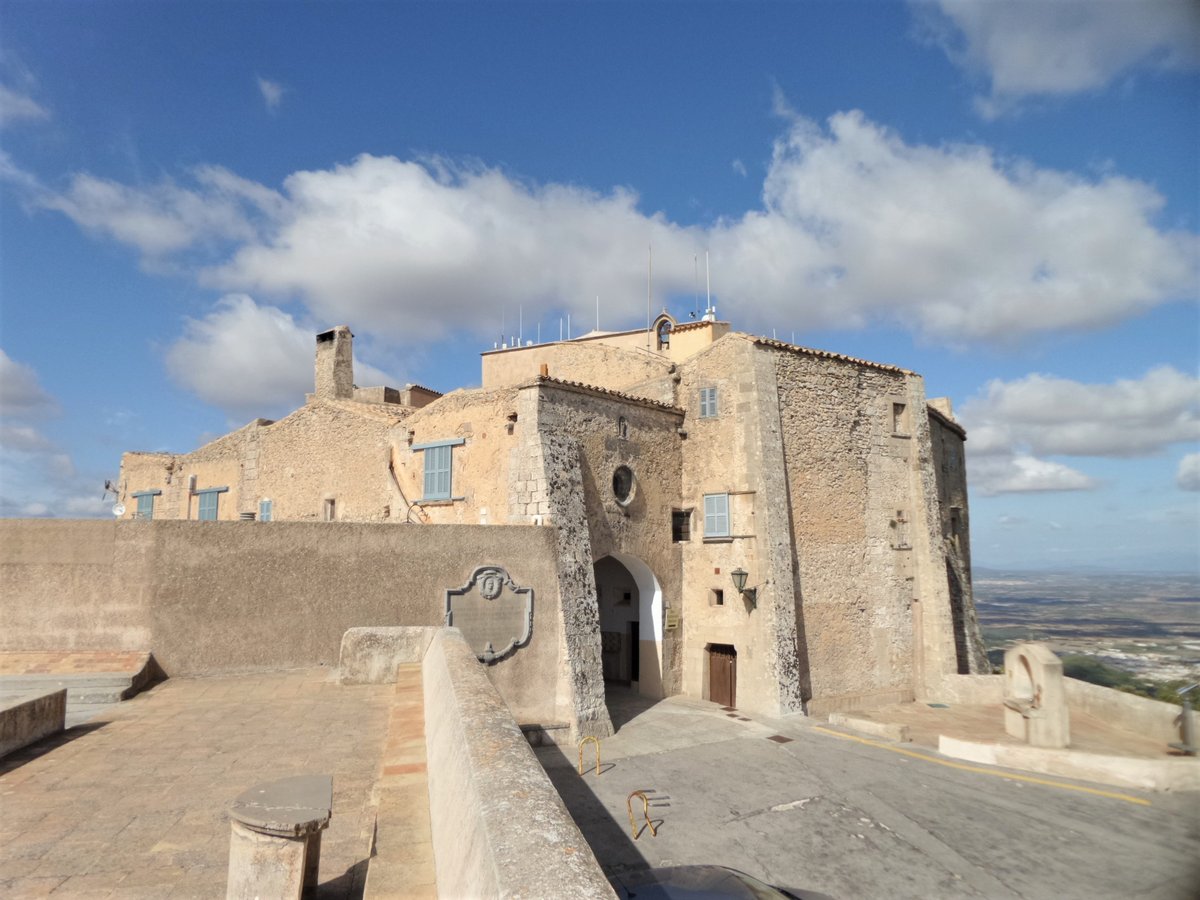

The Santuari de Sant Salvador, a monumental sanctuary in Mallorca, Spain, has a surprising and interesting history. Originally a small chapel built in 1348 to protect against the plague, it grew over time with the support of Spanish royals and home to hermits from the 19th century. Today, the site is a mix of history, art, and faith, attracting visitors from around the world. Here is the story, from its origins in the 14th century to its present day state.
**Origins**
The first records of the Santuari de Sant Salvador date back to 1348. King Pere III ‘the Ceremonial’ granted a privilege to build a chapel to protect against the plague in the town of Felanitx. The primitive chapel had a stone retable from the 15th century representing the Passion of Christ.
**Royal Patrons**
In 1595, there were new interventions at the sanctuary, related to the school of grammar founded in the mid 16th century. The current appearance of the sanctuary, including the hostelry, dates from the remodeling at the beginning of the 18th century, between 1707 and 1716. This renovation was partly funded by the Spanish monarchy, who supported the expansion of the site.
**The Hermits**
Between 1824 and 1851, hermits from the Congregation of Sant Pau and Sant Antoni resided there. They stayed until 1992.
**Today**
Visitors can visit the Santuari de Sant Salvador and see the 15th-century image of the Virgin and the confrari in its name dates back to 1601. The site also includes a retable dedicated to the Virgin of Sant Salvador, created by Pere Codonyer, and a monument dedicated to Christ Rey, also created by Tomàs Vila, at the foot of the mountain.
Sources: Wikipedia, OpenStreetMap, Wikidata, Wikimedia Commons
Written by Nicolo Ciampini
Discuss this with the author and others
No comments yet. Be the first to start the conversation.