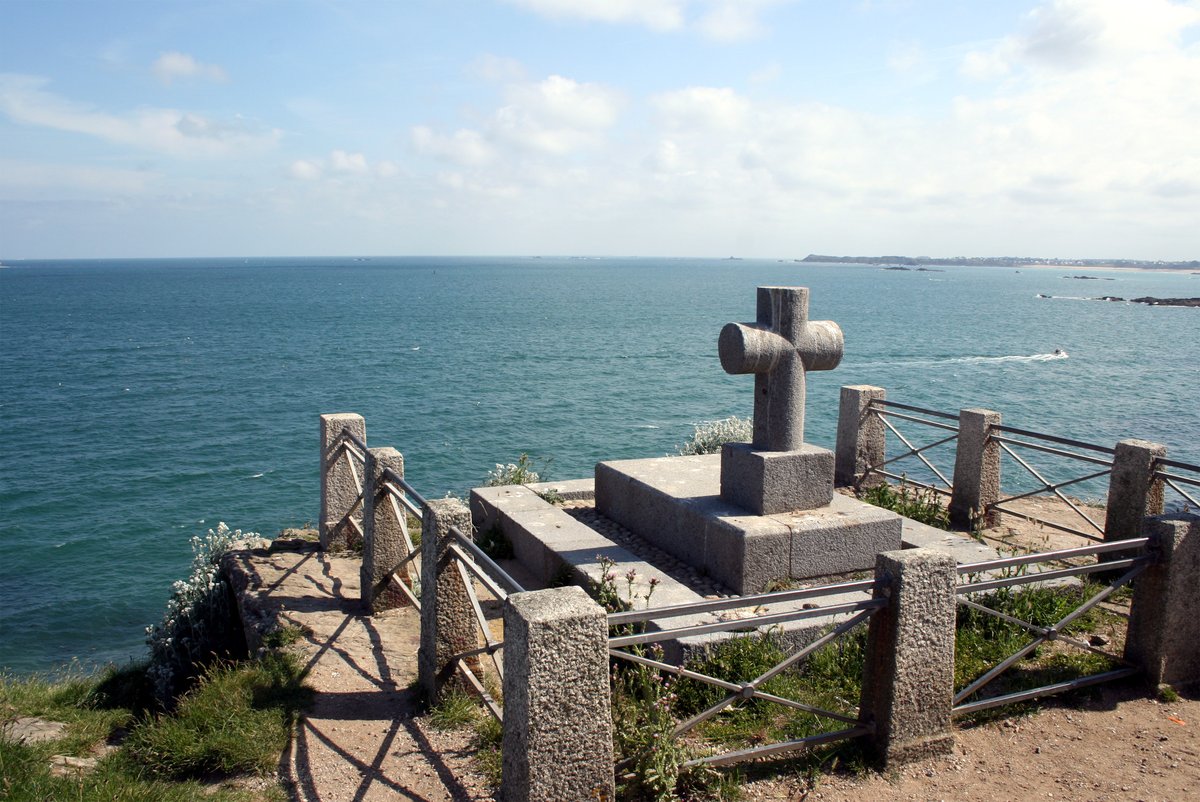

François-René de Chateaubriand, a famous writer from Saint-Malo born in 1768, died in Paris on July 4, 1848. He had a passionate desire to be buried on Grand Bé, an island adjacent to the coast of his hometown. His pursuit for an ideal burial spot began in 1823; despite an initial refusal from the municipal council, the site was eventually agreed upon in 1831. The tomb was finally ready ten years before his death, in 1838.
The tomb is located near the edge of the cliff, eternally facing the sea and the storm. Since 1924, the site has been threatened by erosion. While the writer's family authorized a move, the tomb remains in its original location due to a lack of consensus among experts. In 1944, a shell broke a corner of the tombstone, leading to the replacement of the iron railings with a design that allowed the writer to continue his dialogue with the sea.
In 2023, the municipality of Saint-Malo requested a preliminary study for potential conservation measures. The site has drawn notable figures throughout history. In her work La Force de l'âge, Simone de Beauvoir describes an excursion to the site with Jean-Paul Sartre, noting that the tomb seemed so pompously simple that Sartre expressed his contempt for it in a peculiar way.
Sources: Wikipedia, OpenStreetMap, Wikidata, Wikimedia Commons
Written by Nicolo Ciampini
Discuss this with the author and others
No comments yet. Be the first to start the conversation.