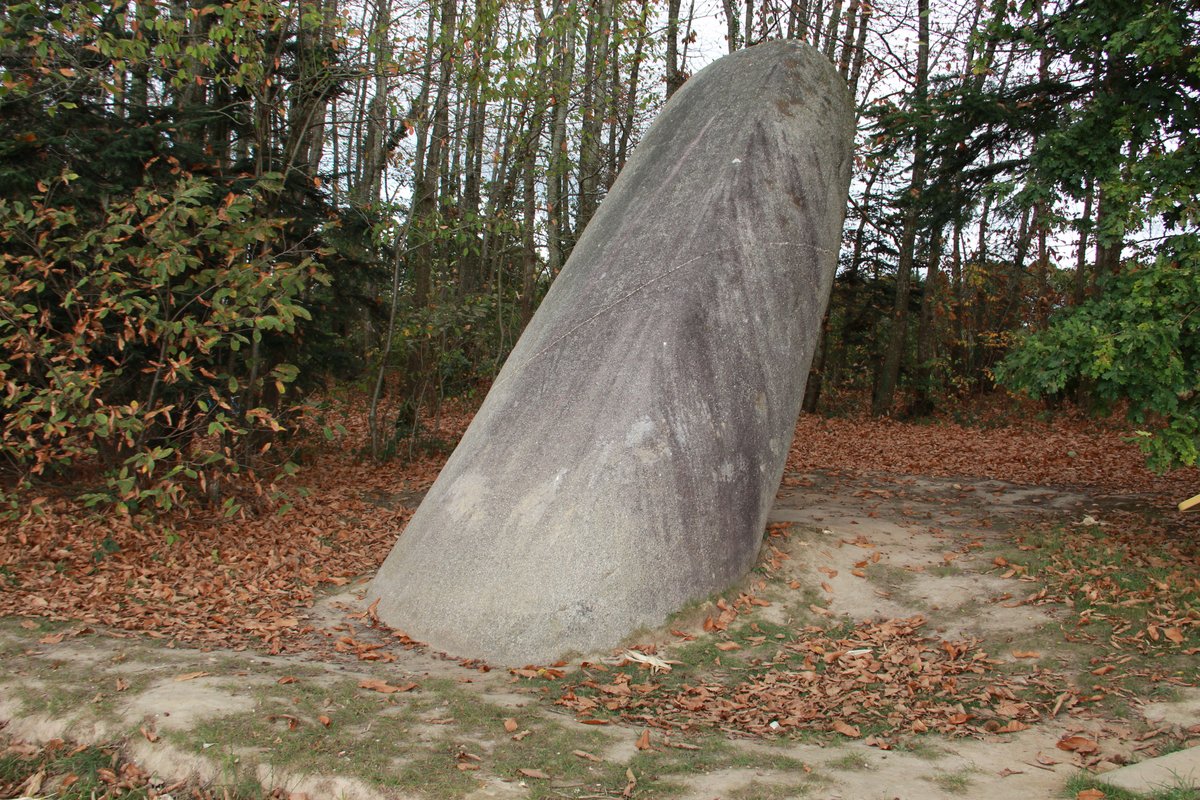

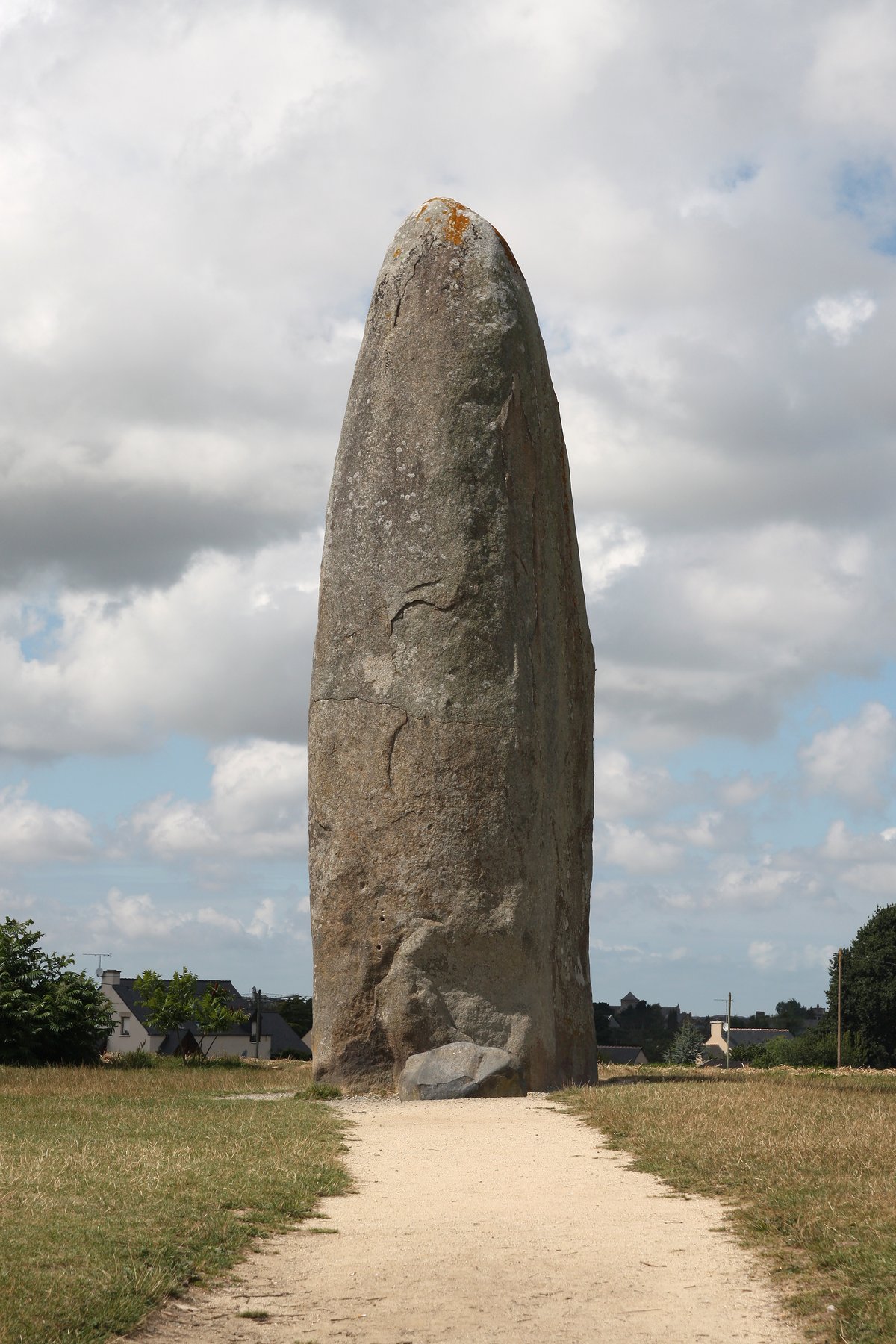
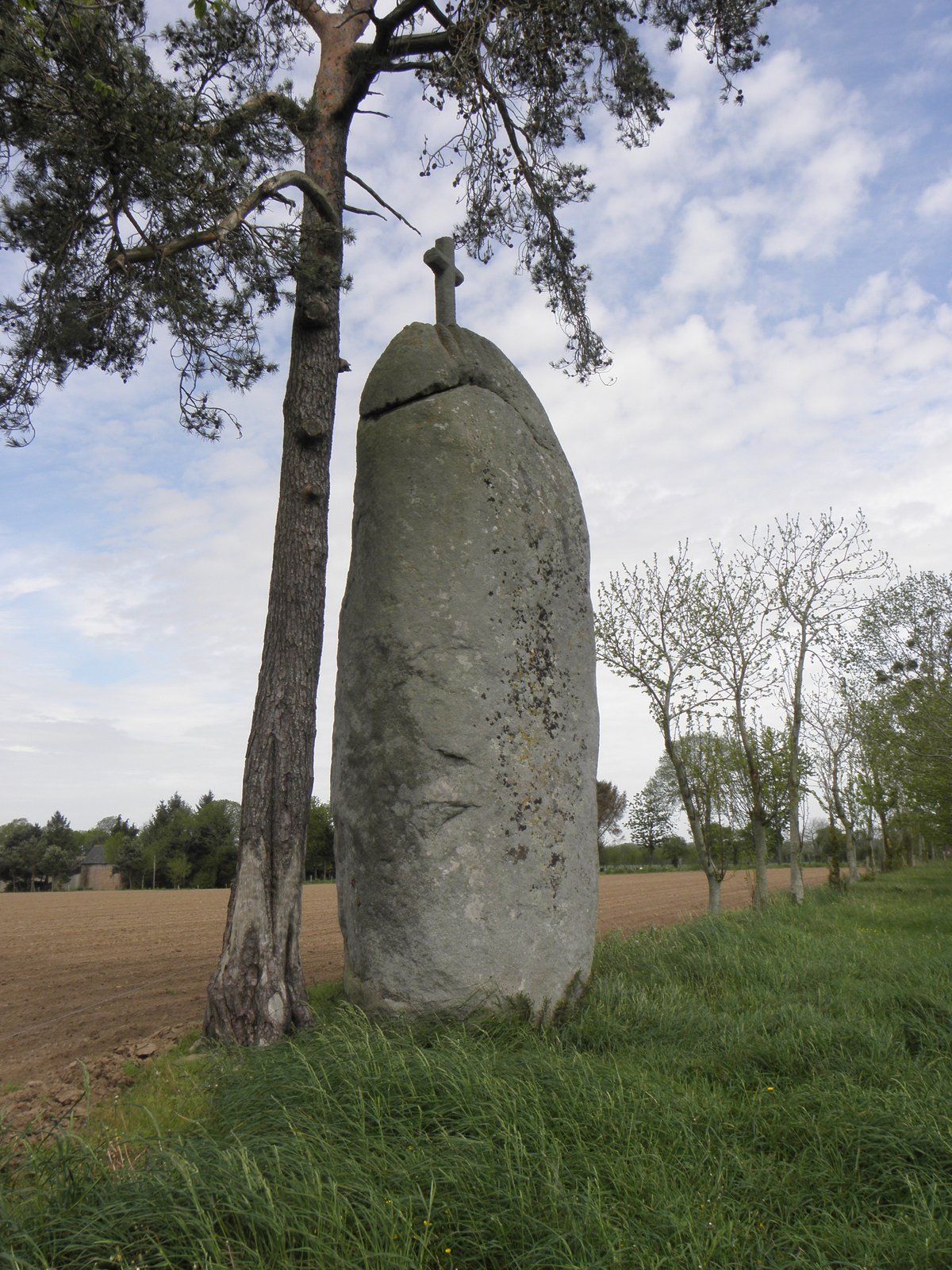
Local legend says the Menhir de la Tiemblais is one of three stones closing the entrance to hell, a name that gives it the nickname "Bonde de l'Enfer". Another version is even more dramatic - it is a key to the sea, and turning it would cause a flood. According to another tradition, saint Samson faced temptations nearby but, seeing his failure, a spiritual entity scratched the stone out of spite, marking it with the filaments of quartz it contains.
Standing 8.50 metres tall, this local granite monolith leans 45 degrees toward the east. Its inclination would result from clandestine excavations. It is a truncated pyramid, 2.10 metres wide and 1.60 metres thick, with a small vein of white quartz. The stone has been bocked, giving it a regular appearance with relatively flat faces. It weighs between 50 and 60 tonnes.
Twelve dense cartouches are carved into the surface, framing engravings interpreted as clubs and hafted axes preceded by small animal silhouettes. These carvings were only discovered in 1972 by Pierre-Roland Giot and are now only visible in artificial raking light. This suggests that the drawings were originally highlighted by colored pigments to be visible. One other legend describes it as a sliding stone - a woman wishing to marry soon had to succeed in sliding all the way along in a baptismal gown without scraping her skin.
Officially listed as a historical monument on 3, 1977, the stone is a significant megalithic site. It is also known as "Pierre Longue" and has been mentioned since 1636. The monument is located in Saint-Samson-sur-Rance in the Côtes-d'Armor department of France.
Sources: Wikipedia, OpenStreetMap, Wikidata, Wikimedia Commons
Written by Nicolo Ciampini
Discuss this with the author and others
No comments yet. Be the first to start the conversation.