
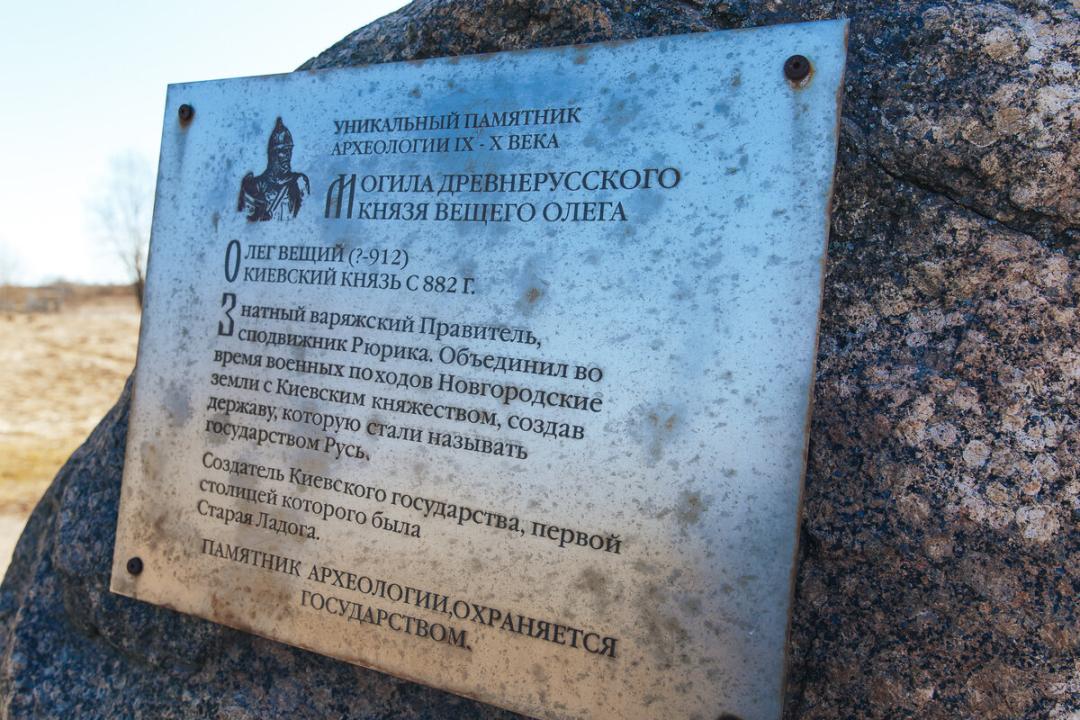
Prophetic Oleg was the first Kiev prince from the Varangians, invited to rule the Slavic tribes in the 9th century. So says the chronicle "The Tale of Bygone Years." Oleg ruled the territory of the future Kievan Rus at a time when Rurik’s son Igor was still a child. Such a ruler under a legitimate but underage prince is called a regent. Interestingly, in the "Tale of Bygone Years," compiled by Abbot Sylvester in 1116, there is a legend about the prince’s death caused by a horse’s skull, which has a mythological tint, and a report about Oleg’s grave in Kiev. The Radziwiłł Chronicle says the same: “And all the people wept with great mourning, and took him down and buried him on the hill called Shchekovitsa; and his grave remains to this day, called Olga’s grave.”
However, in the First Novgorod Chronicle, reflecting the Initial Compilation of 1093–1095, the death of Prince Oleg is described as follows in the year 6430 (922 AD): “Oleg went to Novgorod, and from there to Ladoga. Others say that while going overseas, a snake bit him in the leg, and he died from that; his grave is in Ladoga.” Some legends passed down through the ages confirm precisely the Novgorod version. Although, on the other hand, it seems logical that the Kiev ruler would be buried in Kiev. Be that as it may, the place, the tract called “Sopki,” is indeed unusual.
Many legends are connected with the mound of Prophetic Oleg or Oleg’s grave; besides, many remember Pushkin’s “Song of the Wise Oleg.” Prince Oleg ruled Rus in the 9th–10th centuries. He was a very successful military leader, captured Kiev, and ruled the territory of the future Kievan Rus at a time when Rurik’s son Igor was still a child. Such a ruler under a legitimate but underage prince is called a regent. Oleg became famous for his campaigns against the Khazars, as well as a victorious war with Byzantium. As a result of the latter, for refusing to storm Constantinople, the Rus troops received a large ransom. By the peace treaty, Byzantium agreed to regularly pay tribute to Kiev. Alexander Sergeyevich Pushkin wrote his “Song of the Wise Oleg” based on historical material as well as legends found in ancient chronicles.
In short, Prince Oleg ruled Rus in the 9th–10th centuries. He was a very successful military leader, captured Kiev, and led military campaigns against Tsargrad (Constantinople) and the Khazar Khaganate. He received a grim prophecy from the sorcerers that he would die from his beloved horse. That is exactly what happened, despite all of Oleg’s attempts to secure himself. The prince was bitten by a snake that crawled out of the horse’s skull and died.
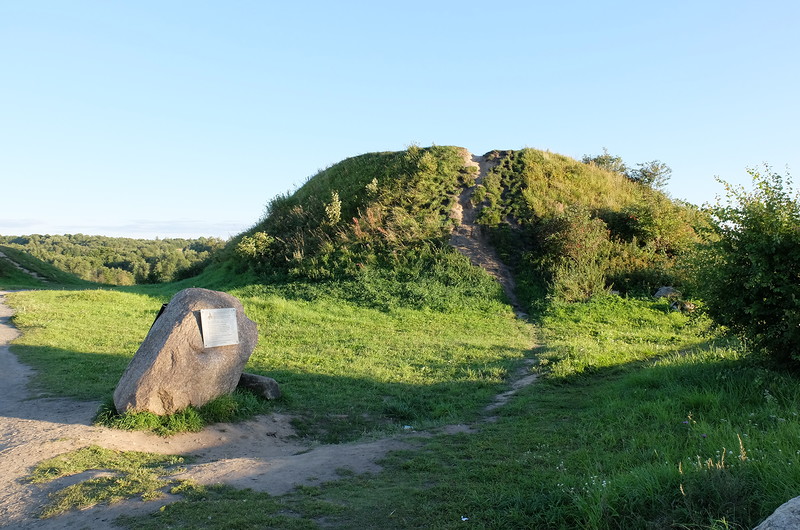
From the high mound (Oleg’s grave), there is a stunning view of the Volkhov River and the surroundings. The sight is truly majestic, almost epic.
And the fact that a rather strong wind blows over the mound in almost any weather adds sharpness to the sensations. In short, it becomes not so important whether Prophetic Oleg was buried here or not; apparently, this mound is considered a place of power for a reason.
It is quite obvious, of course, that if this is indeed a burial, it does not belong to an ordinary mortal. The huge 10-meter-high mound stands out strongly against the background of other mounds only 3–5 meters high. According to archaeologists’ calculations, the mound was originally higher, about 14 meters. It became lower due to natural processes—soil erosion—and because of excavations conducted here.
In 1820, the mound was partially excavated, about one-third, by Zorian Dolenga-Khodakovsky. Now the mound is sometimes called by his name, “Khodakovsky’s Mound.”
These excavations yielded little material; at that time they found: a two-edged socketed spearhead (sulitsa), dated to the 8th–early 9th century, “a piece of iron resembling a latch in a lock, and coals...,” “several burnt bones.”
Perhaps the burial was looted in ancient times, or maybe they simply didn’t dig deep enough... No further archaeological excavations have been conducted here.
According to some researchers, judging by the finds, Oleg’s grave appeared already in the 8th century; according to others, the burial, based on the cremation rite, dates to the 9th century, and therefore cannot be the grave of the Kiev prince Oleg, who died either in 912 or 922.
For example, G.S. Lebedev believes that “... there are grounds to see in this majestic mound not a ‘grave,’ a ‘burial place,’ but ‘Oleg’s Hill,’ a ritual seat where certain social and cult functions were performed.” Naturally, there are also many arguments in favor of the idea that the highest mound of the “Sopki” tract is nothing other than the burial of Prophetic Oleg, and some of these arguments are not only convincing but also clever.
Of course, it is hard to suspect modesty in the Viking prince. He was a decisive, tough man, respected among the Varangian warriors, who feared nothing, and who maintained that authority. He could compel the enemy to pay tribute and tell his own people: I am the boss here. Then, regarding the question of why Oleg left for Ladoga, one possible answer is this: In old times, the concept of inheritance meant a lot, if not everything. Oleg was a temporary ruler during the minority of Igor. When the prince grew up, the uncle had to leave. Which Oleg did. Otherwise, the warriors who, in Pushkin’s poem, remembered the past days, could ask unpleasant questions. If the answer was unsatisfactory, they would kill immediately. And only to the one who met their ideas of a true leader, after death, as a sign of respect, did they heap the highest funeral mound.
After all, Rus began here, at least no one has yet managed to convincingly dispute this.
Sources:
http://lesnoytur.ru/teoria/tursever/ladoga-s/kurgan-oleg.html
https://ru.wikipedia.org/wiki/Oleg's_Grave_(Ladoga)
Written by Jermaine
Discuss this with the author and others
No comments yet. Be the first to start the conversation.