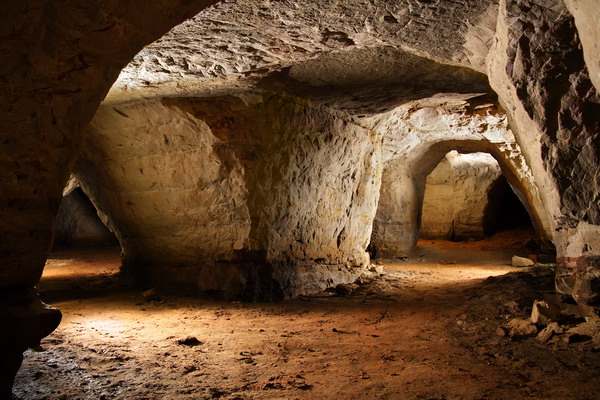

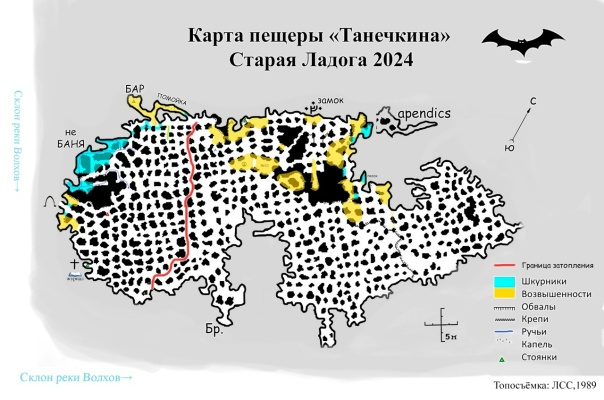
A man-made quarry that appeared at the end of the 19th century, when white quartz sandstone began to be mined here for glass production. Mining was carried out using the chamber-pillar method, which created numerous extensive cavities called column chambers. Between them, pillars—columns—were left to support the vault (this helped prevent collapses). Today, no work is conducted here due to the depletion of mineral resources; the cave has long been abandoned. Over the years, nature has worked on it: streams have broken through underground, limestone deposits have formed on the walls, and the beginnings of future stalactites and stalagmites have appeared. The walls are decorated with whimsical patterns of multicolored rock layers. Their height almost nowhere exceeds 1.2 meters.
The underground world’s picturesque nature is also enhanced by a large lake, whose depth reaches half a meter. When it gets hot above ground, the lake dries up, leaving only a few disconnected puddles. During spring floods, this underground reservoir fills to the brim again. Tanechkina Cave is the longest in the Leningrad region. According to official data, its length is more than 7.5 kilometers (taking into account that some galleries have collapsed). Locals claim that its true length exceeds 40 kilometers, and the underground passages lead to an ancient fortress in Staraya Ladoga.
So why is the cave called that? There are no official documents explaining this. But there is a folk legend. The tale says that long ago in Staraya Ladoga, there lived a lonely father raising his daughter, Tanechka. The father worked in the quarry, and Tanechka brought him lunch every day. One day, the girl disappeared in the cave. The whole village rushed to search, exploring many passages; the father was beside himself with grief. Fortunately, on the fourth day, Tanechka was found scared, tired, but alive and well. Since then, the place has been called by that name. By the way, inside there is an amazing spot where the temperature always stays at +6 degrees Celsius. Scientists are still puzzled as to how this is possible!
Today, the cave is a protected area because many bats of different species have settled here. There are more than 400 of them! In winter, during floods, and heavy rains, the cave entrance is closed.
Why is it called Tanechkina Cave, where does this name come from? There are no official documents explaining the origin of this name, so it can be said that the cave was named by the people. Locals tell that many decades ago in Staraya Ladoga, there lived a man who raised his daughter Tanechka alone. They lived very harmoniously; the father worked in the quarry, and the daughter brought him lunch every day. One day, the girl did not return from the cave. The whole village searched for her for several days. The father was inconsolable with grief. But on the 4th day of searching, Tanechka was found—she was frightened, exhausted, but safe and sound. Since then, the place has been called Tanechkina Cave. Inside the cave, there is a place where the temperature always remains the same—+6 °C.
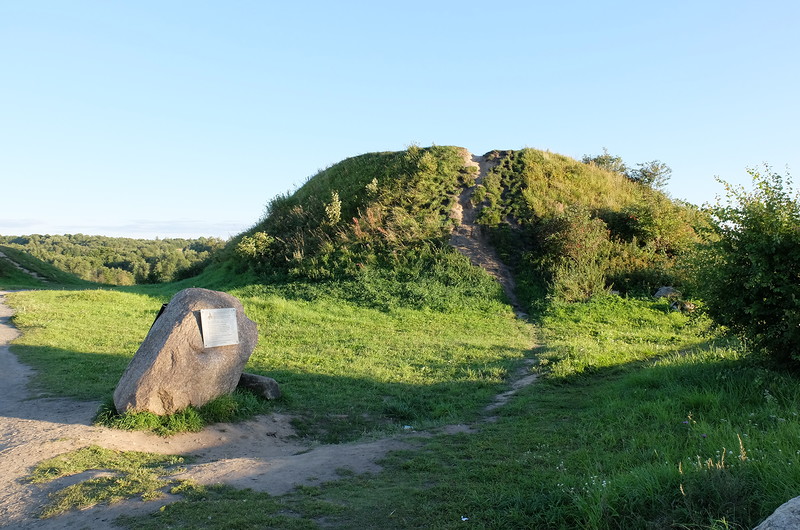
Tanechkina Cave has been declared a protected area because several colonies of bats have settled there—water and pond noctules, northern bats, long-eared bats, and Brandt’s bats. In total, more than 400 individuals of these animals inhabit the cave. In winter, during floods, and heavy rains, the cave entrance is closed. The entrance is located on the bank of the Volkhov River near the burial mounds.
Sources:
https://logoslab.ru/full_img/karta-tanechkinoj-peschery/3
https://vk.com/wall-8811488_3462


Written by Jermaine
Discuss this with the author and others
No comments yet. Be the first to start the conversation.