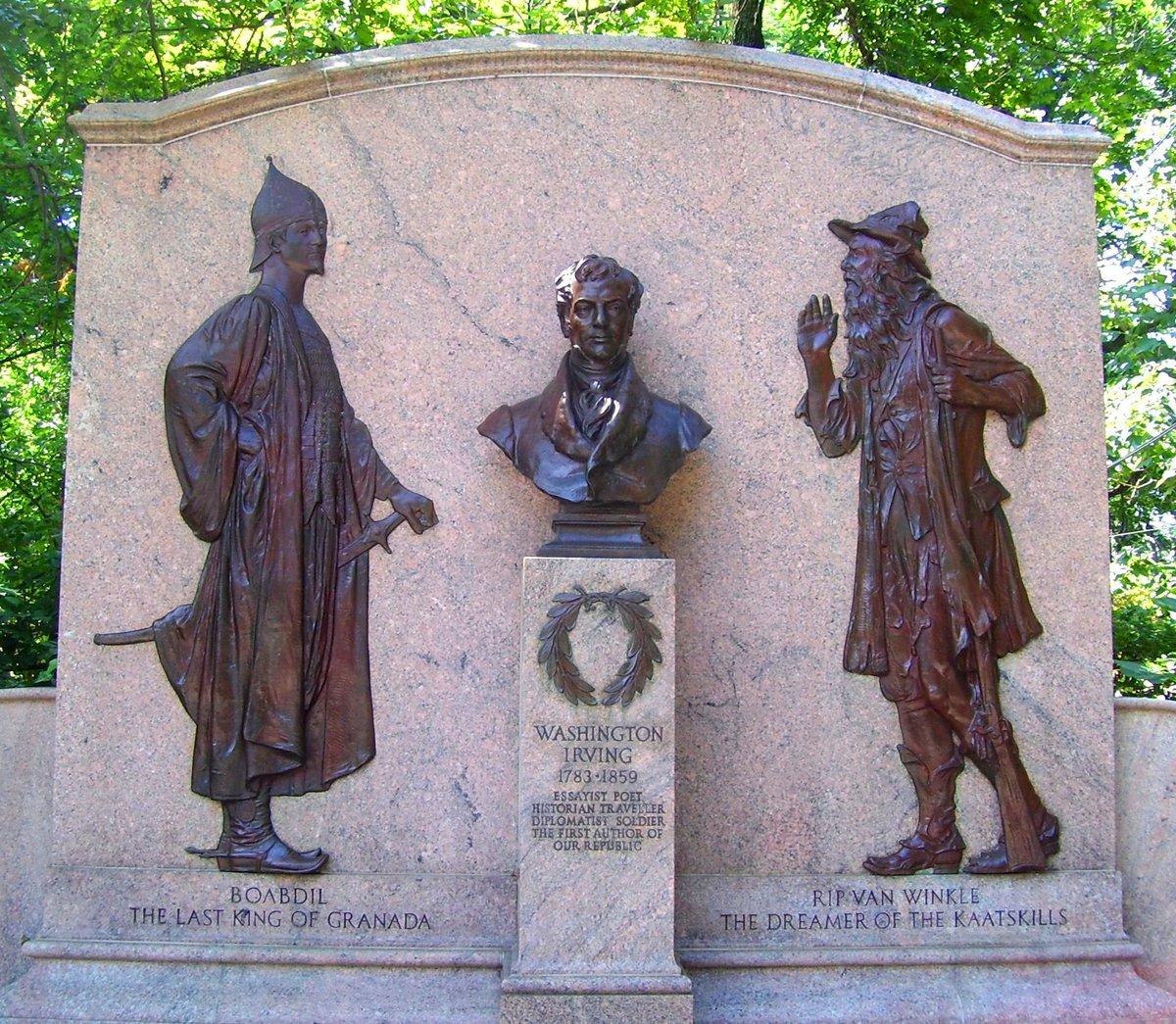

A small stone plaza at a road junction in Irvington, New York, houses the Washington Irving Memorial. The site features a bust of Irving on a six-foot pedestal, flanked by bronze sculptures of two of his better-known characters, Rip Van Winkle and King Boabdil. These figures are set in a small stone plaza designed by Charles A. Platt, featuring pink Vermont granite with dark veins. The memorial was created to provide a place for admirers to pay their respects when the Sunnyside estate was still a private residence.
The memorial was the result of a long campaign by local resident Jennie Prince Black, who began advocating for it in 1909. After nearly 20 years of effort, Cyrus West Field put her in touch with sculptor Daniel Chester French in 1924, who was commissioned to design the memorial that summer. The project faced many financial difficulties and site issues, leading to a construction process that lasted until the memorial was finally dedicated in 1927, a year later than originally planned.
The memorial sits on a small triangle of land at the southwest corner of the junction, which marks the northern end of Irvington. Sunnyside Creek, a small tributary of the nearby Hudson River, flows through a culvert underneath and lends a sloping, wooded character to the land behind the memorial. The structure consists of a tall central panel ten feet high and eight feet wide, the flanking sculptures, and curved wing walls four feet high and twelve feet long, further extended by ten feet of wrought iron fencing.
French's choice to include Boabdil met with some controversy; a local publisher complained that the sculptor should have chosen a local character from Irving's work instead. French noted that it was his privilege as the artist to decide how to memorialize Irving in bronze, consulting with a curator at the Metropolitan Museum of Art regarding the Moorish king's attire. The memorial was added to the National Register of Historic Places in 2000.
Sources: Wikipedia, OpenStreetMap, Wikidata, Wikimedia Commons



Written by Friendly Jane
Discuss this with the author and others
No comments yet. Be the first to start the conversation.