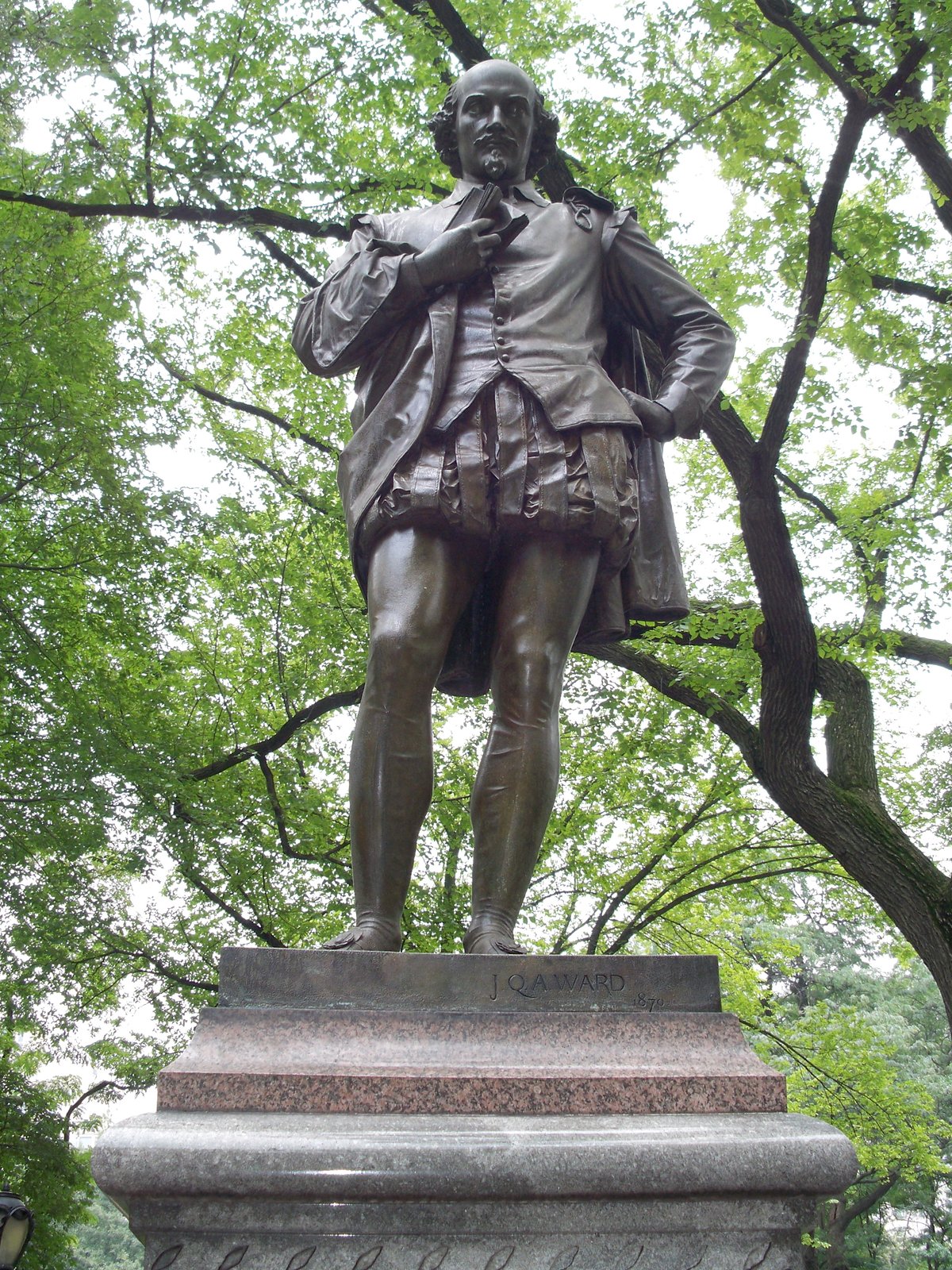

When the bronze William Shakespeare was unveiled in Central Park in 1872, a poet from Lexington, Kentucky, named William Ross Wallace affixed a placard to the base of the statue. The poem argued that Shakespeare was the mirror of God's universe and belonged to both the Old and New Worlds. The placard was immediately torn down by police.
The commission for the statue emerged from the private social club, the Century Association. Four thousand dollars toward the funding was raised at a benefit performance of Julius Caesar on November 24, 1864, performed by the sons of Junius Brutus Booth - Junius Brutus Booth Jr, Edwin Booth, and John Wilkes Booth - at the Winter Garden Theater. The play was interrupted by firebells as a set of Confederate saboteurs set a series of fires around Manhattan that night, including at the Lafarge Hotel across the street from the theater.
The morning after the benefit, the Booth brothers read about the fires over breakfast and John Wilkes exclaimed his sympathy for the Confederates, leading Edwin to kick him out of the house and vow never to speak to him. Less than a year later, John Wilkes assassinated President Lincoln.
To capture the likeness, artist John Quincy Adams Ward studied the Chandos portrait, the Stratford bust, and the engraved portrait of Shakespeare by Martin Droeshout. The costume for the statue was based on one worn by Edwin Booth. The pedestal for the monument was designed by Jacob Wrey Mould.
Sources: Wikipedia, OpenStreetMap, Wikidata, Wikimedia Commons

Written by Friendly Jane
Discuss this with the author and others
No comments yet. Be the first to start the conversation.