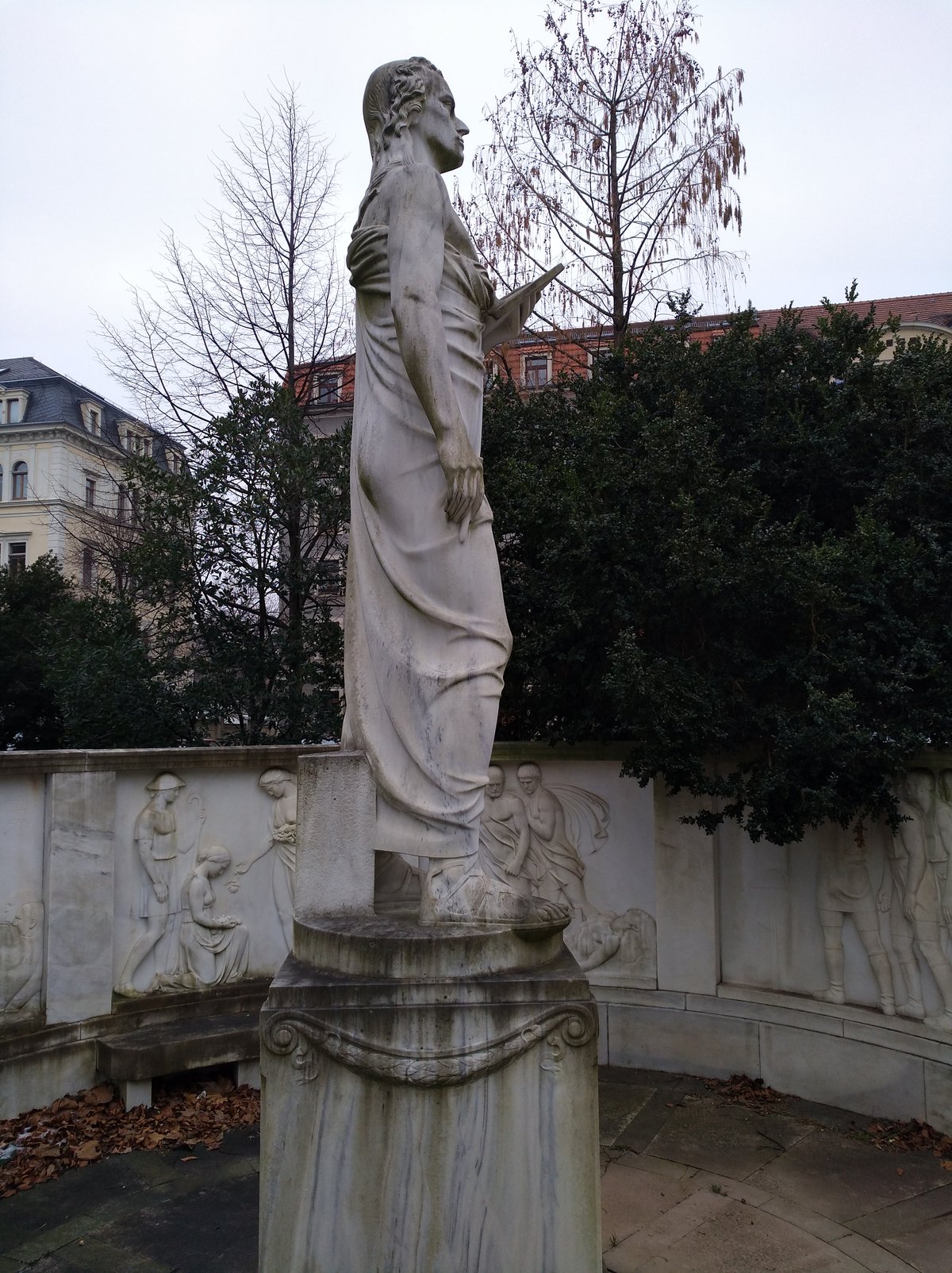
The locals in Dresden gave this monument a nickname that stuck: Schiller in the Bathtub. It is a bit of a whimsical description for a serious piece of marble, but it captures the peculiar architecture of the rotunda. The roof sits only at shoulder height, creating a shallow, enclosed space for the 3.40-meter-high statue of the poet Friedrich Schiller.
The journey to this finished monument was long and stalled by lack of funds. A committee began work in 1905 to mark the centenary of Schiller's death, and while the city provided the land on Jorge-Gomondai-Platz for free, the private donations for the 30,000 Mark budget proved elusive. A 1908 competition for a design produced nothing usable. It wasn't until 1913, during a period of artistic reform in the city, that Selmar Werner won the commission. He was a student of Robert Diez, the man who gave the nearby Albertplatz its famous fountains.
Werner chose to portray Schiller not in contemporary dress, but in Greek attire, framing him as an ideal poetic spirit. He is depicted surrounded by his works. The structure itself, designed by Oswin Hempel, is carved from white Laaser marble. To enter the rotunda, you descend a single step - a movement intended to be symbolic - and find yourself in a space accessible from only one side. The interior walls serve as a gallery for nine reliefs by Werner, each one a specific scene from Schiller's plays and poems.
These reliefs avoid the distractions of scenery or perspective. The ground is treated merely as a surface for the figures to stand upon, focusing the eye entirely on the human drama. You can see 'Die Teilung der Erde' from 1795, where Schiller stands before the throne of Zeus. There is 'Leander mit dem Leichnam Heros' from 1801, and the vision of Jeanne d’Arc from 1800. Other scenes include Hektors farewell to Andromache, the Bürgschaft, and the famous Lied von der Glocke. The walls also hold 'das Mädchen aus der Fremde', the 'Kraniche des Ibykus', and the Tellschuß.
The monument survived the 1945 air raids on Dresden largely because it stood in an area spared by the heaviest bombing. To keep the white marble from weathering, it was fitted with winter housing, a common practice of the time. While the surrounding city underwent major redesigns in the 1970s and a more careful renovation in the 1990s, the bathtub remained intact. Today, the rotunda still holds its quiet, white interior, offering a glimpse into a 20th-century vision of a 18th-century hero.
Sources: Wikipedia, OpenStreetMap, Wikidata, Wikimedia Commons

Written by Aurora
Discuss this with the author and others
No comments yet. Be the first to start the conversation.