

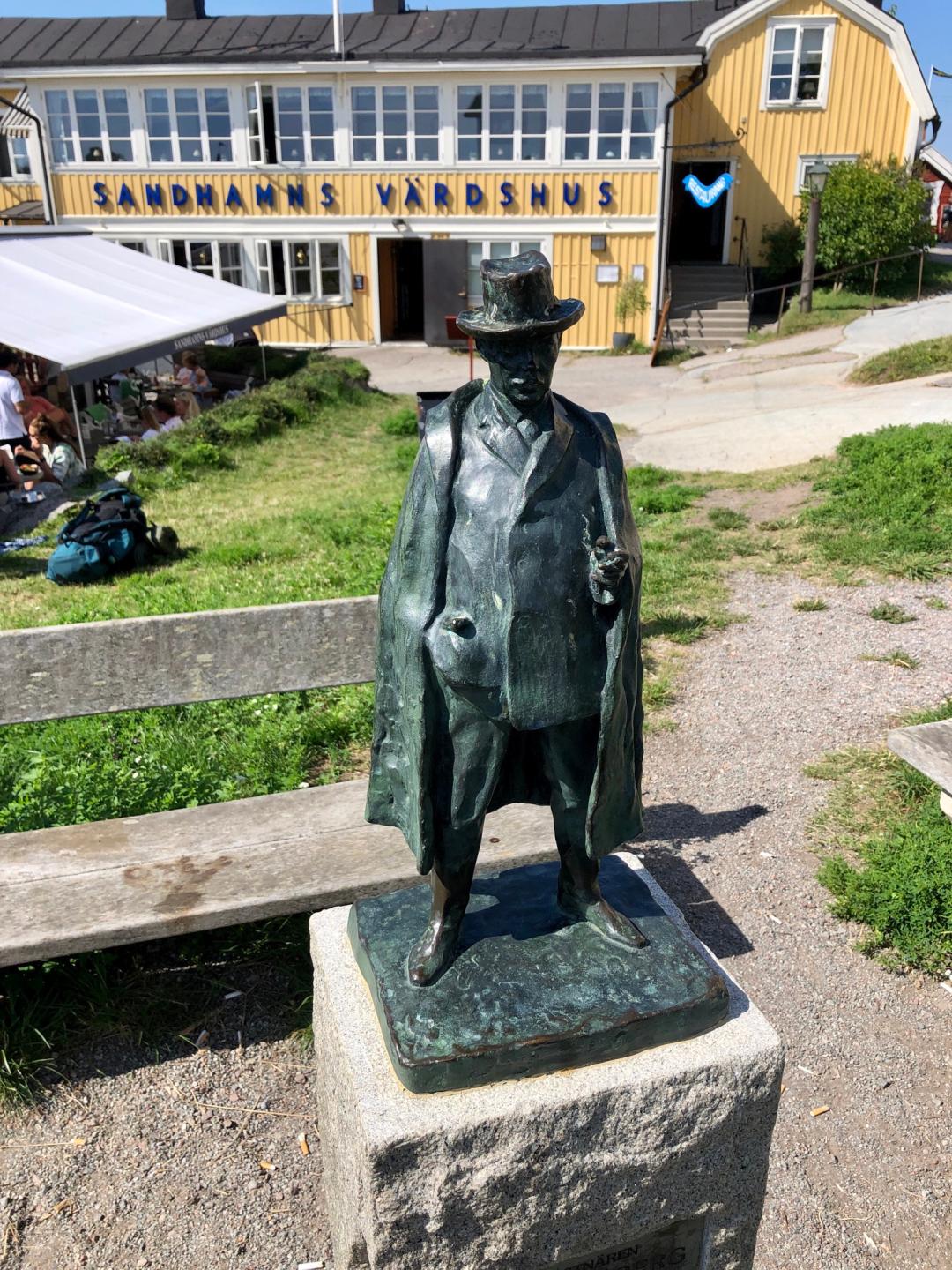
Sandhamn's inn is one of Sweden's oldest. Sandhamn's location by the busy shipping lane made the island interesting for innkeepers. Already during the time of Charles XI, in 1672, the island had an inn that probably belonged to the pilots. In the late 1600s, a pub cottage was owned by a man named Beltman, who was a hunting lieutenant (chief) of a customs post. Two pub cottages were located at the site of the current customs house (https://reveal.world/sv/story/sandhamnstullen-och-den-ofrivillige-tullare). When the customs house was erected, one of the cottages was moved to the pilot master's farm, "Holmska gården", which lies behind the current inn. The timber from the second pub cottage forms the oldest part of the current inn. The rest was built in the middle of the 1800s. The veranda was added at the beginning of the 1900s.
In 1896, the artists Verner von Heidenstam, Gustaf Fröding, JAG Acke, Albert Engström, and Birger Mörner, together with their wives, spent a few weeks in August in Sandhamn. They celebrated most of the time, and Albert Engström invented his famous "floating buffet" during the stay. The company each lived in small red cottages, but meals were taken at a communal table in the Inn.
On the evening of December 11, 1940, a large part of Sandhamn's Inn burned down. The cause was a few ashtrays that ended up in a corrugated cardboard box. With the help of old drawings, the Inn was able to be rebuilt. On May 30, 1941, the Inn could be reopened.
In the middle of the 1900s, the Värdshuset was run by Carl Erich Zaar. He managed to secure both wine and spirit rights, but with the proviso that spirits were only to be served in the restaurant on the upper floor. However, this did not concern Calle Zaar, who called the cognac and whisky "white sherry" in the simpler section a flight of stairs down. The food mostly consisted of hearty home cooking, falukorv, meatballs, fried herring, and in the restaurant on the veranda, salted meat, boiled pike, and Calle's own meat patties. There was rarely anything green to accompany the food, at most a few lonely canned peas on the edge of the plate. The guests had great respect for Calle. There was never a need for security guards if it became too rowdy. Instead, he resolutely fetched a jug of ammonia and splashed it heavily onto the tavern floor. In less than a minute, all the guests had rushed out of the premises. Calle Zaar ran the Värdshuset until his death in 1976.
Today, there is a pub, a classic à la carte restaurant, and an outdoor terrace in the premises. People come here to experience a piece of Swedish culture and good food with a wonderful view over the water.
Sources: Eknö Hemman Samfällighetsförening (www.eknohemman.se) - Exhibition about Sandhamn, https://www.destinationsandhamn.se/om-sandhamn/historia, https://www.sandhamns-vardshus.se


Written by Alexa
Discuss this with the author and others
No comments yet. Be the first to start the conversation.