


It was on October 19 (October 31 by the new style) in 1811 that the solemn opening of the Imperial Tsarskoye Selo Lyceum took place — the first lyceum in Russia, an educational institution for noble “youth, especially intended for important parts of state service.” The Lyceum was founded by the decree of Emperor Alexander I, and its program was aimed at preparing high-ranking state officials. Although a whole galaxy of outstanding people graduated from the Lyceum — the Decembrist Wilhelm Küchelbecker, poet Anton Delvig, Chancellor of the Russian Empire Alexander Gorchakov, writer Mikhail Saltykov-Shchedrin — it was primarily, of course, the poet Alexander Sergeyevich Pushkin who glorified it, having begun writing poetry while still a lyceum student. His lines “My friends, our union is beautiful!” became a motto for all lyceum students.
The Tsarskoye Selo Lyceum was the first in Russia. The very name — Lyceum — was given to it by the State Secretary of the Russian Empire, Mikhail Speransky. Speransky, who at that time was working on plans to reform the Russian state, believed that the graduates of the Lyceum should possess broad knowledge, the ability to think, love Russia, and work for its benefit. This was a time when the sovereign was influenced by Enlightenment ideas, a time of reform projects, hopes, and expectations, which Pushkin called “the beautiful beginning of Alexander’s days.” The Tsarskoye Selo Lyceum became the child of this wonderful time. According to Speransky’s idea, who was working on plans to reform the Russian state, the new school was to prepare young people to implement these plans and work in a Russia transformed by reforms. Speransky believed that Lyceum graduates should have broad knowledge, the ability to think, love Russia, and work for its good. According to historian Voensky: “The Lyceum was established with bright hopes to create a class of state people who were to lead Russia on the path of enlightenment and common good.”

For the needs of the Lyceum, a palace wing of the Catherine Palace in Tsarskoye Selo (now the city of Pushkin) was allocated. The solemn opening of the new educational institution was attended by the emperor and his family, high officials, and cultural figures. A detailed description of the ceremony is given by its participant, Lyceum alumnus and future Decembrist Ivan Pushchin in the publication “Notes of I. I. Pushchin about Pushkin” (1907), and the official version is provided by historian, bibliographer, and Lyceum graduate of 1856 Dmitry Kobeko in the book “Imperial Tsarskoye Selo Lyceum” (1911). “The immediate reason for the establishment of the Lyceum was apparently the intention of Emperor Alexander I to create an educational institution where the young grand dukes, brothers of the Emperor, could study sciences together with several peers. However, over time, this idea was abandoned,” wrote Dmitry Kobeko.
“The ‘Regulation on the Lyceum’ strictly regulated the requirements for applicants: students had to demonstrate their knowledge upon admission, possess high morality, and be physically healthy. The age of applicants ranged from 10 to 12 years, and students also had to provide proof of their nobility.”
The basis of education was the principle “…not to obscure the children’s minds with lengthy explanations; but to stimulate their own activity.” The Tsarskoye Selo Lyceum was a closed educational institution; its students lived on full board, and leaving the Lyceum during the school year was prohibited. All lyceum students followed a strict daily schedule supervised by the director, staff supervisors, and teachers. “...The embryo of that inseparable, delightful bond that unites the first-year Lyceum students. On this basis, probably, the Lyceum was arranged so that as far as possible all the comforts of home life were combined with the requirements of a public educational institution,” wrote Ivan Pushchin.
“The inclinations and knowledge acquired here will determine which path the youth should choose later to prove themselves true sons of the fatherland.” It so happened that the Lyceum was first glorified not by a statesman, but by a poet. The Lyceum became the cradle of Pushkin’s poetry and entered the poet’s work along with his first verses. Until the end of his days, Pushkin praised the school that raised him, and the poem “October 19” (1825) became a true anthem of the Lyceum.
From Sadovaya Street opens one of the most beautiful views of Tsarskoye Selo — of the palace church with domes, a slender arch with three spans, and the Grand Duke’s wing of the Catherine Palace. Built at the end of the 18th century by Neelov, the wing was transferred in 1811 to the Ministry of Public Education to house the Lyceum. Architect Stasov rebuilt the building and adapted it for the needs of the educational institution. According to Ivan Pushchin’s recollections, here “all the comforts of home life were combined with the requirements of a public educational institution.” The ground floor housed the administrative offices, the second floor — the dining room, hospital with pharmacy. The third floor contained the recreation hall, classrooms, physics cabinet, room for newspapers and magazines, and the library.
Lyceum students rose exactly at 6 a.m., went to morning prayer, after which they repeated their teachers’ assignments. Classes began at 8, with breaks for breakfast, lunch, and walks in the park; from 3 to 5 p.m. the last lessons took place in the classrooms. After that, there was a short rest, afternoon tea, walks, games, and gymnastic exercises. After dinner, review of lessons, and evening prayer, at 10 p.m., all students went to bed.
“The subjects of study at the Lyceum are divided into two courses, the first called the initial, the second the final. Each lasts three years. The initial course at the Lyceum will include the following subjects: A. Grammatical study of languages… B. Moral sciences… C. Mathematical and physical sciences… D. Historical sciences… E. Basic foundations of fine literature… F. Fine arts and gymnastic exercises… The final course will include the following sciences: A. Moral sciences. B. Physical sciences. C. Mathematical sciences. D. Historical sciences. E. Literature. F. Languages. G. Fine arts and gymnastic exercises,” states, in particular, the “Regulation on the Lyceum.”
The Lyceum employed seven professors, two adjuncts, a priest, six teachers of fine arts and gymnastics. Among the educators were representatives not only of the Russian but also foreign faculty; for example, French was taught by Professor David de Budry, the brother of the famous revolutionary Jean-Paul Marat.
Despite being located in a palace, the Lyceum students lived quite ascetically. Pushkin, for example, called the students’ rooms “cells.” The bedroom walls sometimes did not reach the ceiling, which allowed neighbors, in particular Pushchin and Pushkin, to talk to each other. “In each room — an iron bed, a chest of drawers, a writing desk, a mirror, a chair, a washstand, including a nightstand. On the desk, an inkwell and a candlestick…” recalled Pushchin.

The Lyceum and the Director’s House
The first graduation from the Lyceum took place in June 1817. The graduates of this class were called “the cast-iron ones” — in memory of their strong friendship, they were given rings shaped like joined hands, made from a cast-iron bell that was broken after the graduation, which had summoned students to classes for six years.
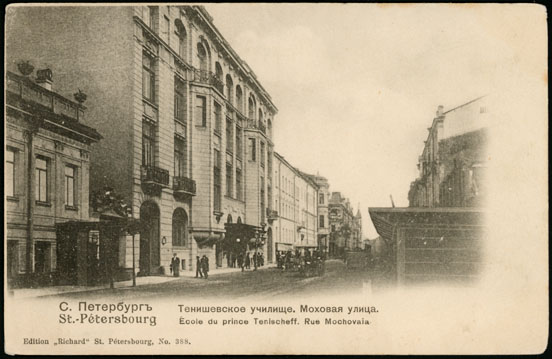
In 1843, the Lyceum was moved from Tsarskoye Selo to St. Petersburg and by the decree of Nicholas I was renamed the Imperial Alexander Lyceum, preserving the traditions of the Tsarskoye Selo Lyceum. The building was rebuilt and used as a residential house for a century. In 1899, a memorial plaque was installed on the building: “Here was educated Alexander Sergeyevich Pushkin. 1811–1817.” A second plaque, installed on the facade in 1912, stated: “In this building from 1811 to 1843 was the Imperial Lyceum.” The memorial museum-lyceum was opened in 1949 and initially occupied only part of the building. In subsequent years, its historical layout and architectural-decorative decoration were restored. On June 6, 1974, on the poet’s birthday, the Lyceum appeared to visitors as it was in Pushkin’s time.
Among the restored rooms is the Great Hall. Called in Stasov’s documents the gymnastic or recreational hall, it was intended for leisure time. The hall was extraordinarily beautiful: bright, spacious, with large windows, mirrors in gilded frames in the wall panels. The walls, painted to resemble pink marble, and the ceiling were decorated with paintings. All the most important events in the life of the educational institution took place in this hall. The very first celebration was the opening of the Lyceum on October 19, 1811. On this day, the educational institution was presented with the Highest granted Charter containing the Lyceum’s Statute. Today, the Charter occupies its historical place in the Great Hall. On the opening day, the names of thirty first-year students, presented to the sovereign, were announced for the first time. Three years later, these same names would be heard again in the hall — at the transfer exam when students moved to the final course. For one student, this exam brought the first fame. On January 8, 1815, at the exam in Russian literature, Alexander Pushkin read his poem “Memories in Tsarskoye Selo” before the patriarch of Russian poetry present, Derzhavin. Derzhavin was delighted. He called the young poet his successor. The poet would express the excitement of that day many years later: “I read my ‘Memories in Tsarskoye Selo,’ standing two steps from Derzhavin. I cannot describe the state of my soul: when I reached the verse where I mention Derzhavin’s name, my youthful voice rang, and my heart beat with rapturous delight.”
Next to the hall is a small room called the Newspaper Room. It is memorable to all pupils in connection with the events of the Patriotic War of 1812. “Our Lyceum life merges with the political era of the Russian people’s life: the storm of 1812 was preparing. These events strongly affected our childhood,” recalled Ivan Pushchin. In this troubled time, the noisiest and most crowded room in the Lyceum became the Newspaper Room, where “amid incessant talks and debates, Russian and foreign newspapers were read.” During these days, the interaction between students and mentors became especially close — together they followed the course of military actions, read and discussed reports, army orders, and appeals to the people. For the first time, the words “people” and “Fatherland” sounded especially meaningful for the Lyceum pupils. They felt like one family, living with one mind and one feeling.
Through the entire arch connecting the Lyceum with the Catherine Palace runs a two-story gallery where the library was located. As in Pushkin’s time, today six large mahogany bookcases stand here. They contain more than seven hundred original books of the Lyceum library. Alongside editions of French Enlightenment authors are works by English and German authors, books on history, theology, art, travel descriptions, legislative acts, and moral treatises. The book selection testifies to the encyclopedic nature of Lyceum education. A manifestation of Alexander I’s care for the students of the school he created was the permission to use books from his youth library in the Alexander Palace. In a separate cabinet are works by Russian poets and writers of the 18th and early 19th centuries, including Zhukovsky. The library collected first editions of almost all Russian authors of that time. The Lyceum statute prescribed creating an environment in the institution where students would never be idle. This was achieved: the Lyceum respected intellectual labor and mental activities. What intellectual activities can do without reading? During their student years, A. Illichevsky reasoned about the benefits of reading: “Reading nourishes the soul, forms the mind, develops abilities.” Later, recalling Lyceum education, Korf noted: “We studied little in class, but more in reading and conversations with constant friction of minds.” “Reading is the best learning,” said Pushkin.
Two arched passages from the Great Hall lead to two small rooms intended for study after classes. In these rooms, each student had a separate writing desk. Today, in one of the rooms, a late 18th-century mahogany writing desk stands as a sample. Among the autographs of Lyceum Pushkin’s poems — “Memories in Tsarskoye Selo.” Many years after Derzhavin’s death, while sorting the poet’s archive, Grot found this Pushkin autograph in his manuscripts. Grot believed that Pushkin read his poem from this manuscript at the transfer exam. In the neatly copied poem, there is one correction, and it is in the very first line: “The dark night’s veil hangs.” The word “night” was corrected to the Old Slavonic “noщи.” However, the correction was not made by Pushkin; it is believed that Derzhavin himself made this amendment.
From the study rooms, one can enter the classroom, resembling a university lecture hall. The classroom has six semicircular tables arranged amphitheater-style, one above the other, with five students seated at each. The teacher’s desk is raised on three steps. Students were seated according to their academic performance: the lower the student’s success, the farther from the desk he had to sit. It is impossible to determine a specific place where Pushkin sat: with different professors, the poet occupied different seats. However, in lessons of Russian literature and French rhetoric, Pushkin was invariably among the first. “From the very beginning, he was our poet,” recalled Pushchin. “I still see that afternoon class when, having finished the lecture a little earlier than the scheduled time, the professor said: ‘Now, gentlemen, let’s try our pens: please describe a rose in verse.’ Our poems generally did not come together, but Pushkin immediately read two quatrains that amazed us all.”
After lectures in physics and mathematics, the lyceum students went for practical lessons to the nearby physics cabinet. Today, the physics cabinet houses physical and mathematical instruments from Pushkin’s era. It was a time of humanities, and exact sciences sometimes caused boredom and annoyance. “Oh, Urania’s dark child, / Oh, boundless science, / Oh, incomprehensible wisdom, / Immeasurable depth!..” wrote Alexey Illichevsky about mathematics. However, there is no doubt that lessons in physics and mathematics broadened the lyceum students’ horizons and encouraged the exploration of the universe’s mysteries. In one of the lyceum letters of the future navigator Fyodor Matyushkin, one can read: “If it were possible for a mortal to rise above the earth and see the structure of nature, the source of the suns, what knowledge and pleasure would he gain from this…” Just a few years later, scientific and technical discoveries would change the views of the world and spark great interest in exact sciences. And the brilliant Pushkin lines would appear: “Oh, how many wonderful discoveries / The spirit of enlightenment prepares for us, / And experience, the son of difficult mistakes, / And genius, the friend of paradoxes…”
At the beginning of the 19th century, mastery of drawing was mandatory for educated people. The “drawing teacher” Chirikov applied the academic system of teaching, paying main attention to drawing. After acquiring the first skills, students began copying antique busts, fragments of engravings, and later tried their hand at portrait art. The teacher paid much attention to the choice of originals for drawing. According to Goethe, acquaintance with works of art should begin with perfect examples, as taste should be formed only on selected works of art. By the degree of talent, the “drawing teacher” divided all his students into four categories: “excellent talents,” “good talents,” “great talents,” “average talents.” Pushkin was included by Chirikov in the first category.
More than thirty drawings by first-year students have survived to us, two of which belong to Pushkin. These drawings depict antique heads, rural landscapes, scenes from biblical times, images of flowers, birds, and animals. Some of them (in copies) can be seen in the classroom.
The neighboring room was occupied by the Singing Class. Music and singing were among the favorite activities of the students. Instruction in instrumental music was conducted as private lessons during free hours. Wilhelm Küchelbecker, Mikhail Yakovlev, and Sergey Komovsky played the violin; Nikolai Korsakov played the piano and guitar. Korsakov and Yakovlev tried their hand at composition. Pushkin’s poems were set to music by his comrades already in Lyceum years and were popular not only in the Lyceum but also in Tsarskoye Selo. Since 1816, the lyceum students began singing under the direction of Tepper de Ferguson. A musician and composer, he not only taught singing but also composed spiritual concerts for the students, arranging Bortnyansky’s concerts with various variations. Often, classes were held in the Singing Class attended by both Lyceum courses — senior and junior. The junior course left a description of the class: “Here is the philharmonic hall, and music lovers often captivate the lyceum students with their singing. Sometimes, in a noisy choir, all the citizens sing national songs…” Today, in the class on an old piano lies the edition of the “Farewell Song” of 1835, undertaken by the former Lyceum director Engelhardt. Engelhardt undertook the publication of the “Song” in connection with the 25th anniversary of the Lyceum’s opening celebrated in 1836. Engelhardt sent copies of the “Song” to his former pupils, among whom was the “state criminal” Pushchin. In a letter to him in Siberia, Engelhardt regretted that Pushchin would not hear the Lyceum song’s melody. But the old director was mistaken. Pushchin’s comrades in exile learned the “Song” and, with the help of the wives of the Decembrists Maria Volkonskaya and Kamilla Ivashova, performed it for Pushchin.
A wide corridor runs through the entire fourth floor. On both sides are the students’ rooms. Each lyceum student had a separate room. This showed respect for the student’s personality and care for his health. Above more than thirty doors are attached black metal plates with the room number, the surname, and the name of its owner. Pushkin’s room, number 14, turned out to be smaller than the others: on one side, it had a solid wall. The poet often called his narrow room a “cell,” and the Lyceum a monastery. Such perception was facilitated by the proximity of two churches, the strictly regulated Lyceum life, and the six-year uninterrupted stay in Tsarskoye Selo. But how the “student’s cell” transformed when Pushkin felt himself a poet! He confessed to his comrades that he saw poems even in his dreams. At night, when everyone fell asleep, conversations were held in a whisper through the partition with his “first friend” Ivan Pushchin, who occupied room number 13. Often, the talk was about Pushkin’s relationships with comrades, which were not always simple. Comrades wondered why Pushkin, who was ahead of them in many ways, reading books they had no idea about, remembering everything he read, did not pride himself on all this and did not even appreciate it. “It happened that we were truly surprised by his moods: you would see him absorbed in thoughts and readings beyond his years, and then suddenly he would leave his studies, enter some fit of rage because another, incapable of anything better, had outrun him or knocked down all the pins with one blow.” Perhaps the explanation for this contradiction in the young Pushkin’s behavior was given in a conversation with Gogol by Zhukovsky, who noted that when Pushkin was eighteen, he thought like a thirty-year-old man, that his mind matured much earlier than his character, and this often surprised him when Pushkin was still at the Lyceum. When comrades realized that Pushkin was a poet, their attitude toward him changed. “God grant him success — the rays of his glory will reflect in his comrades,” wrote Illichevsky. These words proved prophetic.
Sources:
https://ru.wikipedia.org/wiki/Imperial_Tsarskoye_Selo_Lyceum
https://family-history.ru/material/history/spb/spb_49.html



Written by Jermaine
Discuss this with the author and others
No comments yet. Be the first to start the conversation.