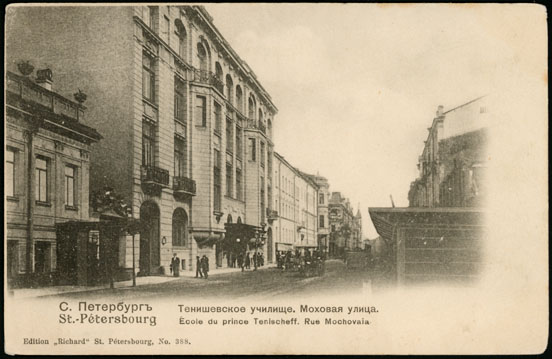

In January 1911, Vladimir Dmitrievich Nabokov enrolled his sons—the elder was almost twelve, and the younger was eleven—in the Tenishev School, a private school founded in 1900 by Prince Vyacheslav Tenishev, who, during the first few years of its existence, allocated more than a million rubles for its needs. From the very beginning, the Tenishev School became one of the best secondary educational institutions in Russia at that time. Markedly liberal, democratic, and excluding discrimination against students based on social status, nationality, or beliefs, the Tenishev School was distinguished in its early years—the years when its first famous pupil, the poet Osip Mandelstam, studied there—by a spirit of equality, camaraderie, and mutual respect between teachers and students. The teachers were professionals, highly educated people, scholars, authors of well-known monographs and textbooks.
The first director of the school was the renowned educator A. Ostrogorsky, author of the best school anthology on Russian literature, The Living Word. Vasily Vasilyevich Gippius, a symbolist poet, Pushkin scholar, and cousin of Zinaida Gippius, taught at the school.
After the death of Prince Tenishev, his wife refused to provide subsidies to the school. Then the writer’s father, Vladimir Dmitrievich, one of the leaders of the Cadet Party, contributed 3,000 gold rubles to the school treasury, which he had chosen for his son. But this did not save the situation. It was then that the school began renting out its theater hall to the Literary Fund. From that time on, the stage of the Tenishev School hosted anniversaries of Russian classics, ego-futurists held poetry concerts and scandalous debates, Kulbin, Malevich, Merezhkovsky gave public lectures, Kuzmin, Mayakovsky, Yesenin, Gumilev, Akhmatova read poetry. Here, for the first time, the poem The Twelve was performed by Mendeleeva-Block.
Descriptions of life at the Tenishev School flicker across the pages of Vladimir Nabokov’s Other Shores. Vladimir did not like the school. Prince Tenishev was a positivist in the spirit of the 19th century. Convinced of the importance of precise scientific measurements and classifications (the school he founded published detailed statistical data on the ethnographic composition, physical development, and socio-economic status of the students), he insisted on a utilitarian orientation of education, on practical education, and strongly disliked “fine literature,” novels, any fantasy, and invention. The Tenishev School, like other “real schools,” not only preferred scientific and practical knowledge to Greek and Latin studied in gymnasiums but even introduced for graduating students such a number of subjects necessary for a practical citizen—law, economics, accounting, even commodity science—that there was almost no time left for the main humanities and natural sciences. It is no wonder that Vladimir found it difficult to adapt to the Tenishev ideals. Later, one of his favorite characters would write: “Between us, trade books and book trading look surprisingly unreal in the starlight.” His dreamy, introspective mother always encouraged her son’s dreaminess, and later he would invariably reject all utilitarianism—both in the hundred-page digression in the novel The Gift and in several phrases casually dropped in his autobiographical book: “Proletarians, disunite! Old books are mistaken. The world was created on a day of rest.”
Alienation—at least according to the teachers—indeed posed a major problem for Nabokov the schoolboy. While for Pushkin, the lyceum brotherhood was a welcome escape from a dull family life, for Nabokov, school seemed a forced separation from home, which he loved and which always provided him with both education and independence. At school, he, accustomed to being the only favorite, had to become one among many. All children prefer the familiar; in Nabokov’s case, this tendency was developed to an extreme degree. Usually not inclined to hide his antipathies, he categorically refused to use the “disgustingly wet towel and communal pink soap in the washroom” and was disgusted by the “stale gray bread and alien tea,” which, along with meat and cabbage pies and cold kissel, were served for breakfast at school.
What irritated him most was the need to follow certain rules, and he resisted this desperately. He refused to accept the dictatorship of egalitarianism: why should he have to get to school on the “democratic” tram, recently introduced in Petersburg, if his father provided him with a car every morning? One of the teachers suggested he leave the car two or three blocks from the school, thus sparing his schoolmates the necessity of watching the chauffeur “in livery” break his hat in front of him—that is, the school would allow him to drag a dead rat behind him, but on the condition that he would not shove it under people’s noses.
School in Nabokov’s works usually casts a gloomy shadow. In the novel Under the Sign of the Illegitimate, a nightmarish tunnel leads its hero, the philosopher Krug, to the school where he once studied in the same class as Paduk, who later became a bloody dictator of the country, ready to reduce everything and everyone to the lowest common denominator. Throughout the school year, Vladimir Nabokov also had to pass through a tunnel from the Fontanka embankment to reach the Tenishev School’s student entrance, which retrospectively seems a symbol of the sudden closure of open space that school became for him.
However, in reality, school at that time was not a nightmare for him at all. Here Nabokov was able to satisfy his thirst for happiness no less than almost anywhere else fate had thrown him. In the memoirs he wrote for publication, he chose to depict his school years in the spirit of hatred for forced unity, but in a close circle, he recalled the Tenishev School with enthusiasm and warmth.
In 1910, on the stage of the Tenishev School, Olga Glebova-Sudeykina participated in ballet miniatures choreographed by Fokin for a performance of Aristophanes’ play Women in the Assembly, and a year later she played the role of a page in the Prologue of his play The Victory of Death at an evening dedicated to Fyodor Sologub.
After the revolution, the premises of the Tenishev School housed the Institute of the Living Word for some time. Nikolai Gumilev taught in its Literary Department.
Source:
http://nabokov-lit.ru/nabokov/bio/bojd-nabokov-russkie-gody/shkola.htm
Written by Jermaine
Discuss this with the author and others
No comments yet. Be the first to start the conversation.