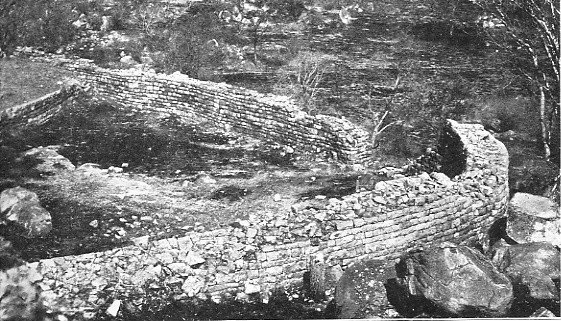

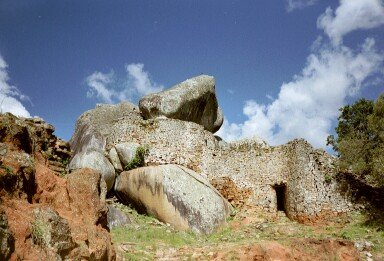
Once the capital of the Kingdom of Butua, Khami is located 22 kilometres west of Bulawayo, Zimbabwe. The settlement developed from architectural forms that emerged at Great Zimbabwe in the 13th century AD and a local Leopard's Kopje culture that built platforms of rough walling for houses. The area around Khami is riverine, hot, and has had problems with malaria. Builders used laminar granite to create retaining walls and platforms, an innovation that recognized the environment. Because much of the stone produced was of poor quality, the builders produced retaining walls instead of free-standing dry stone walls. Building platforms also made the houses cooler than those in the open areas and eliminated the problem of malaria for the royals who stayed in the built-up areas.
The retaining walls are built without mortar. Unlike at Great Zimbabwe, some of the walls at Khami have foundations built with huge blocks which would have been lifted by at least four people. Excavations have revealed well-planned buildings, especially at the Hill Complex, which was occupied by the king. This complex was first built by creating terraces of rough walling, which were then covered by quality walling of dressed stone blocks. Each terrace was highly decorated with either a checkerboard pattern, herringbone, or a cord pattern.
The terraces leaned inwards so that gravity would not cause collapses. These terraces had wooden poles, probably for guards to hold on to as they walked along the high and steep walls. The site reveals seven built-up areas occupied by the royal family, while open areas in the valley were occupied by commoners. The ruins include a royal enclosure or Hill Complex, and a Christian cross believed to have been placed by a contemporary missionary.
Sources: Wikipedia, OpenStreetMap, Wikidata, Wikimedia Commons


Written by Mutabor
Discuss this with the author and others
No comments yet. Be the first to start the conversation.