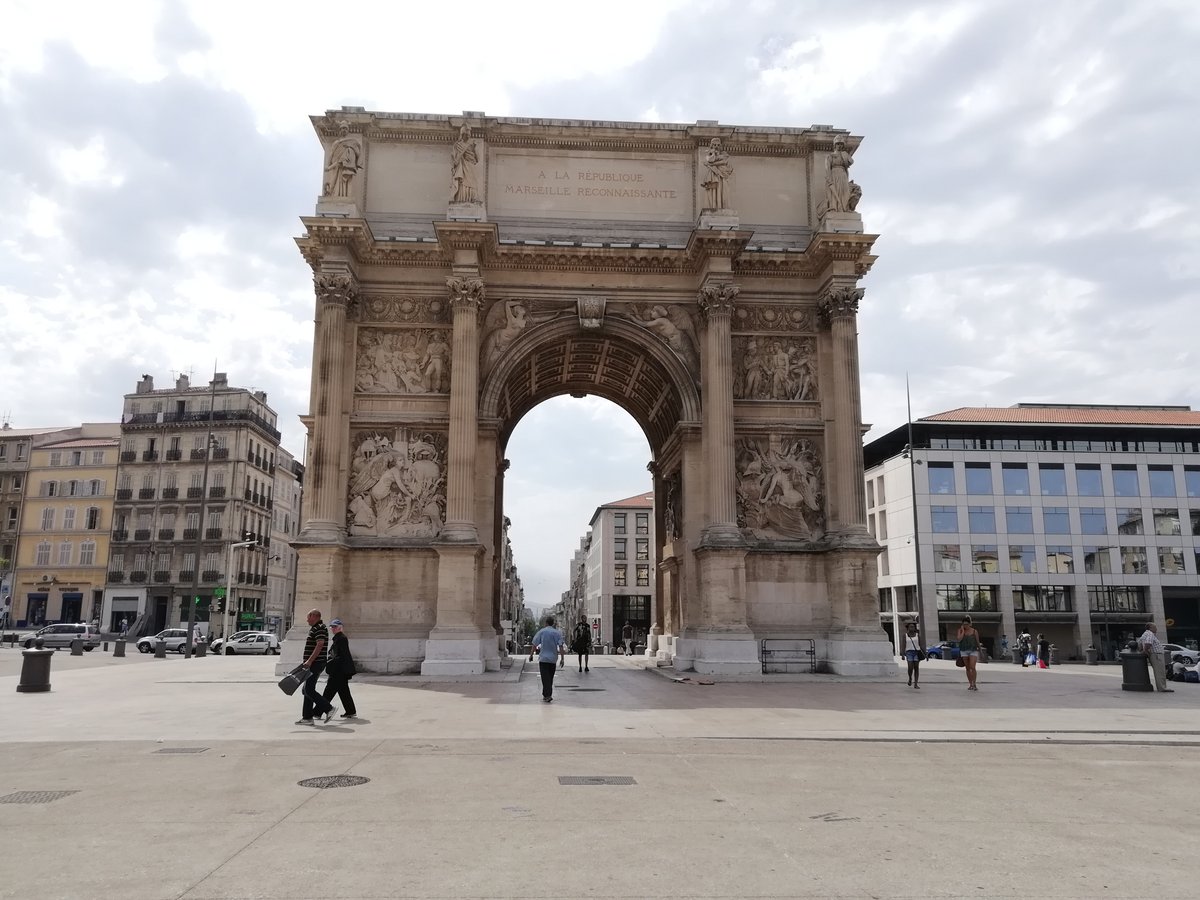

The Porte d'Aix, also known as the Porte Royale, is a triumphal arch in Marseille marking the old entry point from Aix-en-Provence. Its classical design by Michel-Robert Penchaud was inspired by the triumphal arches of the Roman Empire. The project was initially conceived in 1784 to honour Louis XVI and to commemorate the Peace of Paris, which ended the American Revolutionary War. However, the project was abandoned during the French Revolution and Napoleonic rule.
Following the restoration of the Bourbon monarchy, the project was resumed in 1823 by the mayor of Marseille, the Marquis de Montgrand. This time, the arch was intended to commemorate French victories in the Spanish Expedition, notably at the Battle of Trocadero. The first stone was laid in 1825, and the overground aqueduct that once stood in the place d'Aix was demolished three years later to clear the site.
Because of further changes in regime, the monument was eventually completed in 1839 under Louis-Philippe. Due to these intervening political changes, the arch's theme shifted from the specific campaign of the Duke of Angoulême to a more general theme of French victory. The site was originally formed by the arches of the aqueduc de l'Huveaune, which were removed to make way for the monument.
Sources: Wikipedia, OpenStreetMap, Wikidata, Wikimedia Commons


Written by Nicolo Ciampini
Discuss this with the author and others
No comments yet. Be the first to start the conversation.