The House of the Queen of Spades

Malaya Morskaya St., 10-4, Saint Petersburg, Russia, 191186

In every corner stood porcelain shepherdesses, a dining clock made by the renowned Leroy, little boxes, tape measures, fans, and various ladies' toys invented at the end of the past century along with the Montgolfier balloon and Mesmer's magnetism. Hermann went behind the screens. Behind them stood a small iron bed; to the right was a door leading to the study; to the left, another — to the corridor. Hermann opened it and saw a narrow, winding staircase that led to the room of the poor ward... A. Pushkin. The Queen of Spades

The House of the Queen of Spades (also known as the House of Chamberlain Prince S. V. Gagarin, the House of Princess N. P. Golitsyna, the House of Minister A. I. Chernyshev, etc.) is a mansion in Saint Petersburg at 10 Malaya Morskaya Street, where Princess N. P. Golitsyna (née Chernysheva; 1741/1744–1837) lived.

In 1790, the Golitsyn princes settled there, Vladimir Borisovich and Natalya Petrovna, whose daughter Ekaterina was the wife of the former owner of the house, Stepan Apraksin. The Golitsyns moved to Petersburg from France after the revolution.

From autumn 1832 to May 1833, living next to Princess Golitsyna at 26/14 Bolshaya Morskaya was A. S. Pushkin. There is a legend that the poet used to visit her house.

According to researchers, the character of the countess in the story is a composite, but details of her biography and the house were borrowed from Natalya Petrovna Golitsyna. In city folklore, the mansion at the corner of Malaya Morskaya and Gorokhovaya streets is called the “House of the Queen of Spades,” and the intersection where it stands is known as the “Queen of Spades Crossroads.”

Natalya Petrovna Golitsyna was one of the most influential ladies not only in Petersburg but in Europe. In her youth, she shone in society and was known as the Russian Venus. Among her close acquaintances were the Austrian Empress and the Queen of France. During her lifetime, the princess saw five monarchs on the Russian throne, and her word could ease the fate of even a rebellious Decembrist.

Natalya Petrovna Golitsyna, by Vladimir Lukich Borovikovsky (1757-1825), Russian Museum

…He found himself on one of the main streets of Petersburg, in front of a house of ancient architecture. The street was lined with carriages, coaches rolling one after another to the illuminated entrance. From the carriages, at intervals, emerged a slender leg of a young beauty, a rattling boot, a striped stocking, and a diplomatic shoe. Furs and cloaks flashed past the majestic doorman. Hermann stopped.

— Whose house is this? — he asked the corner watchman.

— The countess’s ***, — the watchman replied.
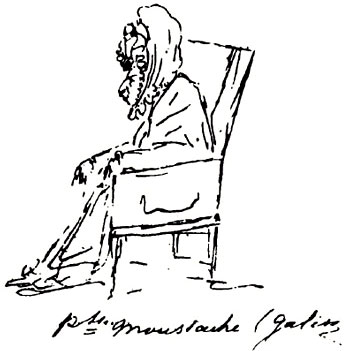
The mustached princess, drawing by A. S. Pushkin

In old age, she grew a mustache, for which Golitsyna was nicknamed behind her back the Mustached Princess (Fr. Princesse moustache). However, this physical peculiarity did not hinder her in the least; at that time, the high-ranking lady had reached the heights of power. Observing recognition from the royal family, all of Petersburg came to pay homage to Golitsyna. There was nothing flashy about her receptions; in old age, the princess was frugal. However, her favor was highly valued.

After the publication of “The Queen of Spades,” on April 7, 1834, Pushkin wrote in his diary: "My 'Queen of Spades' is very fashionable. Gamblers bluff on the three, seven, and ace. At court, they found a resemblance between the old countess and Princess Natalya Petrovna and, it seems, are not angry..." Close friends of Pushkin, the Nashchokins, recounted that, according to Alexander Sergeyevich himself, the main plot of the story was not fictional. The old countess is Natalya Petrovna Golitsyna, who really lived in Paris as Pushkin described. Her grandson Golitsyn told Pushkin that once he lost at cards and went to the old lady to ask for money. She did not give him money but told him the three cards assigned to her in Paris by Saint-Germain. "Try," said the grandmother. The grandson placed the cards and won back his losses. The further development of the story is fictional.

In Petersburg mythology, the Queen of Spades has another house, the former mansion of Princess Yusupova at 42 Liteyny Prospect, but it was built 22 years after Pushkin’s death.


Follow us on social media

More stories from In the Footsteps of Literary Characters

The Romance of Count Arakcheev and Nastasya Minkina – Two of the Most Cruel People of Their Era

4VWJ+PH Gruzino, Novgorod Oblast, Russia

"—…Madam Minkina, oh how beautiful! A bit nervous. Why on earth burn the maid’s face with curling tongs! Of course, under these circumstances, they’ll be killed!.."

Lions from the Bronze Horseman

Admiralteysky Ave, 12, Saint Petersburg, Russia, 190000

Where above the elevated porch, With a raised paw, as if alive, Stand two guardian lions,

Blokovskaya "Stranger" - Ozerki Station

Ozerki, Saint Petersburg, Russia, 197375

“In the evenings above the restaurants, the hot air is wild and deaf…” Who isn’t familiar with these lines from the famous Blok poem *The Stranger*? Under the poem, there is a note: “April 24, 1906, Ozerki.” It is commonly believed that the poet wrote it in the station restaurant in Ozerki. But where exactly? In this popular summer suburb, there were two stations: one on the Finland railway line, the other on the Ozerki branch of the Primorskaya (Sestroretskaya) railway…

The Suicide Pharmacy of Blok

Chkalovskaya metro station, Admiral Lazarev Embankment, 24, BC "Trinity", Saint Petersburg, Russia, 197110

Night, street, lamp, pharmacy, Meaningless and dim light. Live for another quarter of a century — Everything will be the same. There is no way out.

Oh, don’t believe this Nevsky Prospect!

Nevsky Ave., 38, Saint Petersburg, Russia, 191186

Всё обман, всё сон, всё не так, как кажется!

Raskolnikov's House - Crime and Punishment

Grazhdanskaya St., 19/5, Saint Petersburg, Russia, 190031

It is commonly believed that "Raskolnikov's house" is house No. 5, the corner building at the intersection of Srednyaya Meshchanskaya and Stolyarny Lane. Today, this is 19/5 Grazhdanskaya Street (the corner of Grazhdanskaya St. and Przhevalsky St.). In the mid-19th century, this house belonged to one of the heirs of the carriage master Joachim and was five stories tall (now, after major renovations, it is four stories). From the archway, you need to turn immediately to the right; at the corner, there is a door to the staircase described in the novel.

The Old Pawnbroker’s House – Crime and Punishment

Griboedov Canal Embankment, 104d, Saint Petersburg, Russia, 190068

The old pawnbroker’s house is located on the embankment of the Griboedov Canal. The character killed by Rodion Raskolnikov in Dostoevsky’s novel *Crime and Punishment*, Alyona Ivanovna, who was engaged in usury, lived there. The address of the old pawnbroker has been the subject of many years of searches and discussions among researchers of the novel’s topography. Since the 1920s up to the present, various versions of the house’s location have been proposed, with most researchers considering the residential building facing three streets, located at the address: 104 Griboedov Canal Embankment, to be the one that most closely corresponds to the description in the novel.

Sonechka Marmeladova's House - Crime and Punishment

Griboedov Canal Embankment, 73, Saint Petersburg, Russia, 190031

Griboedov Canal Embankment 73 is the house where, according to one version, the heroine of Fyodor Mikhailovich Dostoevsky's novel, Sonia Marmeladova, lived. The house is on a corner, located at the end of Malaya Meshchanskaya Street, where Dostoevsky himself lived while writing the novel *Crime and Punishment*, and it faces the "ditch." The house has a characteristic "ugly" blunt corner — one of the distinctive features of Sonia Marmeladova's house.

Porfiry Petrovich's House - Crime and Punishment

Bolshaya Podyacheskaya St., 26, Saint Petersburg, Russia, 190068

Porfiry Petrovich is investigating the case of the murder of the moneylender Alyona Ivanovna and her sister Lizaveta. Razumikhin, for the first time, brought Raskolnikov (at his own request—he said he was also a pawnbroker with the old woman and wanted to get his watch back...) to the investigator’s apartment: “Porfiry Petrovich was at home, in a robe, in very clean underwear, and in worn-out slippers. He was a man of about thirty-five years old, shorter than average height, plump and even with a belly, clean-shaven, without a mustache or sideburns, with closely cropped hair on a large round head, somehow especially prominently rounded at the back.”

Russian Tristan and Isolde – punishment for the "vile abomination"

Nevsky Ave., 16, Saint Petersburg, Russia, 191186

The story began on a May day in 1851, when a carriage pulled up to the "English Shop." Lavinia, who had flown out of the store, disappeared into it, and the horses galloped at full speed along Nevsky.

The Island and Château d'If – a Terrifying Prison with a 200-Year History

Embarcadère Frioul If, 1 Quai de la Fraternité, 13001 Marseille, France

The Château d'If – a fortress located on the eponymous island and famous thanks to Dumas' work – is situated just a mile from Marseille and is clearly visible from the city’s waterfront. Since the late 16th century, the castle has been used for isolating and guarding particularly dangerous criminals. It was from that time that the fort received the name Château d'If. The dungeons housed Huguenots, politicians, leaders of the Paris Commune, as well as individuals who posed a threat to France.

Head of a Knight (Sculpture at the Spring or Adam's Head)

Boulder "Adam's Head," Oranienbaum Highway, Saint Petersburg, Russia, 198504

Head (or Sculpture at the Spring) — a sculpture by an unknown artist, carved into a giant granite boulder and located on the territory of the former Leuchtenberg estate in Peterhof. It is an object of cultural heritage of federal significance.

Monument to Leo Tolstoy and Hadji Murat

JH4C+F2 Tsalkita, Republic of Dagestan, Russia

Hadji Murat, the real-life hero of Tolstoy's work, was an Avar leader and a naib of Imam Shamil. But over time, the relationship between the two military leaders deteriorated; Shamil began to suspect Hadji Murat because of his growing popularity. They had a quarrel, and Hadji Murat's wife and children were taken captive by Shamil. To free them from captivity, Hadji Murat switched to the Russian side. However, the Russians did not intend to help him in rescuing his family. Then Hadji Murat returned to the mountains and died in a clash with the Cossacks.

Cranes - Seven Fates Crippled by War

2CJ8+FF Dzuarikau, Republic of North Ossetia-Alania, Russia

They slow down. Above the gray rock by the mountain river Fiagdon, seven white cranes, touching wings, are frozen in eternal flight. The monument is dedicated to the Gazdanov brothers. One after another, Magomed, Dzarakhemet, Khadjismel, Makaerbek, Sozyrko, Shamil, and Khasanbek went to the front during the Great Patriotic War, and one of them did not return. Their mother Tasso died when the third death notice arrived. Three more times after that, the village postman knocked on their door with sorrowful news. When the seventh death notice came, he refused to deliver it to the Gazdanovs. This difficult mission was taken on by the elders. The head of the family, Asakhmat, fell dead when he saw the elders dressed all in black entering his yard…