


The Kleinmichel Mansion, a remarkable architectural monument, is located in the northwestern part of Kamenniy Island, on the bank of the Krestovka River, a tributary of the Malaya Nevka, which separates Kamenniy and Krestovsky Islands. The development of these territories began after extensive land reclamation works in the 1810s, which drained the flood-prone areas of Kamenniy Island.
By 1827, an architectural ensemble of the Theatre Square had formed near the 1st Yelagin Bridge. It included the Summer or Kamenniy Island Theatre, the theatre directorate’s house, a summer house for the pupils of the Theatre School, small houses for the theatre caretaker and security, a Coffee House, and the Zhenyes Summer House. It was Zhenyes, the leader and actor of the French troupe whose performances were popular in the Summer Theatre, who in 1834 became the first owner of the plot where the Kleinmichel Mansion later appeared. Later, the Zhenyes summer house belonged to Verkhovtseva.
In 1893, the Verkhovtseva summer house and the right to lease the land plot (for 90 years) were acquired by Countess Maria Eduardovna Kleinmichel. M. E. Kleinmichel was the hostess of a high society salon in St. Petersburg, a member of the editorial board of the magazine "Capital and Estate," a person of deep intellect and independent thoughts.
Maria Eduardovna was the wife of a colonel of the Preobrazhensky Regiment, Kleinmichel, who died five years after their wedding. His father, a count and general-adjutant Kleinmichel, was awarded by a personal decree of Nicholas I the right to depict the Winter Palace engulfed in flames on his coat of arms for the heroism he showed during the fire at the imperial residence in 1837. This stone coat of arms can still be seen above the entrance to the Kamenniy Island house today.
The appearance of the Kleinmichel estate was formed gradually. The mansion acquired its final look in 1904 when it was rebuilt in the Gothic style: a roof with a high spire above the central two-story volume, a separately highlighted main entrance with a spacious vestibule crowned with a cartouche bearing the Kleinmichel coat of arms.
In 1907, part of the plot was leased by the wife of the famous circus owner Chinizelli. For her, in 1909, architect von Postels built a two-story wooden mansion in the Art Nouveau style with a high mansard roof topped with a turret. The entrance to the mansion was through the main vestibule of the Kleinmichel summer house. The central part of the house is guarded by bronze dragon figurines.
The architectural discord of the houses was the reason for another reconstruction of the countess’s summer house in the Neo-Gothic style in 1911-1912, designed by architect Meibom. The building is decorated with a roof with a high spire and a corner turret.
Besides the impressive architecture of the old mansion, it is also worth noting the unusual gate grille. More precisely, the grille itself is quite ordinary, but the ornament decorating the bars is special. Behind the unsuspecting passersby, on the gate grille, watches a fiery salamander. The salamander is a mythical creature. According to legends, it does not burn in fire but extinguishes it as it passes through. This creature decorates the steel bars for a reason. The father of the countess’s husband once showed outstanding heroism in extinguishing the fire at the Winter Palace, for which he was granted the right to depict the Winter Palace engulfed in flames on the family coat of arms. The salamander became a reminder for descendants of Count Kleinmichel’s feats. Unfortunately, the interior decoration has not been preserved, although it is known that the mansion’s walls were decorated with oak panels, and the Large Drawing Room had a fireplace made of white marble.
A monumental grille with two main gates. According to Preys’s design (1904), a magnificent openwork wrought-iron grille with plant ornament and salamanders, a wicket gate, and double-leaf gates with the monogram "MK" (Maria Kleinmichel) were forged. Installed in 1909.
In 1912, at the "San-Galli" factory, Neo-Gothic gates were made according to Meibom’s design, with round pillars topped with forged lanterns.
The interiors of the Kleinmichel mansion are known thanks to a series of photographs by Karl Bulla in the magazine "Capital and Estate." The vestibule walls were paneled with oak; to the right of the entrance was a massive fireplace faced with patterned ceramic tiles. A staircase with carved railings led to the gallery. The carved staircase posts were decorated with male heads wearing wide-brimmed hats. The enfilade of the main rooms was adorned with Corinthian pilasters and stucco friezes in the form of wreaths with garlands. The Large Drawing Room had a marble fireplace with atlantes, in front of which on low pedestals lay two sphinxes with female heads. A gentle arch led to the Small Drawing Room, then to the living room, where a huge ceiling skylight illuminated tapestries, paintings, and parquet flooring.
There was a collection of porcelain, as well as paintings, tapestries, and oriental carpets on the floor.
In 1914, the countess organized a hospital in her mansion, which she financed herself. The furnishings of the house were moved to her home on Sergievskaya Street (now Tchaikovsky Street, 33-37). In 1918, Kleinmichel left Russia, selling her collection and city house.
"The most famous hostess of that time was Countess Kleinmichel, whose masquerade balls were talked about by all of St. Petersburg’s high society. Wealthy, eccentric, slightly limping, the countess rarely left her mansion, and everyone who held any position in society considered it an honor to be invited to her home. She was a grand dame to the tips of her fingers," testified Grand Duchess Olga Alexandrovna, "and at the same time an extraordinarily insightful and intelligent woman. Somehow, she managed to learn the intimate secrets of almost all of St. Petersburg society. Her mansion was known as a hotbed of gossip. Moreover, she was fascinated by occult sciences."
The "Petersburg Newspaper" wrote in June 1910: "...crowded gatherings at the Kamenniy Island summer house of Countess Kleinmichel on Thursdays, when on the platform in front of the summer house all evening and past midnight numerous motors and autocars await the departure of guests. The salons of the kind and hospitable hostess, both in summer at the summer house and in winter on reception days, are filled with numerous visitors. Here gathers all of high society St. Petersburg, all foreign diplomats arriving from abroad, and notable persons attracted both by the kind and cordial hospitality and by the prospect of interesting conversation with the hostess and visitors of her salon."
In Kleinmichel’s memoirs, an account is given of one of the costume balls she arranged in early 1914. At that time, an incident occurred that seemed insignificant then but had tragic consequences for the countess and nearly cost her life. With the outbreak of war, rumors spread that she had allegedly passed a Russian mobilization plan to Germany ("in a box of chocolates"). The information came from the brother of Pavel Rodzyanko, chairman of the Fourth State Duma, who was taking revenge on her for not being invited to that costume ball.
From the beginning of World War I, the mansion housed a hospital that the countess herself organized and financed. In 1918, before leaving Russia forever, the countess closed the shutters, locked all the doors, and hung a handwritten notice above the entrance: "Entry strictly prohibited. This house belongs to the Petrograd Soviet. Countess Kleinmichel has been arrested and placed in the Peter and Paul Fortress." The witty countess’s hoax helped her pack valuable things and leave the country without unnecessary trouble.
In 1918, the summer house was nationalized; in spring 1920, the mansion, repaired by participants of communist voluntary workdays, was adapted as a combined club for workers’ rest houses on Kamenniy Island. It was here, at a small concert on the evening of July 19, 1920, that Lenin visited, getting acquainted with the first experience of organizing rest houses for workers in our country. Thanks to this event, in 1976 the Kleinmichel mansion was included in the list of memorable Lenin sites and placed under state protection as a historical monument.
After the war, the house served as a dormitory for the "Elektrik" factory. All halls were divided by partitions into small rooms, but the vestibule was untouched; there was a magnificent fireplace, walls were paneled with oak, a staircase with carved railings led upstairs, and under it were charming carved gazebos.
From 1986 to 1989, the "Restaurator" association carried out reconstruction works based on architect Morozova’s project. During this, the countess’s mansion interiors were destroyed, and the Kleinmichel mansion was painted green. While the reconstruction project of the Kleinmichel summer house was being developed, in 1978 the Chinizelli summer house was dismantled. In 1990, the building was transferred to the Baltic River Shipping Company, and a recreation base was opened here.
In 2006-2007, a new reconstruction of the building was completed. The main house, service wing, and wrought-iron fence were restored. For a long time, we knew it in one appearance (previously its walls were green), but by 2007 the house was restored to its original form. The Chinizelli summer house was recreated. Kamenniy Island is being prepared as the residence of the President of Russia, which includes the Kleinmichel mansion. Now the Neo-Gothic mansion looks like a palace from a fairy tale, if only because, unlike most summer houses on the island, it has been restored and is not closed off by a solid fence.
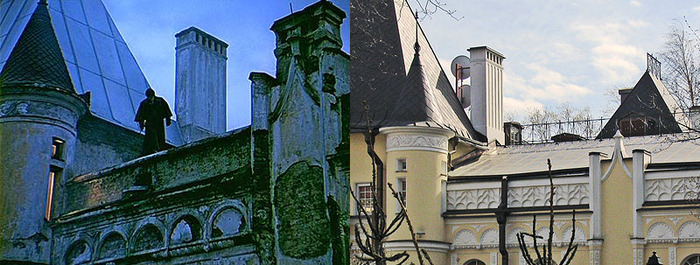
A scene from the film "Sherlock Holmes and Dr. Watson" was shot in the mansion — the mansion-animal house of taxidermist Sherman ("The Treasures of Agra"). Watson was sent here by the detective for a dog named Tory.
At the beginning of the 2nd episode of the film "Agony," this mansion is shown. Part of the house with the tower is missing in the frame — apparently, this is the moment of dismantling.
Sources:
https://www.citywalls.ru/house2488.html


Written by Jermaine
Discuss this with the author and others
No comments yet. Be the first to start the conversation.