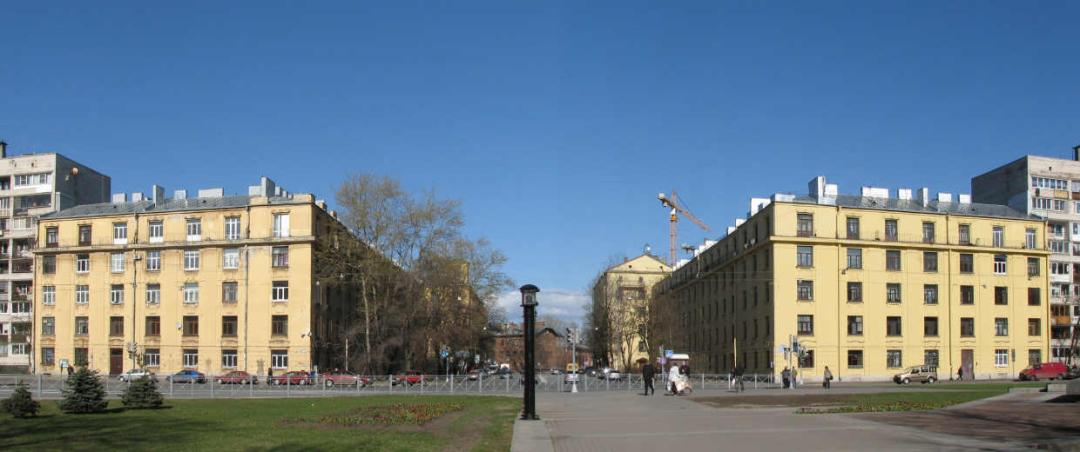

Unimproved streets, factories, warehouses, sparse shabby houses, two cemeteries, and vegetable gardens. This is roughly what the territory of the present-day Decembrists' Island looked like at the beginning of the 20th century.
The island, regularly flooded either by the Smolenka River or by storm waves from the Gulf of Finland, was a place where the shores were reinforced with construction debris. In general, the place was not pleasant — a depressing wasteland between factories and graves. Today this place is known as Decembrists' Island, but more than a century ago it was called Goloday. Contrary to expectations, the name does not come from hunger, but from the surname of an English landowner, Holiday, who, oddly enough, had a "festive" surname. It was this bleak territory that the well-known city entrepreneur Gerasim Shalit, who was engaged in the supply of building materials, decided to transform into an elite quarter. To realize his grand idea, in 1898 Shalit purchased a substantial plot of land on Goloday Island and began constructing the first house.
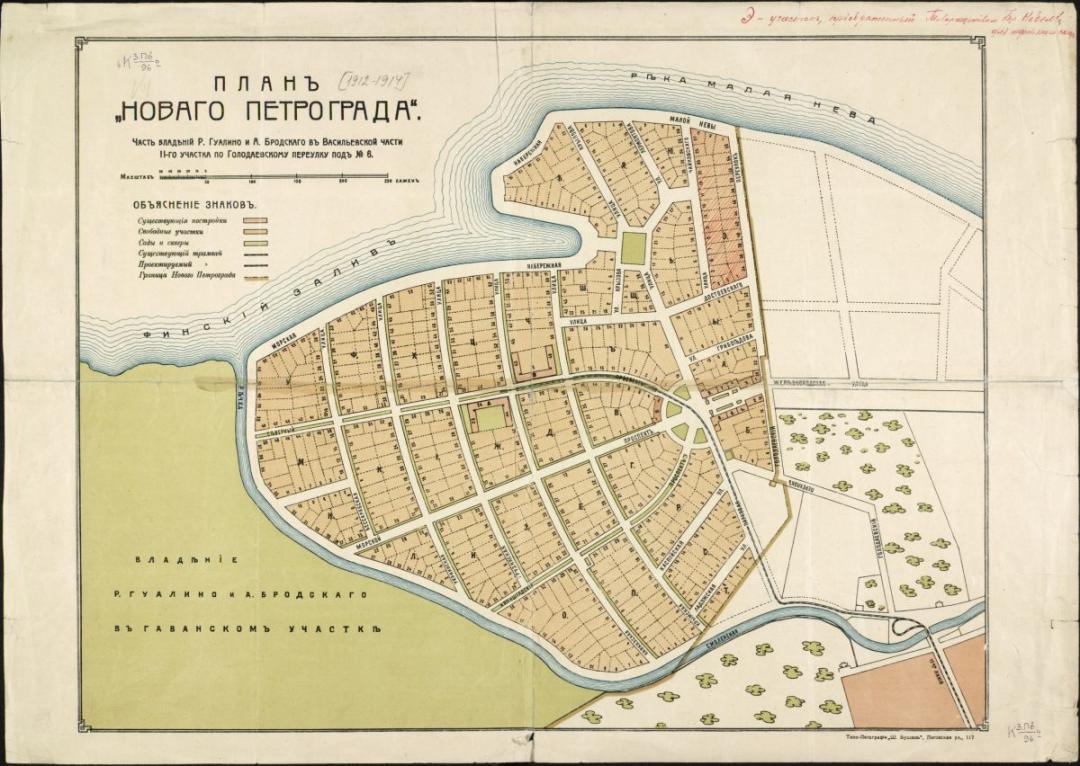
This house was supposed to be part of a grand project called "New Petersburg." He even created a joint-stock company with the same name. However, the company's shares were not in demand, as the public found the idea of creating a garden city on a "God-forgotten" island less appealing than its author did. Nevertheless, the first house was built quite quickly. Incidentally, it has survived in a somewhat altered form under the name "G.L. Shalit's Income House" and is located at 10 Kakhovsky Lane. Today, miniature patricians in Roman togas gaze down at passersby from the building’s front facades, standing out noticeably alongside the columns against the backdrop of other houses in the area.
In 1910, the territory was purchased by Italian millionaire Riccardo Gualino together with A. A. Brodsky. Around the same time, I. A. Fomin developed a plan for the new district. Fomin proposed implementing a large ensemble composition in the Palladian style.
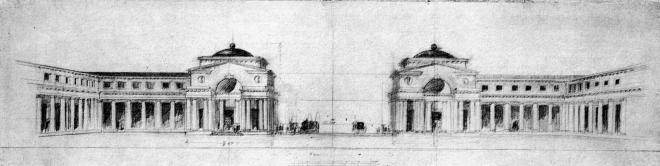
Project of the "New Petersburg" ensemble on Goloday Island. Architect I. A. Fomin. 1912. Fragment.
The center of the district was to be a semicircular square, from which three radial avenues extended westward, while on the east side the square was adjacent to a market square.
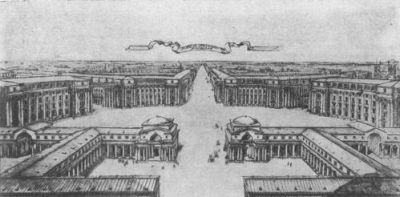
"New Petersburg," drawing by I. A. Fomin, 1912
In 1912, according to Fomin's design, two houses were built (No. 2 and No. 10 on the current Kakhovsky Lane). Architect Ernest Shtalberg, a student of Fomin, participated in the work on house No. 2. When working on house No. 10 (built in 1899–1900 by architect V. F. Rozinsky), the building’s exterior was completely altered according to Fomin’s ideas, with the repositioning of windows and doors. The facade received architectural treatment in the neoclassical style. Half-columns and pilasters of the Ionic order, medallions appeared. At the same time, part of the attic was rebuilt into a fifth floor, which was later extended over the entire building in the 1930s.
Between 1912 and 1914, instead of the market square, two more houses were erected on the site (current addresses: 19 and 34 Zheleznovodskaya Street). F. I. Lidval built these houses on the principle of a propylaea, creating a "rational composition," simple and modern. He utilized the plot’s potential, free from construction: the compact buildings he designed stand freely and are visible from all sides. The decorative design of these houses is much stricter and simpler than Fomin’s: fluted pilasters of a large order and flat graphic ornamentation barely stand out against the monochrome facade surfaces. Architects A. M. Litvinenko and E. K. Koch participated in the design of these buildings. These two buildings on Zheleznovodskaya Street laid the foundation for the future creation of a complete urban ensemble.
The buildings on Zheleznovodskaya Street laid the foundation for the future creation of a complete urban ensemble, which, unfortunately, was not realized.
In 1914, the project was renamed "New Petrograd" and underwent periodic revisions, but in reality, the project stalled due to World War I, the October Revolution, and the subsequent Civil War, as there were no funds to implement it.
Starting from the mid-1920s, the project was revisited. Between the mid-1920s and the late 1930s, the modern KIM Avenue and Kakhovsky Lane ("right ray") were laid out, as well as Baltic Yungs Square created; several houses were built. World War II again interrupted the district’s development.
In the 1960s, the district’s formation was completed, but with adjustments: the continuation of Zheleznovodskaya Street became the "central ray," while the "left ray" was abandoned.
Thus, the planned street and road network is fundamentally close to I. A. Fomin’s plans, but the architectural component underwent significant changes.
Sources:
https://kima7.ru/category/history/


Written by Jermaine
Discuss this with the author and others
No comments yet. Be the first to start the conversation.