

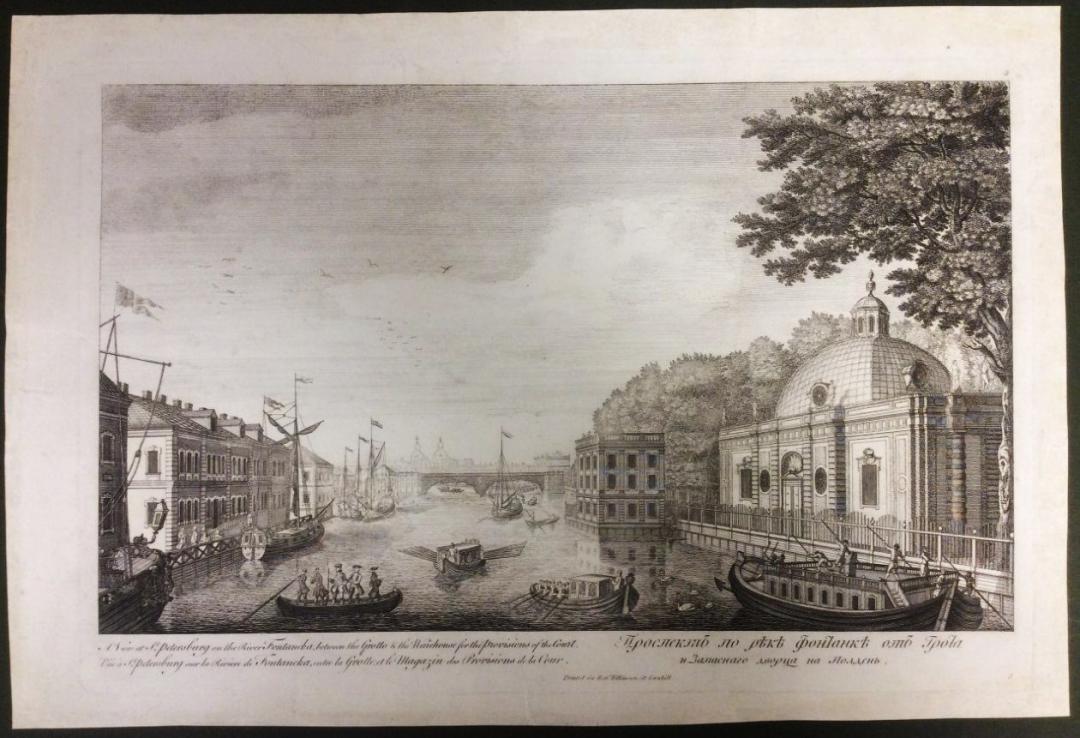
In the census book of the Vodskaya Pyatina from the year 1500, the river is mentioned as Golodusha. Until 1712–1714, it was called Erik or Nameless Erik and was a marshy river forming islands and backwaters along its course. Later, it was called the Fountain River and finally, in 1737, it received its current name. In the 1751 description of Saint Petersburg, it is said: “It is called the Fontanka because pipes were made through it, conducted from the Basin (at the beginning of the modern Ligovsky Prospect) to the (Summer) Garden for fountains.”
At the time of the construction of the first bridge over the Nameless Erik, the width of the water barrier was about 200 meters, but as the shallow waters were developed for construction, its width significantly decreased. In 1714, the first clearing and straightening of the Fontanka’s banks took place. At the locations of estates, the banks were reinforced with wooden walls. By 1727, the wooden reinforcements were already in poor condition. Between 1743 and 1752, the Fontanka underwent thorough clearing, deepening, straightening, and bank filling. The first stone embankments on the Fontanka appeared in the 1760s during the reconstruction of the Laundry Bridge in stone.

The modern outlines of the Fontanka’s water surface were acquired after it was cleared and deepened a second time between 1780 and 1789, and its banks were clad in granite. Stone walls were erected along the entire length of the river, stopping just short of its mouth. The reinforcement structure consisted of a high rubble wall on lime mortar, faced with massive granite blocks. The foundation for the walls was made of wooden pile grillages, mostly consisting of two rows of piles.
In the 17th century, the channel was shallow, marshy, and in places significantly wider than the modern Fontanka. Nevertheless, the depths of this river were sufficient for a successful sabotage operation involving more than a dozen boats. When in May 1703 two Swedish ships, Astrild and Gedan, entered the Neva, Peter I was able to take advantage of the fact that the Nameless Erik, having its source from the Neva beyond Hare Island, flows into it much further downstream, not far from the Gulf of Finland. Part of the boats with musketeers under Lieutenant Menshikov’s command stayed near the mouth of the future Fontanka, hiding behind Lammasari (Sheep) Island, while the other half, led by bombardier-captain Peter Mikhailov, went downstream along the Nameless Erik to Kalinkina village (Kalyula). As a result, by dawn the Swedish ships were caught in a “pincer,” and in addition, the wind strengthened and a heavy rain began, significantly reducing visibility. Menshikov’s group emerged from the upper reaches of the Nameless Erik and attacked the Swedes. At the same time, Peter Mikhailov’s group approached from the rear. The musketeers boarded the enemy ships and cut down all who resisted. A commemorative medal was struck to celebrate the triumphant victory with the inscription: “The unprecedented happens.”
At the source of the Nameless Erik stood the villages of Vralovshchina and Kanduya; on the site of the Alexandrinsky Theatre was the village of Usaditsa. In the lower reaches of the river was a small Izhora village known since the 17th century. On some old maps it is labeled Kalyula, on others — Kallina. In the early years of Saint Petersburg’s construction, the village’s name was Russified and it came to be called Kalinkina. This name is preserved in many toponyms, including the name of the Old Kalinkina Bridge.
Currently, there are 26 descents on the Fontanka of two types: pedestrian with two longitudinal staircases and so-called horse descents with two ramps. Pedestrian descents served for mooring boats, motorboats, and piers; horse descents were for hauling cargo on carts delivered by small river vessels and for drawing water into barrels from the river.

In the 1910s, due to the development of automobile and tram transport, some pedestrian and horse descents were eliminated: they were filled in or dismantled.
By 1925, many sections of the stone wall had fallen into disrepair, up to collapse. They began major repairs. From 1947 to 1949, repairs were carried out on the section between the Egyptian and Old Kalinkina bridges, and on the right bank below the Old Kalinkina Bridge — up to the dam. In 1962, a new repair method for the embankment walls was adopted — partially dismantling the wall in thickness and performing work under the protection of the undismantled part. Initially, this construction method was applied on the section between the Panteleimonovsky and Belinsky bridges on both banks. Wooden piles were driven until 1984, later replaced by reinforced concrete ones.
The Fontanka’s railing fences consist of granite pedestals and simple iron wrought-iron grilles, presumably made according to a design by architect J. Quarenghi and forged at the Demidov factories in the Urals.
Sources:
https://mostotrest-spb.ru/embankments/naberezhnaya-reki-fontanki
https://ru.wikipedia.org/wiki/Fontanka


Written by Jermaine
Discuss this with the author and others
No comments yet. Be the first to start the conversation.