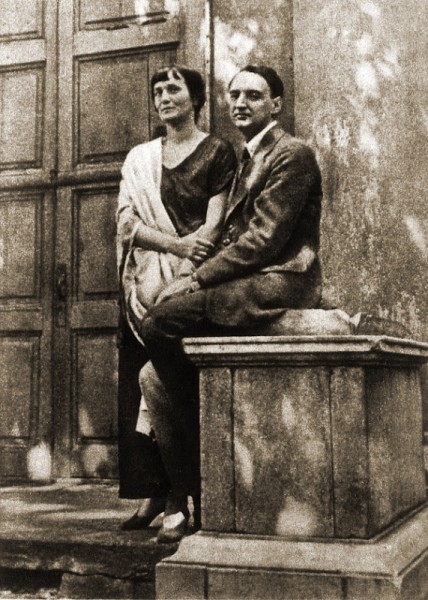

The next period of the poet's life in the Fountain House begins in 1925. It is connected with N. Punin, who painfully and for a long time loved Akhmatova, surprisingly, as she thought, understood her poetry. The bachelor apartment of the married Punin was at 4 Inzhenernaya Street, and Akhmatova used to visit there. In August 1922, Punin, as one of the heads of the Fine Arts Department of the People's Commissariat for Education and the head of one of the departments of the Russian Museum, received an apartment on the third floor in the southern garden wing of the Fountain House, which at that time was under the museum's jurisdiction. Passing through the famous cast-iron lace Sheremetev gates and the palace vestibule, residents entered the inner courtyard. Here still grew old count's lindens, as if from Akhmatova's or Pushkin's poems. The apartment was large—about one hundred square meters, built according to the enfilade principle, with each of the four rooms overlooking the palace garden and also having a door to the corridor.
A turning point in the relationship between Akhmatova and Punin was July 1922. Judging by the short notes sent by her, the initiative to change their relationship belonged to her. This is also evidenced by Punin's reply letters, in which he already characteristically noted Akhmatova's "homelessness" and "beggary": Why do you need to call, and why did you call me? Where with you, well, where with you, homeless beggar? At first, Akhmatova's restlessness and homelessness even touched him, but Punin did not want to destroy his own home. The poet gave him a small homemade notebook with poems written by her hand. At least the last of them was addressed to Punin. After the war, he wrote in his diary: Of all her poems, the strongest is: “I drink to the ruined house...”
On October 19, 1922, Anna came to visit Punin for the first time, but even after that, she did not rush to settle permanently in the Fountain House, living as if in two places, leaving her belongings in the apartment in the Marble Palace. Moreover, Punin's family—his wife and daughter—continued to live in the apartment on the Fontanka.
All this imposed a special imprint of instability and temporariness on Akhmatova's stay in the Fountain House, especially since her marriage to Punin was never registered. A cozy, reliable home did not materialize. The apartment had four rooms: a large rotunda hall, called the "pink room," a dining room, a nursery, and the owner's study, a long corridor along the rooms with mezzanines, a spacious kitchen, and a hallway. Akhmatova settled in Punin's study: there was no separate room for her. Punin often told her: This is your room, but only the sofa and a small redwood table in front of it were her corner here. Already in 1923, when Akhmatova did not live in the Fountain House, Punin wrote in his diary that he wanted to keep Galya in the house and protect her self-esteem.
Having grown up before the revolution, the poet, like many women of her circle, was helpless in everyday matters, practically unadapted to life, and not distinguished by practicality, all of which exacerbated the uncomfortable conditions in the house. Akhmatova could not feel like the mistress; she remained a guest. The family atmosphere and the situation in the apartment are also characterized by the position in which Akhmatova's son found himself: in 1929, he came to Leningrad from Bezhetsk to study in the tenth grade and then enter university. A place for L. Gumilev was found only in the corridor on a wooden chest in an unheated corridor. The son from the first marriage was of no interest to Punin; their relationship did not develop.
At the end of 1936, when Akhmatova lost her permanent personal pension, which she had received for seven years for merits to Russian literature, the situation in the house became even more difficult. In a conversation with Chukovskaya, Akhmatova admitted:
“I was so burdened by the whole situation. Now I understand. The ideal wife for Nikolai Nikolaevich was always Anna Evgenievna. She serves, receives four hundred rubles salary, an excellent housekeeper. And he persistently tried to fit me into this Procrustean bed, but I am neither a housekeeper nor do I have a salary.”
As a result of the unfavorable situation in the house, Akhmatova's son moved to Fontanka 149, to the apartment of his friend, student Bekman. It was there, not in the Fountain House, that Lev Gumilev was arrested. The lines “They took you away at dawn” in “Requiem” broadly recreate the situation of those terrible years. In total, Lev Gumilev endured four arrests, spending about 14 years in prisons and camps. He was later fully rehabilitated.
At the same time, Akhmatova was not completely financially dependent on the Punins (primarily on A. Arens-Punina), as she earned money through translations and articles: for example, a 1940 certificate states that she was paid 5,810 rubles. Apparently, before the war, the poet herself appealed to the Leningrad City Council for the provision of a room, as she lived in her ex-husband's apartment. This is also confirmed by Akhmatova's words said to Chukovskaya in the summer of 1940: So, the promised new apartment for me is a myth, and the second room in this one is also a myth.
The hopelessness and gloom in the house were noted by its frequent guest Luknitsky. Akhmatova herself considered the period from 1925 to 1936 difficult in everyday terms and not very fruitful for creativity, a period of boredom, emptiness, mortal loneliness, but from 1936, according to her own words, her handwriting changed, and her voice began to sound differently.
In the summer of 1937, Punin already speaks of himself and Akhmatova separately, inserting into her life text the now outwardly modest place, which was correctly chosen for the future: [...] I already agree that your place is not on earth: the broken couch on which you sleep is only proof and nothing more. You chose your place well, I no longer argue.
At the beginning of 1937, Akhmatova met Garshin, and in the autumn of the following year, after breaking up with Punin, she moved to a small room, the former nursery, where she lived until leaving for evacuation in the autumn of 1941. Akhmatova did not want to leave the Fountain House, explaining that she was used to it here, and besides, she had nowhere else to move. Her room struck one with some neglect, broken legs of a chair or couch, and at the same time rare antique items from some other life, shards of the past, which is why the reviews of Akhmatova's pre-war dwelling are so contradictory. Her room was indeed illuminated by a magical light for those who knew how to see it.
The year 1940 can be considered a turning point, a time of internal preparation for the creation of the “Poem Without a Hero,” which Akhmatova later described as a “time of summing up.” On the last New Year's Eve before the war in 1941, Anna Andreyevna was alone; Garshin apparently promised to come but could not leave his wife.
Soon after the war began in August 1941, Akhmatova left her room in the Fountain House, asking her friends the Tomashevskys, who lived in the writers' house where there was almost a real bomb shelter, to take her in. On September 26, the poet received a certificate of housing reservation in the Fountain House due to evacuation from Leningrad. She left her manuscripts and valuables and relics in Garshin's care. Two days later, Akhmatova was flown to Moscow. After the November holidays, she finally reached Tashkent by train with writer families. The bombings of besieged Leningrad continued: on November 6, 1941, a bomb fell so close to the Fountain House that the windows shattered, after which the Punins' apartment became uninhabitable. The siege of Leningrad was lifted only on January 27, 1944. In mid-May, the poet finally received a summons to her native city, and her Tashkent friends saw her off home: eight hundred magical days under the blue dome of the southern sky came to an end.
In Moscow, everyone was pleasantly surprised that Akhmatova looked lively, young, and happy. For her patriotic poems, she was soon awarded the medal “For the Defense of Leningrad.” On the first day of summer, the author of “Poem Without a Hero” arrived by train in a soft carriage to her native city, full of hopes and plans. She intended to say goodbye to the Fountain House forever and go straight from the station to Garshin's new apartment on Kirovsky Prospekt. Akhmatova arrived in Leningrad with one small suitcase, as she had left it; acquaintances noted that she always carried very few things. However, all her plans collapsed already at the station: the apartment had not yet been obtained, Garshin, having survived the blockade, was unrecognizably changed, seemed mentally broken to Akhmatova, and there was no question of living together anymore; she was homeless again. After the breakup, at the poet's request, her letters, papers, and belongings were returned to her.
Until the end of her life, Akhmatova believed that she was evacuated from Leningrad by order of A. Fadeev, but the credit for her rescue belongs to the poet O. Berggolts, although the summons was signed by Fadeev himself. At the same time, Berggolts resolutely refused to evacuate.
She expressed her impression of meeting the poet who survived the nightmare of the Leningrad blockade as usual, concisely: A terrible ghost pretending to be my city so struck me that I described this meeting with it in prose. In the Epilogue of the poem, homelessness becomes a common misfortune:
From July 27, 1944, the last period of life connected with the former house begins. Akhmatova very much did not want to return to the Fountain House; however, in early September 1944, she returned to her former apartment in the old house. Cosmetic repairs were made in her room at the expense of the writers' organization. Soon she managed to get another room. Thus, the poet had two rooms in the former apartment, one of which was intended for her son, a front-line soldier. In late autumn 1945, after a seven-year separation (arrest, prison, camp, volunteering for the front, demobilization), they finally met.
When Ostrovskaya, who survived the blockade in Leningrad, first went to visit Akhmatova, she was struck by the similarity of the Fountain House courtyard to one she had seen before: The view seemed almost like Tsarskoye Selo, but the atmosphere itself shocked with its poverty: In the long and narrow room, there was almost no furniture. There were half-broken chairs, an old armchair in which she seated me, a small iron bed covered with something dark yellow, a small table, a wardrobe with a broken door.
Meanwhile, these were months of official recognition of Akhmatova, her election to various boards and commissions; at the end of the year, in the journal “Leningrad,” besides ten poems from the last four years, an excerpt from “Poem Without a Hero” dedicated to the Sheremetev Palace, which survived the war (“So under the roof of the Fountain House...”), appeared.
Ostrovskaya notes that at numerous performances, Akhmatova was met with such an ovational storm that her fame was perceived as intoxicating and strange, strange, and Akhmatova herself was tragic in her fame and loneliness.
The poet regarded the stormy manifestations of fame and the authorities' favor with caution; however, she lost vigilance and caution when she met Isaiah Berlin in the year of victory. In November 1945, 36-year-old British diplomat Isaiah Berlin, shortly before that appointed to work at the British Embassy in Moscow, found himself in Leningrad. Berlin was born in pre-revolutionary Riga, spent his childhood in Petrograd, and ended up in England at the beginning of 1921, when he was only 11 years old. Nevertheless, he retained both fluent Russian and an interest in Russian culture and literature. Berlin became a diplomat from Oxford, where he studied both Russian literature and Soviet politics. However, Akhmatova was for him a part of a distant, deeply past pre-revolutionary life. Therefore, when upon arriving in Leningrad, literary critic Orlov, whom he met by chance in a bookstore on Nevsky, told him that Akhmatova lived nearby, on the Fontanka, and suggested meeting her, Berlin could not refuse.
Sounds fade away in the ether
And dawn pretended to be darkness.
In a forever mute world
Only two voices: yours and mine.
And under the wind of invisible Ladoga,
Through almost bell-like ringing,
Into the light gleam of intersecting rainbows
The night conversation is transformed.
This poem, dated December 1945, is Akhmatova's poetic memory of a memorable meeting. She recalled her interlocutor of that time once again in “Poem Without a Hero,” calling him a “guest from the future.” According to researchers, the meeting was not accidental, that Berlin consciously “set up” Akhmatova, and that she was forced to accept the English diplomat by direct instruction from Orlov. Thus, the poet became a victim in a large diplomatic game of two intelligence agencies.
Lev Gumilev also believed that Akhmatova was forced to accept the English diplomat and that the Leningrad Writers' Union was involved. Most likely, the 1946 decree on Leningrad magazines was only a prologue to the terrible “Leningrad Affair” of 1949.
K. Chukovsky recorded Akhmatova's words about the vicissitudes of her fate, testifying to her worldly wisdom: I was in great glory, experienced the greatest disgrace—and realized that, essentially, it is the same thing.
Saying goodbye to the Fountain House in the poem “I Have No Special Claims...,” the poet calls it splendid but not having endowed the lyrical “I” with material goods; she leaves the palace in all the grandeur of holy poverty. Other riches and acquisitions were always more valuable to Akhmatova: the feeling of inner freedom, her righteousness, deserved “glory,” the memory of her and her poems. The palace is only the “House of the Poet,” albeit sacred, and that is why it is famous. The image of the Fountain House in memoirs is invariably doubled: Sheremetev Palace, “splendid house,” “House of the Poet,” and simply a Leningrad address: Fontanka, house 34, apt. 44, the modest dwelling in the world of Anna Andreyevna Akhmatova.
Sources:
Irina Fedorchuk, The Fountain House in the Life and Work of Anna Akhmatova
https://diletant.media/articles/45247896/
https://www.bbc.com/russian/society/2015/02/150212_akhmatova_berlin



Written by Jermaine
Discuss this with the author and others
No comments yet. Be the first to start the conversation.