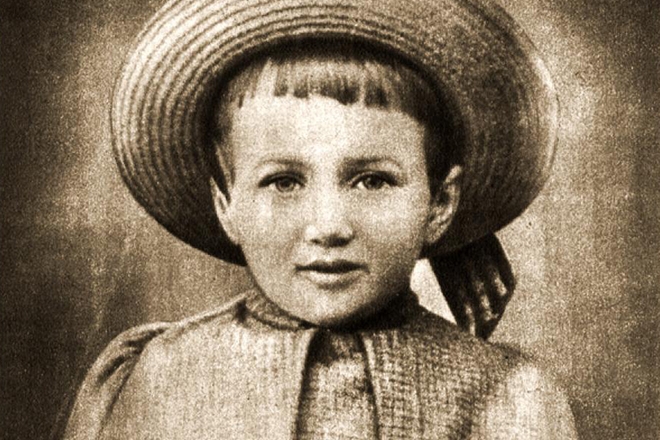
Wild Girl 1889-1905

Pushkin (Station), Saint Petersburg, Russia, 196608

Born in the same year as Charlie Chaplin, Tolstoy's "The Kreutzer Sonata," and the Eiffel Tower

Anna Andreyevna Akhmatova (June 11, 1889 – March 5, 1966) was a Russian poetess, translator, and literary scholar, one of the most significant figures in 20th-century Russian literature. She was born near Odessa (Bolshoy Fontan). The daughter of mechanical engineer Andrey Antonovich Gorenko and Inna Erazmovna, née Stogova. The girl was the third child. There were six children in total in the family. A year later, the head of the family received a position in the government body of State Control, and they moved to Tsarskoye Selo. There, little Anya touched the exciting world of the Pushkin era, admiring the splendor of architectural monuments, parks, and squares of the town, which inspired the creativity of the young literary genius. She learned to read from a school manual authored by Count Tolstoy called "Alphabet," which included riddles, fables, and short stories, and she mastered French by listening to the teacher who taught the language to her older sister and brother. She grew up as an individualist, spending summers visiting her grandfather near Sevastopol, where for her recklessness and capriciousness she was nicknamed "wild girl." As a pseudonym, Anna Andreyevna took the surname of her great-grandmother, a Tatar woman named Akhmatova. Anna wrote about herself that she was born in the same year as Charlie Chaplin, Tolstoy's "Kreutzer Sonata," and the Eiffel Tower. She witnessed the change of eras—survived two world wars, a revolution, and the siege of Leningrad. Akhmatova wrote her first poem at the age of 11—and from then until the end of her life, she never stopped writing poetry. In 1890, the family moved first to Pavlovsk and then to Tsarskoye Selo. In Tsarskoye Selo, the Gorenko family settled near the station, in the house of the merchant widow Evdokia Ivanovna Shukhardina, where they lived until 1905. This house was a hundred years old in the 1890s. It stood at the corner of Shirokaya Street and Nameless Lane. The elders said that in this house "before the cast-iron railway," that is, before 1838, there was a roadside inn or tavern. Unfortunately, this house has not survived to the present day; now a festive Station Square is located in its place. The green, damp splendor of parks, pastures where Anna was taken by her nanny, the hippodrome where small spotted horses galloped, the old station, marble statues, palaces, and much more... All this later entered into the "Tsarskoye Selo Ode"...

Along the alley, horses are led.

The long waves of combed manes.

Oh, enchanting city of mysteries,

I am sad, having fallen in love with you.

Akhmatova called Tsarskoye Selo the city of poetry, a city forever connected with Pushkin. The poetess carried her love for Pushkin throughout her life; he was a constant source of inspiration for her. In Tsarskoye Selo, Pushkin became especially close to her. This feeling is beautifully conveyed in the poem.

Sources:

https://uznayvse.ru/znamenitosti/biografiya-anna-ahmatova.html

https://antennadaily.ru/2019/06/25/peterburg-akhmatova/

http://kfinkelshteyn.narod.ru/Tzarskoye_Selo/Uch_zav/Mariinskaya_gimn_uch.htm

http://www.nashaepoha.ru/?page=obj93178&lang=1&id=2201

Follow us on social media

More stories from Anna Akhmatova’s Petersburg

Internal Immigrants 1924

Fontanka River Embankment, 2, Saint Petersburg, Russia, 191187

This is how the Silver Age was dying...

The Birth of a Decadent Poetess 1899-1905

Leontyevskaya St., 17, Saint Petersburg, Russia, 196627

I did poorly in the lower grades, then well. I always resented the gymnasium.

The Birth of the Decadent Poetess 1899-1905

Leontyevskaya St., 17, Saint Petersburg, Russia, 196627

I did poorly in the lower grades, then well. I always resented the gymnasium.

The Relationship of Two "Egotists" 1907-1916

Malaya St., 57, Saint Petersburg, Russia, 196601

Her marriage to Gumilev was considered "doomed" in her family, and, as it would turn out, not without reason.

Pharmacists and the Stray Dog 1911-1912

pl. Iskusstv, 5, Saint Petersburg, Russia, 191186

Any "wanderer," but necessarily a creative person, could come into the basement and warm up.

Tuchka 1912-1914

Tuchkov Lane, 17, Saint Petersburg, Russia, 199053

Аллея была снежной и короткой.

Pagoda 1915

Bolshaya Pushkarskaya St., 3, Saint Petersburg, Russia, 197198

Heartfelt Attachments

Revolution, the End of Youthful Illusions 1917-1918

Botkinskaya St., 17, Saint Petersburg, Russia, 194044

On the Drawbridge On a day that has now become a holiday, My youth came to an end...

Fountain House - North Wing 1919-1921

Fontanka River Embankment, 34litA, Saint Petersburg, Russia, 191014

Having left the Gumilevs, I lost my home.

Fountain House - South Wing 1924-1952

Fontanka River Embankment, 34, Liteyny, Saint Petersburg, Russia, 191014

The idyll did not happen...

Open House 1952-1961

Kavalergardskaya St., 2/48, Saint Petersburg, Russia, 191015

Students from the Oxford literature department have arrived and are demanding a meeting with me. I can't very well receive them in a communal apartment...

Fear and Losses 1921

Fontanka River Embankment, 18, Saint Petersburg, Russia, 191028

In August 1921, Blok, trapped by the new regime, died; Gumilev was executed by shooting. And Anna's older brother, Andrey Gorenko, unable to withstand the trials that befell the family after the revolution, took his own life.

The Last Refuge 1966

Ozyornaya St., 52a, Saint Petersburg, Russia, 197733

Anna Andreyevna Akhmatova died on May 5, 1966.

Booth 1955-1966

23 Osipenko St., Komarovo (Saint Petersburg), Leningrad Region, Russia, 197733

In 1955, when Akhmatova's poems began to appear in print again, Litfond provided her with a small house in Komarovo, at 3 Osipenko Lane, which she herself called the "Booth." The dacha became a center of attraction for the creative intelligentsia.

Writer's Skyscraper

191186, Griboedov Canal Embankment, 9, Saint Petersburg, Russia, 191186

The St. Petersburg Writers' "House on the Embankment"

Adamini House - The Jester's Shelter

Mars Field, 9, Saint Petersburg, Russia, 191186

The southernmost building of the block on the western border of the Field of Mars and the very first on the odd-numbered side of the Moika River Embankment. Named after its founder, merchant Antonov, the building is sometimes called the Antonov House, while its widely recognized name, the Adamini House, comes from the name of its architect, Domenico Adamini.