

The Nizwa Fort, majestically towering in the shadow of Oman’s ancient palm oases, stands as a testament to the rich history of this country, shrouded in mysteries and legends. With its high walls like impregnable towers and gloomy corridors, it rises above the world as a guardian protecting ancient secrets that have survived many centuries. The history of this fort is closely intertwined with the history of Oman, a land where ancient traditions and modern achievements blend.
Nizwa is a small city located in the northern part of Oman. This region is famous for its oases, green palm groves, and colorful flowers, making it a truly fragrant paradise corner in the harsh Arabian desert. Nizwa Fort rises amid this natural abundance, like a center of strength and wisdom.
The history of Nizwa Fort dates back to ancient times. Scholars claim that the first mentions of this fortification were found in manuscripts from the year 851 (according to other sources, in the 12th century). The earliest references appear in 9th-century documents, but archaeological finds suggest that defensive structures existed on this site long before that period. It is known for certain that in the early 16th century, the Portuguese plundered Nizwa, after which the fort was rebuilt. The current fort was constructed between 1649 and 1661 by Imam Sultan bin Saif. The building materials, as was common at the time, were stone and sarooj — fired bricks made from clay mixed with palm wood.
Nizwa Fort impresses with its architectural grandeur and refined details. It was built on a high elevation, giving it a majestic appearance and providing a strategic advantage in defense.
Inside the fort are imposing towers, halls, and intricate corridors. All of this forms a complex defense system that was once an indomitable bastion against enemy attacks. However, despite its military purpose, the fort also served as an important socio-cultural and religious center.
To the left of the fort’s entrance is the mabraz, a waiting area for arriving visitors and petitioners. From here, passing through the strong gates, visitors entered the inner part of the Imam’s house, where he received guests. To the right behind the gates is a hook on a chain where a water skin hung. Further on was a well with small pools on both sides.
Directly ahead is the majlis — the reception room for visitors, with a ceiling made from Indian teak and mangrove wood. On the walls hang traditional Omani swords and daggers of various sizes, small shields, and rifles with cartridge belts. Such German rifles, produced at the end of the 19th and beginning of the 20th century, are still used by Omanis today as an essential attribute of group male dances. After leaving the majlis to the right are large jars used for storing drinking water, date syrup, and vegetable oil. To the left of the entrance is a storage room with burlap sacks and jars where grain and date syrup were kept. Ahead to the right are utility rooms with a well and a place for ablution before prayer.
A narrow passage leads to the courtyard, from which one door leads to the Imam’s private chambers, and another room is notable for several hatches leading to underground passages, most of which were sealed later to protect against insects. The room was protected from mosquitoes by a thin muslin curtain hung over the bed. The Imam’s chambers are furnished quite modestly, in the spirit of Omani traditions. Beautiful dishes (mostly Chinese) displayed on shelves were used as decoration and only for special occasions. Items resembling wide-brimmed hats are called neti and were used to cover food from dust and flies. Opposite the entrance is a room that served as a bathroom: a well and channels for water supply. Nearby is a small toilet with real sewage, which was very progressive for that time. A cone with a brazier was used to scent clothes with incense.
Next is a passage to the kitchen, where on the left stands a large vat called marjal, and a large round mat on the wall was used for butchering meat and sorting dates. In the left corner is a small oven with a round tray for baking Omani bread called rhall. On the wall hang massive ladles called mahmas, used for roasting coffee beans. The long-spouted coffee pot dallah is a symbol of Omani hospitality. Beyond are the Imam’s private chambers, and on the other side is the reception room.
The citadel, shaped like a round tower, took 12 years to build (completed in 1660–1661). The entrance is from the majlis.
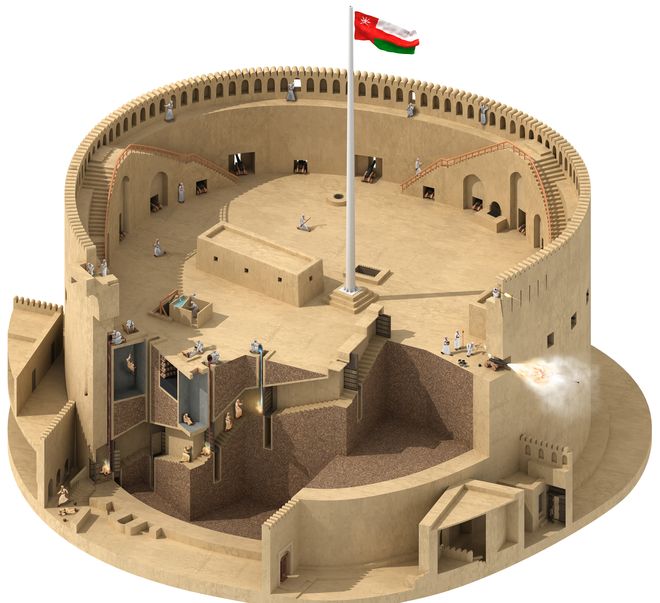
Its height is 34 meters, and its diameter is 45 meters. It serves as a platform with a flat roof built on a rubble foundation; its height is 15 meters, and from the ground about 30 meters. At the fort’s entrance is a narrow staircase. Seven doors branch off from the staircase, each with a turn. These doors have defensive openings at the top. The construction used mud, stones, and rubble. The walls of Nizwa Fort have a rounded, sturdy shape, enabling them to withstand mortar fire. The entrances to rooms are guarded by doors over 10 centimeters thick. Climbing the stairs, blocked by several doors, leads to the upper platform with a flagpole in the center. The height of the wall surrounding the platform is 10.5 meters.
Cannons are placed around the perimeter, firing through embrasures. Light mortars were made in Nizwa; one of them is engraved with the name of Imam Sultan bin Saif. One cannon was made in Boston and was among the gifts brought by the first Omani ambassador from the U.S. president. This cannon is the far right one under the northern staircase on a carriage without wheels. The 12 wells that supplied water to the citadel’s defenders are impressive. A small building on the southern side is a mosque, recognizable by its narrow mihrab resembling an embrasure.
Along the tower’s diameter, holes were made for 24 cannons. In former times, they provided full 360° coverage, so the guards of Nizwa Fort could never be caught off guard. Today, only six cannons remain from the original armament.
The interior space of Nizwa Fort consists of long terraces; sultan’s chambers with high ceilings; tangled labyrinths; secret shafts; wells; false doors and passages. Many of these structures are architectural deceptions. To reach the top of Nizwa Fort, one must overcome a narrow winding staircase hidden behind a wooden door with metal spikes. In former times, enemies who managed to pass this barrier were doused with boiling oil or water.

The former prison area of the castle, with a labyrinth of cells and rooms, has been transformed into an exhibition hall with a collection of more than twenty galleries, each representing a specific theme related to the history and heritage of Nizwa. The wells and baths have also been preserved in their original form.
For the inhabitants of Oman, religion has always been an exceptionally important aspect of life. Nizwa Fort was no exception. Its walls served not only as protection from worldly troubles but also as a sacred place where residents came to pray and perform religious rites. Various cult events and ceremonies took place here, giving the fort a special character distinct from a mere military structure.
Known as the "Guardians of the Desert," the inhabitants of Nizwa Fort were not just warriors; these guardians were considered protectors of their people and culture, steadfast sentinels of national identity. Legends of the Guardians of the Desert, blending with reality, create an atmosphere of mystery and magic around the fort. It is said they possessed unique weapon skills, making the fort nearly impregnable to enemies.
Nizwa Fort, having witnessed many historical eras, has become like a gateway through time. Within its walls are preserved ancient scrolls, manuscripts, and artifacts that tell of remarkable events and people who left their mark on this place. These gates of time are a source of invaluable knowledge about ancient cultures, lifestyles, and legends.
Legends tell that some of the Guardians of the Desert had the power to open the gates of time, allowing them to communicate with ancestors and receive inspiration from ancient sages. These mystical aspects give the fort something more than just historical significance — it becomes a place where past, present, and future merge.
These discoveries allow a deeper understanding of the daily life and customs of the fort’s inhabitants during different historical periods, expanding our perception of how this powerful structure served as a center of social life and military defense.

Today, Nizwa Fort is not only a symbol of the past but also a popular tourist destination. Its walls welcome guests, telling them about Oman’s centuries-old history. Museums located inside the fort offer fascinating exhibitions about the lives of ancient inhabitants, the splendor of architecture, and religious traditions.
Nizwa Fort is not just a stone structure but a true cultural treasure of Oman. Its history is filled with mysteries, legends, and magic, making it a unique symbol of this amazing country. The fort’s walls continue to tell their story to new generations, bearing witness to turbulent times and unwavering resilience.
Sources:
https://en.wikipedia.org/wiki/Nizwa_Fort


Written by Jermaine
Discuss this with the author and others
No comments yet. Be the first to start the conversation.