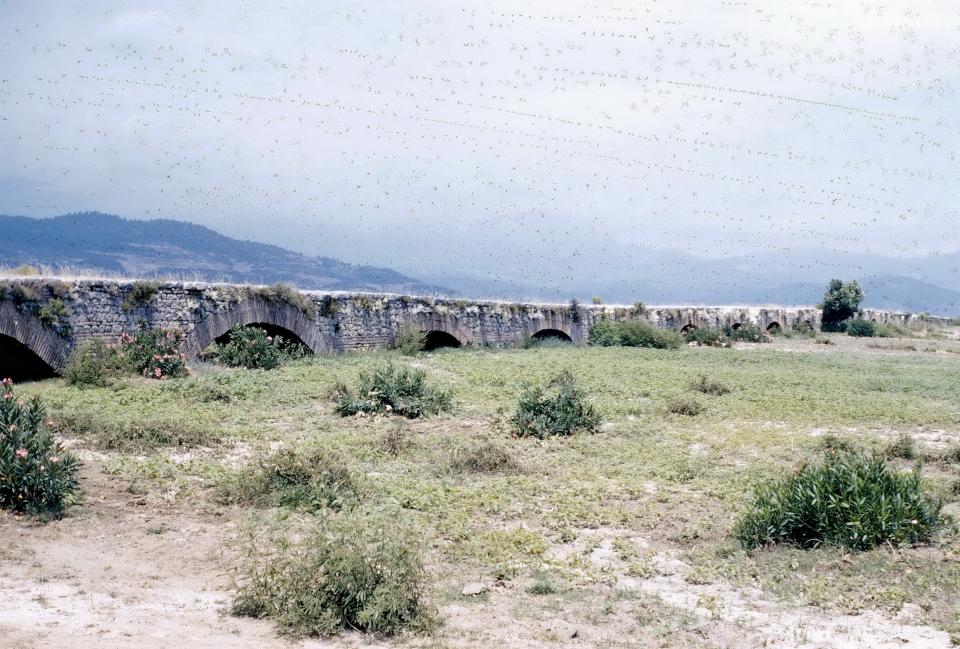
The bridge near Limira (in Turkish, Kırkgöz Kemeri, which means "bridge of forty arches")

The bridge near Limyra is a relatively unknown but unique stone bridge. It is considered one of the oldest segmental arch bridges in the world. It is located near the ancient city of Limyra and is the largest ancient structure in the region. The way the arches of the bridge were constructed gave it an unusually flat profile, which was unique for Roman engineering of that time.

Limyra was quite an important city from the 4th century BCE to the 6th century CE. It is mentioned in the works of various ancient authors, including in Strabo's "Geography":

...at 20 stadia above the sea on a high hill lie the Myra, behind them — the mouth of the Limyra river, and then, after walking 20 stadia inland, [we reach] the town of Limyra.

During the heyday of the Roman Empire in Lycia (as this region was called at the time), active construction was underway. Temples, theaters, aqueducts, as well as a bridge near Limyra, located about 3 kilometers east of the city, have survived to this day.


This bridge is a relatively unknown but unique stone bridge over the Alakir-Chay River, built near Limyra in Lycia (territory of modern Turkey) by the ancient Romans, presumably in the 3rd century. Its Turkish name is Kırkgöz Kemeri, which means "bridge of forty arches." It is among the oldest segmental arch bridges in the world, with a length of 360 meters and 28 spans.
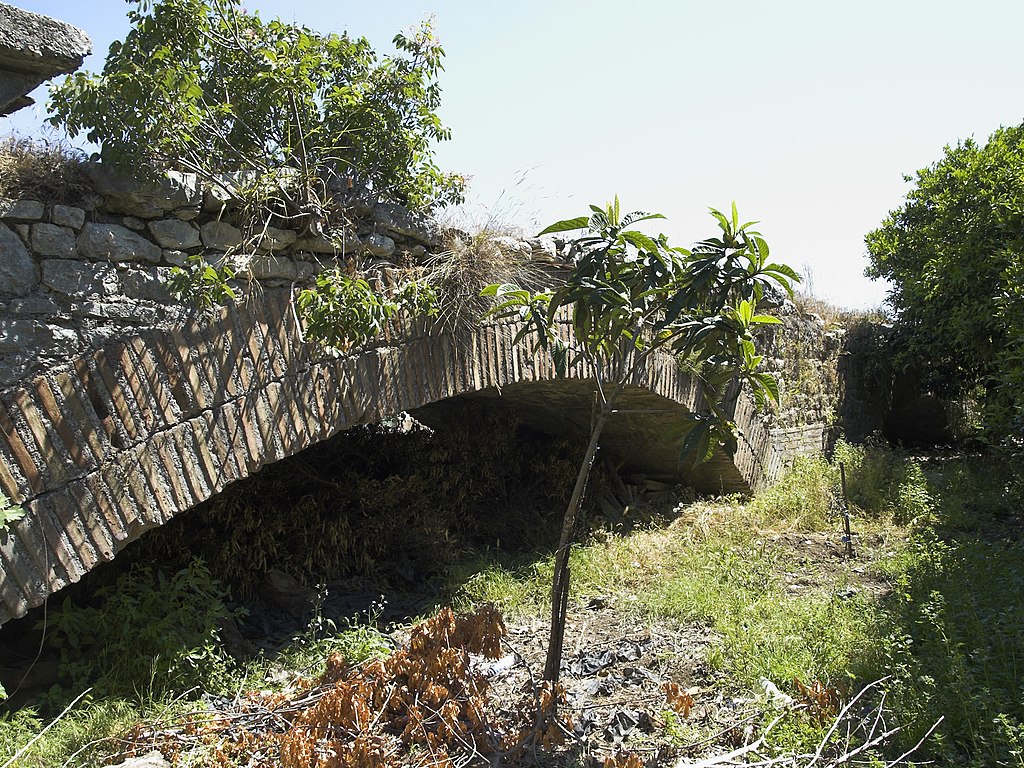

It is considered one of the oldest segmental arch bridges in the world and is the largest ancient structure in the region. The way the bridge’s arches were constructed gave it an unusually flat profile, which was unique for Roman engineering of that time. For this reason, it is difficult to date its construction period. Moreover, the bridge has been scarcely studied, and no records about it survive in ancient historical sources.

The bridge, along with its supports and a special embankment, is a significant structure over 300 meters long; for most of its length, it looks like an ordinary road because river sediments have filled the space under almost all the spans. There are 26 identical arches and one smaller arch at the western edge of the bridge. It is all the more surprising that there are no known mentions of the bridge by ancient authors: ancient geographers, historians, and architectural theorists — none of them mentioned the bridge near Limyra.

It is believed that the bridge was built in the 3rd century CE, although this dating is not universally accepted. Architecturally, the bridge shares common features with constructions of the same period located near Aspendos and Xanthos — major ancient cities. It should be noted that the bridge’s structure is heterogeneous: most of the arches are made of bricks; several arches at the western end of the bridge are mainly made of blocks, and the 27th arch, consisting of two small ones, was clearly repaired at a later time and therefore made of roughly worked stones. Interestingly, the twenty-six large arches also vary in size: their lengths range from 11.6 to 13.6 meters.


Like many other monumental Roman constructions, the bridge was built with a huge safety margin. According to modern studies, a loaded vehicle with a total mass of 30 tons can drive over it. The bridge is still used today by Turkish farmers: many greenhouses and small plots are located along the bridge.

Researchers first discovered the bridge in the mid-19th century. Since the 1970s, it has been studied by German and Turkish archaeologists. A major publication about the bridge was authored by the famous German architectural historian Wolfgang von Würster.

Nearby:

Sources:

https://justtalks.ru/articles/life/sovetyi/samye-starye-mosty-v-mire.html

https://ru.wikipedia.org/wiki/Ancient_Bridge_near_Limyra

https://turkey.obnovlenie.ru/places/limyra-bridge/11489/

https://wikimapia.org/24252521/Limyra-Roman-Bridge

Follow us on social media

More stories from World: The oldest bridges still in use

The Arkadiko Bridge or the Bridge to the Barracks

Leof. Asklipiou 27, Arkadiko 210 52, Greece

The Arkadiko Bridge (Greek name Γέφυρα του Αρκαδικού), or the Bridge to the Barracks, is one of the oldest arch bridges in the world.

Trajan's Bridge — the longest bridge of antiquity

Trajanova 23, Kostol, Serbia

The longest ancient Roman bridge, built between 103 and 105 AD according to the design of Apollodorus of Damascus, spanned the Ister (Danube) to the east of the Iron Gates. It was the first bridge in history across the second largest river in Europe.

Tarr Steps

Tarr Steps Farm, Dulverton TA22 9PY, United Kingdom

Tarr Steps — stone causeways across the River Barle in Exmoor National Park, Somerset, England. They are located in a national nature reserve 4 km southeast of Withypool and 6 km northwest of Dulverton.

Caravan Bridge (Turkish name: Kemer Köprüsü, Kervan Köprüsü)

Hilal, Gaziler St. No:173, 35170, 35170 Konak/İzmir, Turkey

An ancient bridge over the Meles River in the city of Izmir, built no later than 850 BCE in Lydia (present-day Turkey), is registered in the Guinness Book of Records as the "oldest dated bridge in the world still in use." The structure is over 2,860 years old, making it one of the oldest functioning bridges in the world.

Fabricio Bridge, also known as the Jews' Bridge or the Four Heads Bridge

Fabricius Bridge, Ponte Fabricio, 00186 Rome RM, Italy

Built in 62 BC. Also known as the "Ponte dei Quattro Capi" (Italian for Bridge of the Four Heads) — named after the two ancient two-headed herms installed at the beginning of the bridge, depicting the heads of Hercules or the two-faced Janus. In the Middle Ages, another name appeared: the "Jewish Bridge" (Latin: Pons Judaeorum), since nearby, on the left bank of the river from the 13th century, there was a Jewish ghetto.

Jendere Bridge or Septimius Severus Bridge

WJM5+77, 02402 Burmapınar/Kâhta/Adıyaman, Turkey

An ancient Roman bridge located near the ancient city of Arsameia (modern-day Kahta), 55 km northeast of the city of Adıyaman in southeastern Turkey. The bridge, situated near the road leading from Kahta to the famous Mount Nemrut, presents an exciting challenge for those who wish to learn something new and well-documented about this structure.

Pont du Gard (Roman bridge-aqueduct)

400 Rte du Pont du Gard, 30210 Vers-Pont-du-Gard, France

The Pont du Gard bridge was built shortly before the Christian era so that the Nîmes aqueduct (almost 50 km long) could cross the Gard River. The Roman architects and hydraulic engineers who designed this bridge, which is nearly 50 meters high and has three levels (the longest of which is 275 meters), created a technical and artistic masterpiece.

Alcántara Bridge (Puente de Alcántara)

Roman Temple, 10980 Alcántara, Cáceres, Spain

Ancient Roman bridge over the Tagus River in the Spanish city of Alcántara, near the Portuguese border. The tallest of the Roman bridges (72 meters)

Pergamum Bridge

The main function of the crossing, which was 196 meters wide, was to divide the river and direct its water into two channels running beneath the temple. The bridge has survived to this day. It serves not only as a support for a number of modern buildings but also as a transportation interchange.

Römerbrücke, Roman or Old Moselle Bridge

Roman Bridge, Römerbrücke, 54290 Trier, Germany

An ancient Roman bridge over the Moselle River in the city of Trier, Germany. Built between 144 and 152 AD, much of the original Römerbrücke structure has survived to this day, although some parts—particularly the roadway and its arches—date back to the 18th century. The Römerbrücke bridge is still in use and is considered the oldest bridge in Germany. Constructed by the Roman general Agrippa, it was made from large basalt blocks from the German Eifel mountains, held together with iron clamps, just like the remarkable Roman city gates of Trier, the Porta Nigra.

Dezful Bridge or Roman Bridge, the oldest surviving brick bridge

Dezful, دزفول, Old Bridge, 99JR+Q49, Iran

The historic Dezful Bridge has stood for over 17 centuries and is known as the oldest surviving brick bridge in the world. It is also known as the "Roman Bridge," built during the reign of the first Sasanian, Shapur.

Julien Bridge (Julius Bridge), in French Pont Julien

Pont Julien, Les Lavandins, Rte du Pont Julien, 84480 Bonnieux, France

A Roman stone arch bridge over the Calavon River in southeastern France, dating back to 3 BCE. It was originally built on the Via Domitia, an important Roman road that connected Italy with Roman territories in France. It was used for vehicular traffic until 2005, when a new bridge was constructed to protect it from wear. It is still used as a bicycle and pedestrian path. This amounts to approximately 2,000 years of continuous use.

Tiberius Bridge (Ponte di Tiberio), Augustus Bridge (Ponte d'Augusto), or Saint Julian Bridge (Ponte di San Giuliano)

Ponte di Tiberio, Ponte di Tiberio, 47921 Rimini RN, Italy

The Tiberius Bridge (Italian: Ponte di Tiberio), historically also called the Bridge of Augustus (Ponte d'Augusto) or the Bridge of Saint Julian (Ponte di San Giuliano), is a Roman bridge in Rimini, in the Emilia-Romagna region of northern Italy.

Milvian or Mulvian Bridge (Ponte Milvio or Ponte Molle)

Ponte Milvio Bridge, Ponte Milvio, 00135 Rome RM, Italy

The bridge over the Tiber in the northern part of Rome was economically and strategically important during the Roman Empire era. It was the site of the famous Battle of the Milvian Bridge in 312 AD, which led to Constantine's imperial rule.

The Bridge of Saint Angel (Ponte Sant’Angelo) or the Bridge of Hadrian

Eliev Bridge, Ponte Sant'Angelo, 00186 Rome RM, Italy

The bridge over the Tiber in Rome, built between 134 and 139 AD by the Roman Emperor Hadrian. The bridge connected the city center with Hadrian's Mausoleum (later the Castel Sant'Angelo). Since the bridge led to Hadrian's Mausoleum, the Romans called it the "Hadrian Bridge" or the "Aelian Bridge" (Latin: Pons Aelius), after the shortened form of the emperor's full name (Publius Aelius Hadrianus).

Flavian Bridge (Pont Flavien)

70 Av. Maurice Berle, 13250 Saint-Chamas, France

Roman bridge over the Touloubre River in Saint-Chamas, Bouches-du-Rhône department, in southern France. The single-arch bridge was located on the Roman road Via Julia Augusta — between Placentia, Italy, and Arles. It is the only surviving example of a Roman bridge with triumphal arches from the Augustan period, although similar bridges likely existed elsewhere, as evidenced by depictions on coins from the late 1st century BCE.

Pont sur la Laye or the Roman Bridge of Manosque (Pont sur la Laye)

Chemin de Chateauneuf, 04300 Mane, France

An ancient stone arch bridge over the Ley River in French Provence near the town of Man.

Khoda Afarin Bridges: From Ancient Times to the Present Day

5W2Q+3J Khoda Afarin, Iran

The most famous examples of bridges in the Transcaucasus are the ancient Khudafarin Bridges. The well-known Arab traveler and geographer Yaqut al-Hamawi, who visited these places in the 1210s and 1220s, called the Aras "a remarkable river."

Kapellbrücke (Chapel Bridge)

Rathausquai 6, 6004 Lucerne, Switzerland

Kapellbrücke (literally, Chapel Bridge) is a covered wooden pedestrian bridge that crosses the Reuss River diagonally in the city of Lucerne in central Switzerland. Named after the nearby St. Peter's Chapel, the bridge is unique in that it contains a series of internal paintings dating back to the 17th century, although many of them were destroyed along with much of the centuries-old bridge in a fire in 1993. Subsequently restored, Kapellbrücke is the oldest wooden covered bridge in Europe, as well as the oldest surviving truss bridge in the world. It serves as a symbol of the city and one of Switzerland’s main tourist attractions.