

One of the most visited places in Valladolid is undoubtedly the Church of San Servacio with its magnificent towers. It houses the weapons that helped reclaim the city in 1848 from the hands of the rebellious indigenous people who started the Caste War. The residents proudly preserve it as a reminder of their glorious past.
It is located in the center of Valladolid, on the southern side of the main square. It stands on the site of the original church built on March 24, 1545, by Father Francisco Hernández. The main facade of the old church faced west, as was common for most colonial-era temples in Yucatán, and the entrance was on 42nd Street. Evidence of this includes sculptures depicting Saints Peter and Paul, which are now visible on the sides; originally, they guarded the entrance to the church. In 1705, the original church was partially destroyed by order of Bishop Don Pedro de los Reyes Ríos due to its desecration during the so-called “Mayors' Crime.”
“Mayors' Crime” refers to the murder of General Captain Fernando Hipólito Osorno and his friend Gabriel Covarrubias on July 5, 1703, by the first and second mayors Ayuso and Tovar. Osorno and Covarrubias were accused of political offenses and imprisoned. They escaped and sought refuge in the church. Ayuso and Tovar organized a group of supporters, stormed the church, and forcibly removed Osorno and Covarrubias, killing Osorno right inside the church and wounding Covarrubias. Covarrubias later died in his cell. Both were then hanged from the window of their prison cell. In response to this brutality, the viceroy ordered the removal of the governor and sentenced Ayuso and Tovar to death.
In 1706, construction began on the church we see today, and to face the main square, it was given a new orientation, so the facade of this church faces north rather than west.
Over the next century and a half, a series of small uprisings occurred, eventually leading to the Caste War from 1847 to 1901. Near the start of the war, the city and church were captured by rebels. In 1848, Colonel Méndez recaptured them.
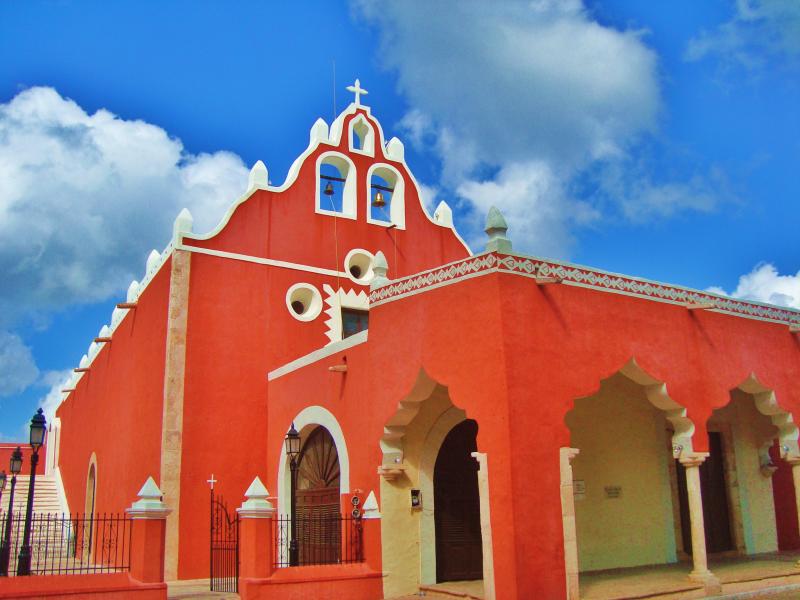
The main facade features a stone-carved shield with arabesques, a royal crown, and in the center—a white sparrowhawk and a palm tree. Flanking the main body of the building rise two square towers, each consisting of three sections; above the main facade are 19th-century clocks, the only public clocks in the city, preserved over the years thanks to the care of a local family of clockmakers. Above the church rise two towers—bell towers—each topped with a stone cross, one on each tower. The building’s interior consists of a nave, a front sacristy, and a sacristy room, while outside there is an atrium and an annex, covering an area of 6,658 square meters.

Inside is the main altar with four additional altars and sculptures in niches; there is also a preserved Churrigueresque-style altar, as well as several crypts, some just over 100 years old.
Sources:
https://www.hmdb.org/m.asp?m=101308
https://en-yucatan.com.mx/valladolid/iglesia-de-san-servacio/



Written by Jermaine
Discuss this with the author and others
No comments yet. Be the first to start the conversation.