

Located in the Sisal area, the former monastery of San Bernardino de Siena (Saint Bernardine of Siena), also known as the Sisal monastery, after the monastery of Saint Anthony of Padua (Convento de San Antonio de Padua) (https://reveal.world/story/monastyr-cvyatogo-antoniya-paduanskogo-convento-de-san-antonio-de-padua) is the second largest Franciscan structure in Yucatán.
Construction began in 1552 under the guidance of the monk Hernando de Guevara, Francisco de la Torre, and the monk Juan de Mérida. The church was formerly called San Francisco because the Franciscan Order built and founded the monastery. The word Sisal is an abbreviation of the Maya ziiiz-ha, which translates from Spanish as "cold water." The architectural complex consists of a church, chapel, former monastery, atrium, and fruit garden. It covers an area of 14,121 square meters. On the entrance door, you can see the coat of arms of the Franciscan order, and below it - "MDLX," which means 1560 and corresponds to the date when this temple was built and consecrated; services began there.
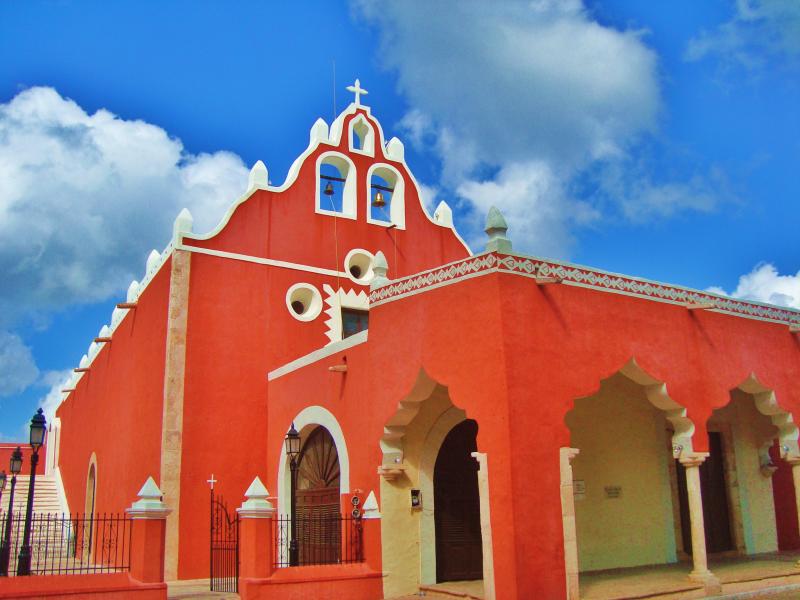
The facade features a long arched corridor with walls more than half a meter thick and an entrance made of hewn stone. In the upper niche above the canopy is an image of the Virgin of Guadalupe.
Outside, the facade stands out, crowned with battlements topping the walls, and a long arched opening reminiscent of medieval fortresses. Inside the church grounds, a beautiful, intricately carved wooden Baroque-style altar with arabesques remains preserved, impressive in its size and fine details.

Photographed By J. Makali Bruton, January 16, 2017
Next is the main altar; on the right side is a small statue of Saint Teresa of Jesus. On the left is the Virgin of Sorrows in a wooden painting, below which is a carved depiction of the Annunciation, God the Father, and the Virgin Mary. In 1978, during restoration work on some altars, Father Andrés Lizama Ruiz discovered several paintings on the reverse side of the altar images, whose authors and reasons for remaining hidden are unknown, but they are believed to date back to the 16th century.
In 1613, the construction of an impressive hydraulic structure was completed near the largest cenote. The Sisal water wheel is the second largest in Yucatán after La de Mama. This example of hydraulic engineering is striking, with a diameter of 14 meters and very sturdy buttresses.

The history of the Sisal monastery as such ends on February 12, 1755, when Presbyter José Prudencio Domínguez, by order of Bishop Ignacio de Padilla y Estrada, handed over the monastery and its estates to state administration (secularization was carried out), and the Franciscan order left the monastery.
After its secularization, the monastery ceased to develop, and in the post-independence era, decline began, which was exacerbated by the Caste War. During the Caste War, the monastery apparently enjoyed respect, despite the parish church being looted and the bells buried in front of the chapel of San Roque. The decline of Valladolid after the brutal phase of the Caste War (1847–1852) also affected the monastery.
Today, the monastery building houses a museum dedicated to the Caste War.
Sources:
https://www.travelbymexico.com/valladolid/atractivos/?nom=a1365389624
https://www.hmdb.org/m.asp?m=101707



Written by Jermaine
Discuss this with the author and others
No comments yet. Be the first to start the conversation.