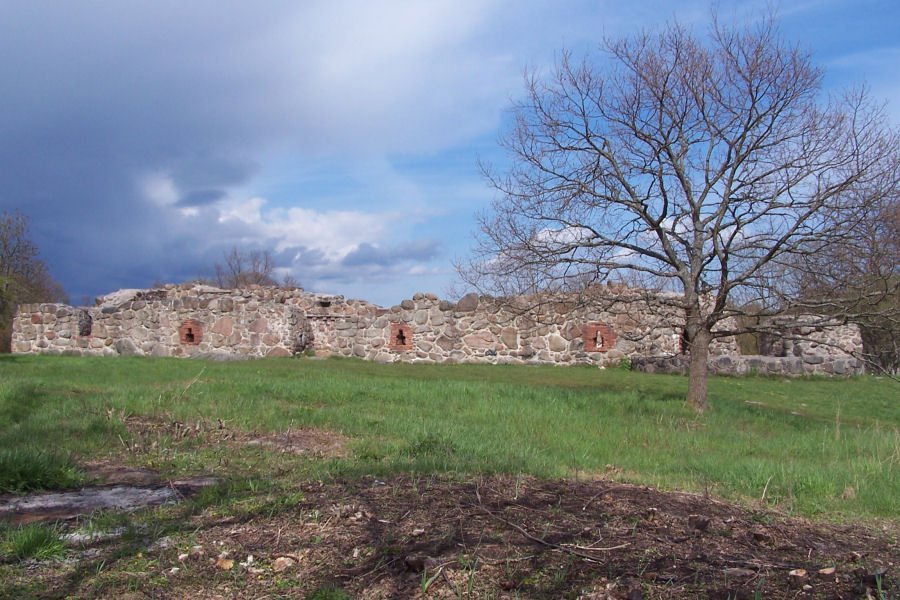

Lyckå was a medieval settlement site in Lösens parish, now in Karlskrona commune, Blekinge, strategically located at Lyckebyån’s outlet. It was first mentioned in 1449, when Claus Nielsen Sparre, fogde for Danish Ivar Axelsson Tott, built a fortified house and a small settlement at Lyckå. Claus Nielsen Sparre served as the lord of the manor over Lyckå lens, which encompassed all of Östra Blekinge. A stone fortress, Lyckå castle, was built 600 meters from the town Lyckå in the 1550s.
Lyckå was vulnerable to Sweden-Denmark wars and was plundered in 1507 by the Swedish riksråd Åke Hansson Natt och Dag. It lost its city privileges in 1600 due to the Danish state’s efforts to move the population and focus on the new city of Kristianopel. The Danish king Christian IV ordered the castle to be demolished in 1600 and the stones to be reused in Kristianopel’s fortifications. After the peace Treaty of Roskilde in 1658, Lyckå became part of Sweden.
Presently, the site of the medieval Lyckå is Lyckeby, a former urban area that is now connected to Karlskrona. The fortified castle is now a ruin, and the wide gray stone walls can still be seen. Archeological excavations were conducted in the early 1970s in the area of Lyckeby, where finely paved streets and remains of houses with timber-frame construction were found. The word fläck, which comes from the medieval dialect Plattyska, means trading town.
Lyckå was a small trading town from the second half of the 1400s to the year 1600. Lyck å means lock or latch, indicating that the inflow at one point was restricted.
Sources: Wikipedia, OpenStreetMap, Wikidata, Wikimedia Commons
Written by Nik Frost
Discuss this with the author and others
No comments yet. Be the first to start the conversation.