


Ivan the Terrible, having captured Dinaburg Castle in 1577, ordered the knightly castle to be demolished to the ground and to begin constructing the ramparts of a new fortress at the confluence of the Shunitsa River into the Daugava, 19 km downstream. The new fortress was planned to be built on a hill, taking advantage of the favorable location: it was protected by swamps from the east and west, and reliably covered by the river and a lake from the south and north. Thus, natural water barriers were used in the construction of the fortress.
The new fortress was intended to cover the western borders of the Russian state, as well as the roads leading to Polotsk and Pskov. It represented a completely new fortification and was designed for defensive battles under conditions of widespread artillery use. From the side of the Daugava embankment, the fortress was enclosed by an earthen rampart 170 meters long, and on the other sides — about 100 meters. On three sides, the fortifications were additionally reinforced by six small earthen bastions. Subsequently, the present-day Daugavpils grew near these fortifications.
To this day, there is no clear answer as to who founded the new Dinaburg fortress. Some historians attributed the foundation of the new Dinaburg to the Polish king Stephen Báthory. They referred to known facts that, according to the peace treaty signed on January 15, 1582, in the village of Kivorova Gora near Pskov, Russia was forced to renounce lands belonging to the Livonian Order. However, there is reliable information that during the construction of the fortress near the Jesuit church in 1819, a copper plate with a Russian inscription was found, stating that "... this fortification was laid by Tsar Ivan IV."
In 1578, Dinaburg again fell into Polish hands as a result of the betrayal of the fortress commandant, Colonel Plater, a descendant of one of those German knights who settled in the Baltics on lands received as benefices. After intoxicating the Russian detachment, he let in Polish soldiers at night under the command of Hetman Chodkiewicz, who slaughtered the entire garrison and seized the fortress. This was yet another example of how betrayal and loss of vigilance led to tragic consequences.
Having taken Dinaburg into his hands, Polish King Stephen Báthory decided to continue the construction of the fortress. The fortress had the shape of an irregular trapezoid. On the southern side, it was covered by the river; the other sides were protected by moats dug along the outer edge of the earthen rampart, which stretched along the Daugava for 340 meters, about 140 meters on the western side, and on the other two sides in a broken line for more than 500 meters. Earthen bastions were built at the corners of the rampart. Water entered the moats through a special canal from the Shunitsa River. This is evidenced by the terrain relief with clearly distinguishable elements of former fortifications in the area of the railway bridge over the Daugava.
The fortress was small in size. But it was built so solidly that it became a center of attraction for many residents frightened by constant military actions. The city adjoined the fortress. It was surrounded by a rampart, the individual sections of which were connected stepwise, facilitating enfilading fire along the rampart. Between the citadel and the city, a deep moat was additionally dug.
Upon completion of construction, Stephen Báthory granted Dinaburg city rights (Magdeburg rights), making it the center of one of the four districts of the Zadvin province of the Polish-Lithuanian Commonwealth.
Agriculture was developed in the city. Townspeople had land for which they paid rent. Some city residents, in exchange for using land plots, were obliged to repair the fortress and tend the garrison garden. To increase revenues, the Polish government sought to increase the city's population. For this reason, people of any nationality were allowed to settle, being allocated houses and gardens. Nevertheless, during Polish rule, Latgale lost its economic significance. There was a deep decline in economic activity, famine, and complete impoverishment. According to contemporaries, "... in 1602, a famine raged so severely throughout the region that there were several cases of cannibalism in the Dinaburg district."
In 1617, a war broke out between Sweden and Poland. After capturing Riga, Swedish troops under Gustav II Adolf advanced inland. In 1625, Gustav II Adolf took Dinaburg, but a year later, troops of Smolensk voivode Alexey Gonsevsky defeated the Swedes outside the fortress and returned Dinaburg to the Poles.
Gradually developing, the new Dinaburg began to compete with Riga in trade along the Dvina, especially after the Swedes captured Riga and Polish King Władysław IV in 1647 turned Dinaburg into a storage place for grain and goods floated down the Daugava. This caused rapid growth in trade and crafts.
Under Tsar Alexei Mikhailovich (Peter I's father), the question of returning Belarusian and Ukrainian lands to Russia and gaining access to the Baltic Sea arose again. In 1654, Ukraine reunited with Russia, significantly strengthening the Russian state. In the same year, Poland lost Smolensk, Mogilev, Vitebsk, and Polotsk. Military actions shifted to the Baltics.
In October 1654, Russian troops under Vasily Sheremetev occupied Latgale, and in 1655 took the Lithuanian capital Vilnius and the powerful fortress Kaunas. The local population welcomed the Russian troops joyfully. For example, one Polish report of that time stated: "The peasants are very hostile to us, everywhere surrendering in the name of the Tsar and causing more harm than Moscow itself."
To prevent the Russians from advancing to the sea and simultaneously use Russian victories to capture as many cities of the weakening Poland as possible, Swedish King Charles X Gustav concluded a treaty with Tsar Alexei Mikhailovich for joint struggle against Poland. Based on this treaty, in June 1655, Swedish troops under Field Marshal Count Lewenhaupt besieged Dinaburg, and after nine days of bombardment, the Polish garrison surrendered. However, the Swedes held the fortress relatively long, hindering the Russian advance, which contradicted the treaty and caused the breakdown of the agreement between Sweden and Russia. On March 17, 1656, Russia declared war on Sweden. On July 30, Tsar Alexei Mikhailovich with an army consisting of noble cavalry, streltsy regiments, Tatars, Chuvash, and Mordvins, after three bloody assaults, expelled the Swedes from the fortress. Eyewitness accounts of those events remain: "3,400 Russian warriors assaulted Dinaburg. They started two hours before dawn and finished half an hour before dawn." The 1656 military records stated: "On July 30... the Tsar's warriors took the city of Dinoborg, burned the yards and churches, whipped the Germans (meaning Swedes, as Russians at that time called Swedes, Danes, Dutch, etc., Germans), and captured the garrison and all artillery supplies."
On October 16, 1657, the Tsar rewarded the commanders distinguished in the capture of Dinaburg: stolnik Ivan Miloslavsky, head of Moscow streltsy Semyon Poltev, and many warriors. Since Dinaburg was liberated on the day of Saints Boris and Gleb, to commemorate the victory, an Orthodox church was built, and the city was renamed from Dinaburg to Borisoglebov (or Borisoglebsk, as it was often called).
Frequent wars hindered the city's successful development. But being under Russian rule for about 11 years and having a favorable location relative to trade routes, it quickly recovered from destruction and became an important trading point. Local peasants were friendly to the Russian authorities, as their welfare significantly improved during the Russian troops' stay in Latgale. Latgale was governed by a special Livonian Order in Moscow. The region's governor was the Russian military and political figure Boyar Ordin-Nashchokin. As a Pskov nobleman, he knew the economic potential of the area well and promoted the growth of Latgalian cities (especially Borisoglebov) and the development of their trade. To this end, he created a trading fleet on the Daugava. The Russian authorities took several measures to quickly settle the city and increase its population. This was especially relevant since many former residents left Dinaburg at the onset of military actions.
Further development of Borisoglebov (Dinaburg) and the construction of its fortifications are evidenced by a plan of the fortress and city that has come down to us. This is the only known graphic document depicting the layout of the new Dinaburg since its foundation. Based on this plan, it is easy to trace the evolution of the Dinaburg fortress.
Having lost Latgale, Polish rulers did not renounce their claims to the lost lands. But devastation and famine due to prolonged military actions prompted Poland to begin peace negotiations with Russia, which lasted several years. Finally, on January 30, 1667, a truce was concluded in the village of Andrusovo (near Smolensk). It was a major foreign policy achievement for both states and marked a turn from centuries of enmity and endless wars to peace and alliance. According to the Andrusovo truce, Poland ceased to claim Ukraine and Smolensk. In return, it received several cities of Latgale, including Borisoglebov. Having received the fortress, the Poles restored it to a defensive state and again called it Dinaburg.
In 1677, Dinaburg was declared the main city of the Inflanty principality. However, overall, Polish rule hindered the development of trade and crafts in Latgale. It lagged in economic development. Although Dinaburg housed the administrative bodies of Latgale, it remained a small town with a population of just over a thousand.
With Peter I's accession to the throne, Russia resumed the struggle for access to the sea. During the Great Northern War (1700–1721), Dinaburg repeatedly changed hands. Expelling the Polish garrison from the fortress, the Swedes sought to turn it into an advanced defense point for occupied Riga. Russian troops, campaigning in the Baltics, expelled the Swedes from the city and handed it back to the Poles.
Stopping in Dinaburg in 1701, and later passing by the city in 1705 during the defeat of Lewenhaupt near Birzai, Peter I realized that although Dinaburg was a dilapidated fortress, it could still hinder Russian troops from reaching Riga. Therefore, during the 1710 campaign on Riga by Field Marshal Sheremetev's troops, he ordered to take Dinaburg again, completely disarm it, and transport the cannons to Vilnius. But fate was even harsher to Dinaburg. That same year, almost the entire garrison died from a plague raging throughout the region. The citadel was disarmed. From that time, the fortress and city fell into decline.
After the death of Polish King Augustus III, Catherine II managed to place Stanisław Poniatowski on the Polish throne and then, in 1772, carried out the first partition of Poland, according to which Dinaburg passed to the Russian Empire, becoming a district town of the Dvina province of the Pskov governorate. In 1796, the city became part of the Polotsk viceroyalty of the Belarusian governorate, and in 1802 was assigned as a district town of the Vitebsk governorate, where it remained until December 14, 1917, when by decision of the Soviet government, Latgale was joined to Vidzeme.
At that time, the city was mainly located between the former citadel and the Jesuit church. Near the church were the Dinaburg treasury and several other administrative institutions. The citadel had already collapsed and represented a ridge of hills. Among them were various shops. Only part of the moat that once surrounded the citadel remained, through which the greatly shallowed Shunitsa River flowed.
On July 19, 1772, the greatest decree was issued on the construction of six fortresses on the annexed lands, including in Dinaburg. However, peace on the western borders postponed the implementation of these plans until 1810. The city gradually developed, but the fortress deteriorated and fell apart. On March 1, 1828, a decree was issued transferring local state estates with 13,000 peasants to the military ministry, which organized militarized settlements (Arakcheev-type) in the Dinaburg district, whose residents were later used for the construction of the new fortress.

From 1721 to 1812, the relatively peaceful military situation in Dinaburg was disturbed only once in 1795. During the Kościuszko Uprising, a Polish confederate detachment under General Count Ogiński (author of the popular Polonaise) unexpectedly attacked Dinaburg and held it for some time. Upon retreat, the confederates set fire to the city. The city archive was destroyed in the fire. For six preceding centuries, Dinaburg had been a military fortified point due to its important strategic position at the junction of three states' borders and crossroads of important trade routes.
Between 1772 and 1810, numerous commissions dealing with the strengthening of Russia's western borders repeatedly shifted the line of planned fortresses but consistently recognized the necessity of having a fortified point in the Dinaburg area. Subsequent events confirmed the correctness of this decision.
At the beginning of the 19th century, as the French armies triumphantly marched across Europe, the Russian ambassador in Paris, Prince Kurakin, reported to St. Petersburg: "There can now be no doubt that Napoleon has finally decided on this war; he only delays its beginning."
Russia began hastily preparing for defense. In March 1810, War Minister Mikhail Bogdanovich Barclay de Tolly presented to Alexander I a note "On the defense of Russia's western borders," indicating the need to build a defensive line along the Western Dvina (Daugava): "At Dinaburg or Druya, having chosen a good location, a fortress should be built to guard communication with the army's center and serve as reinforcement for one of the army's parts, but Dinaburg seems more convenient for this purpose because there are still remains of fortifications there that could greatly facilitate and speed up the work."
Soon, the imperial government decided to strengthen Russia's western border by building new fortresses to protect the road to St. Petersburg and Moscow. On March 14, 1810, by order of the War Minister, a special commission led by Engineer Colonel E. F. Hekel surveyed the Dvina River.
After inspecting the area, Hekel reported to the minister on May 2 that the most suitable place for building the new fortress was Dinaburg. The response came two weeks later: "His Majesty the Emperor has graciously approved your proposal to build a fortress at Dinaburg." Preparatory work—leveling and surveying the terrain—began in May, even before approving estimates and plans.
With the start of fortress construction, city settlements were relocated to the area now called the Old Suburb. Parts of the city that could not be moved were bought out by the state treasury. A special commission was created to assess the expropriation of citizens' property on land and buildings amounting to 50,061 rubles. The Jesuit college demanded 300,000 rubles in gold for lands and monastery buildings. By April 1811, all lands for the fortress were purchased. Colonel Hekel sought to quickly gain control of both banks of the Daugava. Having received trenching tools from Moscow, he immediately began building a bridge cover. This quickly broke the reluctance of local wealthy landowners to sell land for the fortress. The left bank belonged to the Courland Governorate and was owned by Chamberlain Keizerling. The right bank, rich in construction timber, belonged to Count Sieberg.
Military units were mainly used as labor for the fortress construction. This is evidenced by Barclay de Tolly's correspondence. On May 17, 1810, he wrote to Major General Schwanebach that two sapper companies stationed in Dinaburg "were placed under the command of Engineer Colonel Hekel, who will employ them for fortress works." A few days later, an order was issued to Lieutenant General Baggovut stating that by the emperor's command, "troops of the 4th division and reserve battalions are to be used for fortress works in Dinaburg," and battalions of soldiers from Volyn, Tobolsk, Kremenchug, Vilnius, Minsk, as well as battalions of the 4th Jäger Regiment, were sent there. The Mitava Mountain Battalion was ordered: "Hasten to Dinaburg for fortress works... This battalion will eventually be renamed Dinaburg Battalion, where it will remain forever."
To command the troops gathered in Dinaburg and properly organize construction work, in June 1810, Major General of Artillery Prince Yashvil was appointed (chief of artillery of the 1st Corps of the 1st Western Army).
Significant forces were allocated for the construction of new fortifications. The Military Collegium's order to the engineering expedition stated: "By highest order, up to 10,000 troops and 300 artillery horses are now being gathered for fortress works at Dinaburg, where they will camp until winter." Additionally, two thousand peasants from the Vitebsk Governorate, as well as free craftsmen and workers, were involved. A hospital for 300 beds was opened in Ilūkste under the supervision of the well-known physician Dombrovsky.
The construction was impressive for its time. By June 1810, 10,000 soldiers had already begun work. They were stationed in camps on both banks of the river. Work was organized in two shifts. The initial construction estimate was 546,643 rubles 90 kopecks, of which 472,906 rubles 80 kopecks were allocated for the main part, and 73,737 rubles 10 kopecks for the bridgehead fortification on the left bank of the Daugava. The fortress was planned to be completed in 3 years. In 1810, 160,000 rubles were to be spent, and in the next two years, 193,321 rubles 95 kopecks each.
On August 8, 1810, the general construction plan was approved, but a detailed internal layout project was still to be made. On March 9, Engineer Colonel Hekel sent the War Minister an estimate for the construction of the Dinaburg fortress, detailing the required funds for materials, soldier rewards, free craftsmen, and workers. The estimate included building houses for 8 infantry companies and 2 artillery companies, officers' houses, kitchens, storerooms, four two-story stone officers' quarters for 80 senior officers, two temporary powder magazines, premises for the engineering team, and other buildings. The fortress construction was then estimated at 791,552 rubles, including 29,000 rubles for building a floating bridge over the Daugava for unobstructed communication with the left bank fortifications.
The fortress was planned to house a garrison of 4,500 to 7,000 people and to install 595 fortress guns, of which 480 in the fortress itself and 115 in the bridgehead fortification.
Additionally, 500 fortress rifles (heavy long-range rifled guns) were planned for shooting at enemy scouts, and 200 light cavalrymen for communication and illumination at night.
Construction proceeded rapidly. Lime and brick factories were built to supply materials, manned by soldiers. Stones and bricks from the old Dinaburg castle were also used, which peasants sold to the contractor supplying materials for the fortress.
However, Hekel was dissatisfied with the construction pace. He feared the approaching winter, which could create additional difficulties. "Dinaburg was a small Jewish town where no more than a battalion of soldiers could be accommodated," and "work was allowed only down to -14° Réaumur," significantly shortening the construction season.
Moreover, disagreements arose among construction leaders, apparently causing Hekel to report to Barclay de Tolly: "The bridge cover at Dinaburg fortress could have been completed this year if troops worked daily and only rested on Sundays, but the commander of the troops here does not order them to work on holidays, causing many days to be lost and the best time to be missed."
Nevertheless, despite concerns, the planned volume of work for 1810 was fully completed, as evidenced by Colonel Hekel being awarded the Order of St. Anna 2nd class with diamonds.
By the end of 1810, most of the earthen rampart of the bridgehead fortification was built, and in the main fortress, hills were leveled and drainage works carried out. Various difficulties arose during construction. All purchases of small necessary goods had to be made in Riga, Polotsk, and Vitebsk. A shortage of copper coins was also discovered. In Vitebsk and neighboring governorates, these coins were so rare that exchanging them cost up to 50 kopecks per 5 rubles in assignations.
For the winter of 1810-1811, the Tobolsk Musketeer Regiment, 4 pioneer (engineering, sapper) companies, and 400 artillery horses with wagons and forage carts were left for construction work.
In spring 1811, construction accelerated. Up to 15,000 people worked daily. To improve soldiers' rations, "wine portions" were introduced as rewards, with daily payments of 10 kopecks, increasing to 20 kopecks from September 15. These were considerable sums at the time.
Due to early cold weather, the construction season ended on October 26. The situation was complicated by ongoing misunderstandings between construction and military leaders. Fortress commandant Prince Lvov wrote in 1913 that the prolonged construction was explained by many reasons: the short winter (December 1810 to March 2, 1811) and the shallowness of the Dvina, which prevented the preparation and delivery of materials by sled and river; the indifferent attitude of troop commanders who allegedly took no measures to ensure their troops fulfilled tasks; disagreements between the fortress commandant and builder (Hekel). However, Lvov believed the main fault lay with Colonel Hekel himself. For example, it was unclear why Hekel deviated from the approved rampart profiles, increasing them by 6 feet; why he increased the number of artillery embrasures; built a brick factory 18 versts from the fortress when good clay was nearby; and chose a swampy site for the fortress, which diverted much time and money to flood protection.
Similar difficulties were avoided during the construction of a similar fortress in Bobruisk on the Moscow direction.
By spring 1812, bridge fortifications of zero profile were built on the left bank of the river. They consisted of two bastions and two half-bastions, with 16 guns installed. As for the main fortress, according to the general plan, as Hekel reported on March 12, 1812, "less than half of the extensive works needed for completion have been done, and therefore, despite all efforts, it is not expected to bring it to a defensive state this year."
However, despite the bridge fortification being purely earthen and the main fortress only having foundations of the main rampart in some places, on July 14, 1811, the fortress was declared a first-class fortress.
Since it became clear that the Dinaburg fortress would not be completed by the start of the war with Napoleon, a decision was made to strengthen the bridge fortification on the river side by building an additional rampart.
Russia was preparing for war with the French. A large stockpile of food and military supplies was being gathered in Dinaburg to supply the 1st Western Army. In May 1812, the French concentrated a 600,000-strong army on the Vistula.
Given the threatening situation, the War Minister presented the Tsar with a special report proposing to approve the duties of commandants of newly built fortresses. Signed "So be it. Alexander I," the duties were approved as follows: "1. Responsible for defense with life and honor; 2. Know all residents inside and around the fortress, their status, behavior, and mindset; 3. Obtain full information about all incidents, both obvious and secret and intentional; 4. All fortresses on the western borders must be in a military state. Commandants manage civil police. During a blockade, commandants are authorized with autocratic powers."
This document aimed to increase the responsibility of western fortress garrisons and centralize all local forces under a single authority. Overall, it correctly anticipated the commandants' actions in case of a siege.
On the night of June 12 (24), 1812, Napoleon's army invaded Russia. The retreat of the 1st Western Army to the Drissa fortified area opened the approach to the unprepared Dinaburg.
On July 2, Major General of Artillery Prince Yashvil reported from Dinaburg to the War Minister: "The enemy has besieged the Dinaburg bridge fortification with a large number of troops and artillery at almost cannon-shot distance... as for the main fortress, it practically did not exist." The enemy's first attempt to capture Dinaburg fortress and threaten St. Petersburg was thwarted. The enemy offensive changed direction.
During the assault on the bridge fortification, an incident occurred, which fortress commandant I. P. Lvov mentioned in 1915. When the main fortress builder (then already Major General) Hekel was in the bridge fortification, the highest-approved secret plan of the Dinaburg fortress, which for some reason was kept at his apartment, disappeared.
It was suggested that perhaps French scouts took advantage of Hekel's carelessness. Having obtained the layout of the fortifications and information about firing sectors, the enemy could later use them during the assault. Since this secret plan formed the basis for subsequent fortress construction, its disappearance could have tragic consequences in the future.
After Udino's troops left, it turned out that Dinaburg had nothing to defend against Marshal Macdonald's 35,000-strong army advancing along the Daugava from Riga.
Learning of the Dinaburg assault, Russian command sent reinforcements: four reserve infantry battalions and several squadrons of hussars. But these troops arrived too late; the French had already left. General Yashvil accepted the necessity to abandon the fortress and ordered Ulanov to destroy the fortifications and withdraw troops. Later events showed that it was not yet too late to recover the powder stock and guns. Moreover, Yashvil knew the French lacked siege artillery.
During the five-month stay in Dinaburg, Napoleon's troops, as everywhere, plundered locals, robbed houses, and seized food. Soon, the French were defeated and fled Russia. At the end of 1812, Russian detachments returned to the fortress.
Thus, the unfinished fortress experienced its baptism by fire. The war showed that the site chosen for the fortress was very successful. The fortress could serve as a good second-line defense point and a base for concentrating large forces for active combat against the enemy advancing on the capital, as well as a starting point for a strong flank and rear strike.
Since the war confirmed Dinaburg's importance on a strategic direction, another attempt was made to continue fortress construction. On March 9, 1813, Lieutenant General Opperman presented proposals to the emperor. On March 12, a Special Construction Committee was established under the chairmanship of Riga's military governor Paulucci. The committee included fortress commandant Major General Ulanov, fortress builder Major General Hekel, and engineering team commander Lieutenant Colonel Rosenmark.
Since troops were still abroad, construction mainly used prisoners, day labor peasants, and 2,100 French prisoners of war. Later, the Tobolsk regiment returned from long foreign campaigns to the fortress.
Extensive economic work unfolded at the fortress; near the construction site in Kalkuni, a new brick factory was built. In 1817, a port for river vessels and huge rafts delivering construction cargo was built near the fortress. A year later, a new bridge connected the banks of the Daugava, facilitating the supply of construction materials.
By the end of 1818, according to Hekel's project, the bridge fortification was fully built, and in the main fortress, the main rampart, powder magazines, commandant's office, several officers' houses, and the Nikolaev barracks for two infantry battalions were completed. This period also saw the fortress armed with artillery: 181 cast iron guns (160 fortress cannons, 6 mortars, 15 unicorns). On September 19, 1818, Emperor Alexander I arrived in Dinaburg. He inspected the construction, the adjacent esplanade (undeveloped space around the fortress), and approved the first plan for fort placement on the spot. (The placement of these far-advanced field firing structures proved very successful and changed little later). On August 17, 1819, engineer colonel Klimenko was appointed fortress builder, tasked with rebuilding the main fortifications. Construction of the escarp wall of the main rampart with massive granite cladding began. The first strength tests took place on November 15–16. From 140 meters, three large-caliber guns fired 14 shots at the same spot. Damage was purely external; no collapse occurred. Therefore, the escarp wall of the main rampart and fortifications, over 5,000 meters long, was completed according to the project. This is confirmed by a granite plaque installed in 1827 on the main rampart on the river side.
In 1820, cement and instructions for its use were sent to the fortress for the first time, but due to its cost, the cement was not widely used (a response from the Engineering Department to the Tsar's inquiry on May 15, 1845, about the cement composition sent to Dinaburg was provided only a year later). Cement was used only for the walls of the northeast fort. Other works used lime mortar, which specialists believe was mixed with egg white.
Many bold engineering solutions and construction ingenuity were demonstrated in building the fortress fortifications. For example, to prevent soil erosion from the ramparts due to frequent rains (Latgale averages 260 rainy days a year), sheets of expensive pure zinc were laid at a depth of 1.5–2 meters, ensuring water drainage through special stone drains embedded in the walls on their outer surface.
For the same purpose, many trees with developed root systems were planted on the main rampart. During the German occupation, some were cut down by the Nazis for fuel, and others were felled by a strong hurricane in the postwar years. After the rampart was exposed, the escarp wall began to rapidly deteriorate.
Simultaneously with the construction of escarp walls, fortress gates were built in 1821–1822.
Initially, the Alexandrovsky gates, facing the Old Suburb (northeast), were considered the main gates. The main Vienna route passed through these and the Nikolaevsky gates (south). Later, when a dam was built along the river and the Vienna route was laid on it, the Nikolaevsky gates became the main gates, as evidenced by their solemn architecture and the location of the two-story building of the former guardhouse (central guard room), built in Gothic style. Somewhat later, the Mikhailovsky gates (southeast) became the main gates. These are now the fortress's central gates. The Konstantinovsky gates (west), destroyed in the postwar period, were especially beautiful.

All gates were named after Tsar Alexander I and his sons Nicholas, Michael, and Constantine. In front of each gate, two barrier (inner) gates and three removable wooden bridges were built. Icons with corresponding saints hung above the gates; the entrance was decorated with imperial eagles, cast-iron halberds (massive double-edged battle axes; one remains near the Konstantinovsky gates), and decorative hollow cannonballs with fuses lit at night were mounted on special stands.
To accelerate construction, in 1823 the fortress garrison was reinforced with twelve infantry and three engineering-construction battalions.
When the main Vienna route began passing through Dinaburg, "most holy persons" often stopped in the fortress. For them, on the third floor of the commandant's office, a so-called "Travel Palace" was equipped.
In 1820, a new fortress development plan was approved, considering the construction of external defensive fortifications (field forts). Following this, an imperial decree allocated 50,000 rubles from the state treasury as monetary compensation to residents whose houses were relocated to lands farther from the fortress.
A year later, according to the project of the famous architect A. Staubert, a hospital for 500 people was completed. That same year, the Alexandrovsky and Konstantinovsky barracks, granite escarp wall of the main rampart, a stockade for 500 people, and a provision warehouse for 1,256 tons of supplies were finished.
During construction, Dinaburg was repeatedly flooded during Daugava's overflows. For example, on April 2, 1816, during ice drift, a severe flood destroyed part of the structures. Losses were estimated at 129,423 rubles. A similar flood occurred in 1829. This forced seeking solutions and planning measures to protect the fortress and city from future river floods. Two projects were proposed.
The first proposed changing the Daugava's course. But this was too costly, uncertain in success, and beneficial only to local barons, as it allowed them to earn large sums from contracts. The second project proposed building a protective dam along the river six kilometers long (Captain Melnikov's project). As the simpler option, this project was adopted.
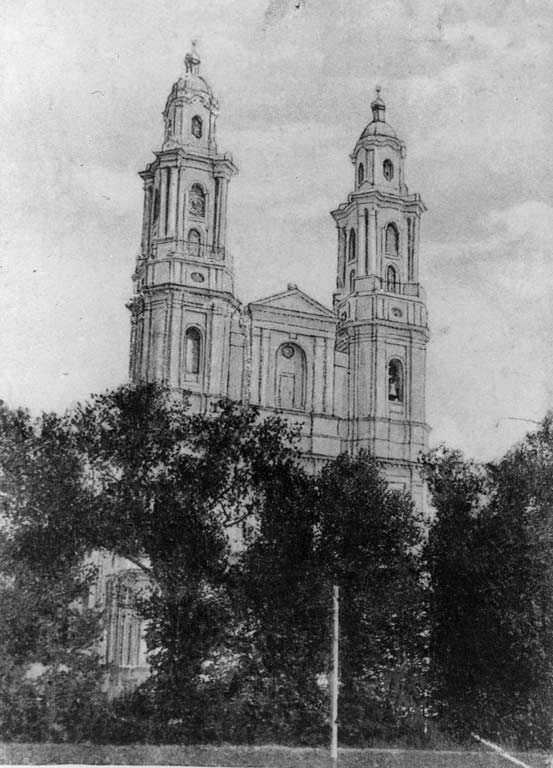
Dam construction began near the fortress and was completed in 1841. However, due to the lack of a prospective city development plan, the protective dam later failed to protect most new buildings from floodwaters. For many years, the Gaiki district was heavily flooded. Reconstruction of buildings inside the fortress continued for several years. In 1828, the fortress church (built by the Jesuit college in 1631) was converted into a military cathedral. The cathedral's height was 60 meters. Locals traveling to the Dinaburg market, seeing its spires, knew the fortress was still 30 kilometers away.
Near the cathedral, fortress commandants and senior clergy were previously buried. Only the tombstone of fortress commandant Major General G. V. Pilenko (1817–1881) remains. Based on archival data about his 1849 award of the main Austrian order "Yellow Crown," it can be concluded that the general actively participated in suppressing the 1848–1849 revolution in Hungary. Among the commandant's awards was a sign of special royal favor—a diamond ring with the Tsar's monogram.
Next to the church was a building that was part of the monastery complex. Later, during fortress construction, it was converted into barracks for the garrison personnel. There are reports that during major repairs, an improbably thick wall was discovered. When the wall was demolished, a small room with a skeleton of a person walled in alive was revealed.
In mid-November 1830, a Polish nobility uprising against Russian rule broke out, spreading throughout Latgale. In connection with this, Nicholas I ordered urgent rearmament of Dinaburg. The fortress received 80 more fortress artillery guns and 20 field guns. To the 600 poods of powder in storage, another 2,000 poods were added. The fortress guard was increased to wartime strength, numbering 18 non-commissioned officers and 273 privates. Several hundred Polish prisoners were used for the most difficult, exhausting work.
In 1833, construction of the main part of the fortress with four bastions and fortifications protecting it from artillery and rifle fire was completed.
On May 21, a solemn opening of the fortress took place. Tsar Nicholas I and the highest clergy of Russia attended. After a prayer service in the fortress cathedral, at the Tsar's request, a procession along the main rampart was held, during which the fortress flag was raised and troops lined along the rampart were sprinkled with "holy" water. Subsequently, the procession along the main rampart became an annual event.
Although the fortress was officially opened, many external fortifications were still unfinished. Only in 1837 was the main rampart with all adjoining structures completed (according to Colonel Klimenko's project). Two more officers' houses, a provision warehouse capable of storing food supplies for 7,500 people for two years of defense, and an artillery arsenal were built inside the fortress. The fortress hospital expanded to 400 beds. The bridge fortification took on a fully combat-ready appearance. In summer 1844, a new floating bridge was built, connecting

the Nikolaevsky gates with the bridge fortification. The main rampart and courtyards, the area around buildings, were planted with many trees. A narrow-gauge portable horse-drawn railway was created, significantly speeding up the transportation of materials for construction needs.
The fortress construction significantly increased the city's importance and authority, positively affecting its development and population growth. If in 1825 the city had 2,885 residents, by 1840 it had 11,361.
The first stone houses were built directly in the fortress according to an approved unified plan. In 1827, the building of the Nobility Assembly was completed. At the same time, the parade ground was paved with cobblestones, where long training sessions and troop parades were held. Later, this parade ground was turned into a square, rightfully called the green decoration of the fortress. Experts believe trees and shrubs were planted so that the square retained its green cover most of the year. The planting system was designed so that plants covering early spring greenery were in the center, and further out were plants remaining green until late autumn. The gazebo now located in the square has long served as a place for the fortress orchestra to perform marching tunes.
Construction continued, fortifications were improved, and their layout gradually enhanced. Due to the swampy terrain where the fortress was located, building foundations were reinforced with oak piles. Ceilings of houses and fortifications were built in the Empire style—massive and highly durable. Wall thickness reached 2.5 meters. Presumably, these represented the last line of defense, as they were located along the main rampart and had a well-thought-out external and internal layout adapted for firing.
The marshy soil made it impossible to keep fortress streets and squares properly clean. In 1843, the fortress commandant petitioned the Engineering Department to pave them with cobblestones and lay underground drainage pipes. The matter was resolved positively, and these works were completed in 1857. In 1843–1844, an engineering arsenal was created near the Alexandrovsky gates, housing various workshops. After construction completion, it was used as an artillery arsenal.
Fortress construction on the Daugava stretched over many decades. The imperial government constantly monitored the work. This is evidenced by the fact that over five years (1846–1851), the emperor personally inspected the fortress 13 times.
However, the work seemed endless. Noting the good quality of fortifications on May 31, 1851, Nicholas I ironically said: "Dinaburg fortress has been built under me for 31 years. I would like it to be finished in my lifetime. But I hardly will live to see it." The Tsar was right. Work continued for another 27 years.
In 1860–1863, during the construction of the St. Petersburg–Warsaw railway, an embankment was created that blocked the view of the terrain from the city side. This led to the construction of the so-called Warsaw fortification line, significantly strengthening the fortress's defense from the east.
In 1863, another Polish uprising broke out. In connection with this, the fortress was rearmed with 258 more guns. Thus, the fortress's armament then numbered 539 guns. This was more than half of all artillery of the Russian army in 1812, when Russia fielded only 930 guns against Napoleon. By 1878, the fortress was fully built. It became one of Russia's most important fortresses on the western border.
From a fortification perspective, Dinaburg fortress was considered one of the most impregnable, distinguished by depth of design, originality of solutions, and many other engineering merits. Its construction used remarkable achievements of Russian military art. In particular, a system of near and distant forts was applied. The first such fortification fortress in the world was built by Peter I in 1710 and named Kronstadt. Famous Russian military engineers Baturin, Snitko, Stavitsky, Brain, and many others participated in building forts, caponiers, bastions, bridges, and the main rampart of Dinaburg fortress. Their names are engraved on plaques embedded in the fortification walls.
Based on studying fortress plans of various years, the placement of defensive structures, and the organized fire system, as well as practical inspection of the terrain, the following conclusions can be drawn.
From the river side, the fortress was protected by a water barrier, whose crossing was impossible due to a powerful bridge fortification. The bridge fortification consisted of two half-bastions adjoining the Daugava bank and two bastions facing the field. Additionally, three earthen lunettes (open field fortifications) were located between them. The capture of the bridge fortification was hindered by continuous swamps, a clear field of fire, and moats filled with water flowing from the swamps year-round.
The placement of firing structures of the fortification met the requirements for enfilading fire along the moats. Practically no "dead" (non-firing) zones existed. Besides the floating bridge, the bridge fortification was connected to the main fortress, as locals claim, by an underground passage dug under the Daugava.
On the western side, the main fortress was protected by three powerful bastions connected by a system of ramparts and moats with the fortress. Underground communication passages existed between the bastions and the fortress. The esplanade was open at that time, and bastions were built on natural hills, increasing the firing zone and avoiding "dead" spaces both at the approaches to bastions and forts and at the fortress approaches.
On the northern side, the fortress was enclosed by a water barrier of a lake and two impressive forts. One was located directly on the lake shore, and the other at the source of the Shunitsa River. Two caponiers were built as connecting firing links between these forts. The field in front was also open and had no buildings at that time. Thus, the fortress was as well protected from this side as from the other two. Additionally, from the city side, a powerful rampart stretched from the fort at the Shunitsa River source to the fortress itself. This rampart was later used as the embankment for the Warsaw railway. For this purpose, in 1881, part of the fortress structures was demolished, including the bastion at the Shunitsa River source.
The defense system from the city side was very cleverly designed. The water level in the lake was always kept elevated thanks to a sluice at the Shunitsa River source, protected by a fort. In case of enemy attack, the sluice gate was raised, and the sluice gate on the dam was lowered, flooding the entire space between the fortress and the city with water flowing from the lake. The location of forts at the river mouth source was not accidental. They protected the sluices from the enemy and the fortress from a breakthrough by troops along the dam. This was the first-line defense system.
The layout and placement of moats, ramparts, and firing structures of the second defense line and their firing connection were even more perfect, making the fortress impregnable.
Six large half-bastions adjoined the main rampart, connected to the fortress by underground passages under the main rampart. Casemates were designed to fire on internal moats and provide enfilading fire from the escarp walls of the main rampart and the walls of five main bastions. The main bastions were located between the six previous casemates and separated from the main rampart by a deep moat. Bastions provided fire coverage of the outer moats. Additionally, seven T-shaped forts were built for firing connection, each capable of firing in all directions. On the ramparts, 12 additional two-story forts (4 guns on the first floor and 2 on the second) were built, capable of firing both along the outer moats (main direction) and along their own.
If necessary, additional guns could be installed directly on the ramparts.
The possibility of installing additional guns is evidenced by the surviving ramps (gun ramps) on all ramparts and gun embrasures. The embrasures had side parapets protecting the gun crews from shell and cannonball bursts. With such a system of ramparts, moats, forts, and bastions on the approaches to the main rampart, the entire area was well covered by fire, and an enemy assaulting the fortress would inevitably come under cross twelve-layered fire. (The fire system was so complex that attempts to create a firing scheme in one plane failed). Practically, guns were not installed on the ramparts. There is only tentative data that until 1905, old-model guns were placed on the main rampart as relics.
To strengthen defense, all fortress moats were flooded with water supplied via a bypass canal from the swamps surrounding the fortress. The canal had a broken line shape, with forts at the corners providing fire along the rampart. Water from the moats was drained into the Daugava through a special pipe. Communication between water-separated fortifications was carried out via temporary bridges, underground passages, or boats. It should be noted that the fortress ramparts were built with increasing height, allowing firing over the crest of the previous rampart.
From the river side, firepower was somewhat less, but the likelihood of enemy appearance from this direction was low due to the strong bridge fortification and water barrier. Of particular interest was the defense system of the main bastions. One of them now houses a stadium. This bastion, like four others, was shaped as a conical trapezoid, with casemates in its wings whose guns fired on nearby fortress moats. Enfilading fire from the escarp wall of this bastion was provided by casemated structures adjoining the main rampart, ensuring its impregnability. Additionally, dagger fire from neighboring bastions and forts would nullify enemy efforts if they tried to overcome the deep water-filled moats.
Even if the enemy penetrated the main bastion territory, access to the gun casemates would be blocked by enfilading fire through special loopholes; both casemates could support each other with internal artillery fire through special embrasures. In critical situations, the bastion could be assisted by installing additional guns on the main rampart. The main bastion area was connected to the fortress by a passage under the main rampart and a drawbridge, which also served as a shield closing the tunnel entrance in the rampart. This is evidenced by huge lifting blocks still preserved in some places.
Forts located in the main rampart allowed enfilading fire from their doors. They were assisted by T-shaped casemated structures. The bastion enabled counterattacks by fortress defenders through special passages along the main rampart.
Equally interesting was the defense system of

the Mikhailovsky (central) gates. The road to them had several closed turns, preventing the enemy from using artillery. To enter the fortress, one had to cross a sliding bridge onto the bastion over a shield covering a deep pit. This shield, when raised, served as the bastion's first gate. After passing the second gate, one had to cross a second sliding bridge into an arched structure, also protected by shield gates. Upon exiting the arch, one could finally cross the third sliding bridge to the fortress entrance. The fortress entrance was blocked by two oak gates iron-bound with massive locks and bolts. The local history museum holds the lock and keys to these gates. Their monolithic size and weight (up to 28 kg) are impressive.
Military engineers always considered gates the most vulnerable part of any fortress. It is no coincidence that their defense was meticulously planned and serious attention was paid to their fire cover. During combat, shield gates were raised, and bridges were drawn. If the enemy managed to break through the first defense line and reach the first sliding bridge, they would inevitably come under crossfire from the two-story fort and main bastion guns. Even if they captured the first sliding bridge, it would be destroyed during attempts to seize the first gates by fire from special loopholes in the bastion and fort. This was aided by the small area in front of the gates, preventing the enemy from concentrating enough forces for a direct breakthrough. The same principle applied to the second gates of this bastion and the gates of the arch. An enemy breaking onto the bastion platform would be destroyed by deadly fire from the T-shaped fort or, in the worst case, by defenders in hand-to-hand combat.
If the enemy reached the second sliding bridge, they would immediately be shot by crossfire from the T-shaped fort, bastion, and distant two-story casemated fortification.
Even if the enemy reached the third bridge and (which is completely unrealistic) tried to approach the main fortress gates, they would be destroyed at close range by guns of the main rampart casemate and the adjoining bastion. Deadly fire could also be delivered by guns additionally installed on the ramparts.
Other gates were similarly protected. The only exception was the Nikolaevsky (southern) gates, where, in addition, the destruction of an enemy penetrating the fortress entrance would be carried out through a system of internal loopholes (inside the gates).
Thus, an unusual, original defense of bastions and fortress gates was devised. Far-advanced zero forts ensured premature deployment of attacking enemy detachments, exhausting and destroying their manpower, disrupting planned assaults.
The entire appearance of the low, 6–8-meter-high fortress, buried in the ground and intersected by ramparts, forts, and additional fortifications, inspired involuntary fear in the enemy. The unusual configuration of fortifications, the absence of traditionally visible embrasures and loopholes from the field created uncertainty in choosing attack routes. One-third of the guns were aimed directly at the front; two-thirds of the barrels were designed for flanking and enfilading fire from the escarp walls. Additionally, the flooded space between the main rampart and all defensive fortifications should be added.
The moats had varying depths (from four to nine meters) and abounded with treacherous trap pits. Moreover, the passage inside the main rampart and the developed network of underground communications from it to the bastions significantly enhanced the fortress's power and impregnability. This is evidenced by the fact that during the Crimean War in 1854, England and France sent a fleet to the Latvian coast but feared to land a landing force. At that time, a 7,000-strong garrison was stationed in Dinaburg fortress, and exercises were conducted, confirming the excellent combat qualities of the fortifications described above. In 1855, the fortress was militarily subordinated to the commander of the Baltic Corps.
In 1870, the Russian government moved the main defense line further west. Dinaburg fortress was downgraded to a second-line fortress, then to a second-class fortress. On August 31, 1874, the Vilnius district artillery depot with its administration and workshops was established in the fortress.
On January 14, 1893, due to the city's renaming, Dinaburg fortress became known as Dvinsk fortress. With the development of the fortress defense system of the western border, the strategically obsolete Dvinsk fortress was reclassified as an arsenal fortress on April 12, 1897. From then on, it became a kind of arsenal for storing Obukhov plant guns (samples of these guns still exist on the fortress territory).
Additionally, military workshops for manufacturing gunpowder, grenades, shells, as well as workshops for sewing officer and soldier uniforms, were located there, along with quartermaster units and a small military garrison. Incidentally, the revolutionary and classic of Latvian literature, creator of the immortal poem "Lāčplēsis," Andrejs Pumpurs served at that time in Dvinsk fortress as a staff captain of the quartermaster's office. Gradually, the fortress was disarmed. Only relic guns remained on the ramparts.
Such is the history of the creation and improvement of Dinaburg fortress and its loss of strategic significance.
Sources:
https://dwaiu.narod.ru/kazak/index.html#content
Kazak V.V. Daugavpils Fortress: History and Legends from the Middle Ages to Our Days: A Historical Sketch.



Written by Jermaine
Discuss this with the author and others
No comments yet. Be the first to start the conversation.