
The first Jesuit college opened in Dinaburg in 1630, when it was still a stretch to even call it a city. The Jesuits established an elite educational institution inaccessible to the common folk. The first thirty students were children of local landowners. The young nobles were taught theology, arithmetic, grammar, geometry, astronomy, music, and various languages. In 1661, when Dinaburg briefly came under Russian control for the first time, the college was transformed into a gymnasium. Six years later, the city returned to Polish hands, and the college regained its original name. It was significantly expanded by opening theological classes intended to train Catholic clergy. Renowned scholars taught at the college—for example, the writer and linguist Georg Elgar, who moved to Dinaburg in 1638. Besides his primary duties teaching languages, he introduced what would later be called literacy courses for the townspeople. Elgar also compiled the "Polish–Latin–Latvian Dictionary," published in Vilnius—which, by the way, was the first Latvian dictionary.

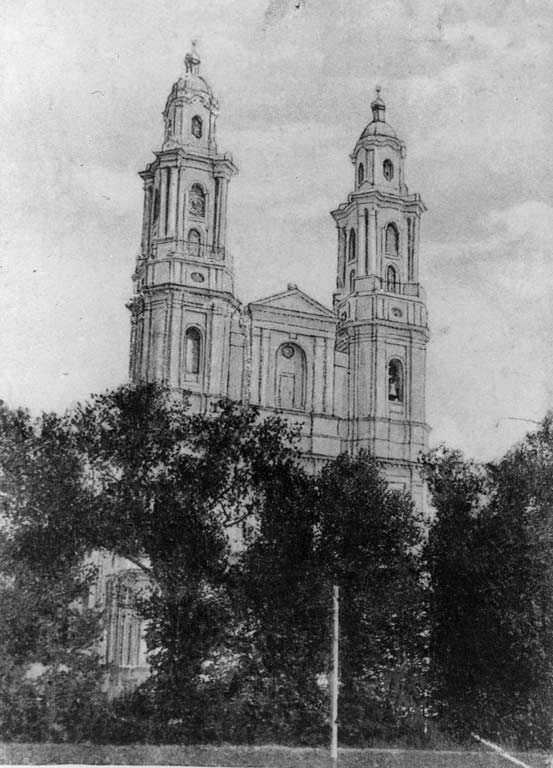
In 1746, the Jesuits, steadily expanding their presence, founded a monastery in the city, where they erected a majestic two-towered church (constructed from 1737 to 1746) of Saint Jude Thaddeus (St. Tadeus Juda). This temple was very beautiful—the architecture, born in sunny Italy, was brought north by the Jesuits and enriched with local sculpture and painting. The exact name of the cathedral’s creator is unknown, but according to one version, the sketches were made by the famous Francesco Bartolomeo Rastrelli, who was living in Courland at the time. Another version attributes the project to architects Karl Francesco Randelli or Johann Christoph Glaubitz. It is reliably known that the bricks for the Jesuit cathedral were made at a factory located right next to the construction site. The church was consecrated on Trinity Sunday, but finishing works continued for many years. The names of those who contributed to decorating the building have survived—painters Gouldlfinger and Vasilevski, woodcarvers Schulz and Shvill.
The result of their collective work was impressive: the cathedral’s snow-white towers soared 60 meters high, making it the tallest building in Dinaburg. At that time, the town had no other "high-rises," so the fortress cathedral was visible from any point in the city. Old photographs confirm that this temple was a true architectural gem. This three-nave basilica was one of the best examples of Baroque in Latgale. Around the cathedral, an entire Jesuit quarter emerged. After Pope Clement XIV’s bull dissolved the Jesuit order in 1773, the Dinaburg Jesuit college became a refuge for members of the order who suddenly became church dissidents. Jesuits from other European countries who disagreed with the Pope’s decision began to gather here.
The fortress cathedral was clearly visible from the Forstadt, New Construction, the market squares in the city center, as well as from Griva and the Kalkun Heights. The splendor of the fortress church is attested by surviving photographs taken at different times: during the Tsarist era, the First Republic, and World War II. It was a true jewel of Latgale, one of the best and only examples of Baroque (a three-nave basilica) in the region.

But time brings its changes. With the construction of the Dinaburg fortress, the Jesuits were removed. Compensation for their real estate, buildings, and land amounted to 300,000 rubles. The Holy Synod purchased the cathedral, after which the Jesuit monks retreated to Kraslava. In 1811, the former Jesuit church (together with the Jesuit college) was transferred to the military department for its subsequent conversion into an Orthodox garrison church. At the same time, it was decided to preserve the historical appearance of the building as much as possible. In 1817, the cathedral was consecrated in the name of the Nativity of Christ; an antimins was sent for it, consecrated by Bishop Daniil of Mogilev. (An antimins—a rectangular cloth with special images, consecrated and signed by a bishop, on which the Divine Liturgy is performed. Usually, the antimins contains a small sewn pocket with relics of martyr saints.) The initiator of the cathedral’s repair and restoration was Nicholas I, who donated 10,000 rubles for this purpose.
In 1827, the fortress church, which was under diocesan authority, was transferred to the supervision of the chief priest of the Russian army and navy. In 1828, the cathedral’s remodeling was completed. Small domes with Orthodox crosses appeared on the towers, internal and external repairs were carried out, and the roof was replaced. An "iron clock" was installed on one of the towers. The belfry—on the other—was supplemented with a large bell inscribed: "Cast from guns taken from Polish rebels." The side chapel was dedicated to the Protection of the Holy Virgin. According to the staff, the converted church was assigned a protoiereus, a priest, and three psalmists. The cathedral was affiliated with a cemetery church and a church for the camp artillery assembly. The author of the interior reconstruction was largely the Russian Emperor himself. Nicholas I personally approved the iconostasis project.
Art historians believe that the Orthodox icons were painted by artist A. Perminov, and two icons in the iconostasis belonged to A. Ivanov, the author of the famous painting "The Appearance of Christ to the People." The interior of the building amazed contemporaries with its "colossal spaciousness and height, abundance of light, and exquisite ornament decoration."
They also mentioned eight magnificent Corinthian columns, at the base of which stood four small columns on pedestals, giving the cathedral an even more grandiose appearance; "beautifully arranged choir and altar area, resembling a chapel with porticoes and four skillfully decorated columns…".
The fact that after the above-mentioned transformations no more funds were allocated for the maintenance of the church is confirmed by a report on the visit to the cathedral (in 1895) by His Grace Alexander, Bishop of Polotsk and Vitebsk.
"The cathedral building is extremely majestic, but unfortunately has not been repaired for a long time, so that in places its walls have completely lost plaster," reported the "Polotsk Diocesan Gazette."
Unfortunately, no reliable information about the underground part of the church has survived. Researchers of its catacombs in the postwar period spoke of tunnels, galleries, labyrinths, and wells. At that time, it became known about an underground passage leading from the cathedral to the college. According to one breathtaking legend, it was possible to rush on a troika of horses under the riverbed from the bridgehead fortifications to the cathedral’s basement, which supposedly was used by a certain lieutenant who was late for his wedding at the fortress cathedral in pouring rain.
During the years of World War I and the revolution, the cathedral fell into even greater neglect. During the creation of the Latvian Republic, a Latvian garrison was stationed in the fortress. The crosses were changed again in the church, and an organ sounded under its vaults. The left chapel was given to Catholics, and the right—at the request of the rector Augustin Peterson—to Orthodox military personnel. On November 28, 1926, the Orthodox chapel was consecrated in honor of the Holy and Life-Giving Trinity. Services, including Lutheran ones, were held according to an agreed schedule.
According to established opinion, the church was mined and blown up on July 27, 1944, during the retreat of the occupying forces, after which numerous human bones were found in its basement.

Against the backdrop of wartime disasters, it was easy to assume that the Germans blew up the cathedral along with the last prisoners of the concentration camp. In 1947, Soviet military personnel examined the remains in the presence of the rector of the Borisoglebsky Cathedral, Archpriest Ioann Dubakin. However, Yu. Chertov, who lived in the city during the occupation, claims that after the Red Army recaptured Daugavpils, only one of the two towers of the fortress church was half-destroyed. The fact that the Germans had no intention to blow up the entire cathedral is confirmed, according to Chertov, by a document personally seen by another local historian, Ya. Kivrinsh, in the archive of the State Military Museum (Riga). The document was a list of objects that the Nazis were to blow up during their retreat, but the fortress cathedral was not on the list. "If we still assume that the Germans blew it up, then they did not use powerful charges, otherwise the nearby college building would have been damaged. This building was not damaged, so a low-power charge was used," reasons Yu. Chertov.
The local historian further says that according to the postwar commission’s conclusion in 1947, the basement with prisoners and the pediment with towers were blown up. "And was this done by one explosion? Or were there several? Did the Germans have time first to blow up one part and then lay charges again for another explosion? For three years after liberation, no one entered the basements, but the commission did. It turns out the basement was not damaged by the explosion, i.e., its ceiling, which is also the cathedral floor, remained intact. They saw bones and concluded that these were prisoners’ bones. But I doubt that human remains could have turned into mere bones in three years! It seems they belonged to monks, and these bones were about 200 years old! It is known that in the basement rooms of churches it was customary to entomb the bodies of deceased clergymen. Probably, their mortal remains were discovered by Soviet soldiers," Chertov suggests.
In 1951, a commission that inspected the ruins of the church concluded that restoring the building was impossible. The clearing of the debris fell to the cadets of the then aviation school.

According to former deputy head of the school, Colonel Agafonov, to facilitate the clearing of the ruins, they were periodically blown up, but since the headquarters was nearby, the explosions were low-powered, after which the ruins were dismantled manually. Brick debris were then collected in bags and dumped into the moat. The cathedral’s huge underground chamber was also filled in. The site where the temple once stood was cleared down to the foundation. There is an oral testimony from the postwar years when a veteran during a fortress tour said he personally fired at the cathedral towers from artillery. This was done because the 60-meter towers allowed the Germans to conveniently observe the movement of Soviet troops.
The cathedral in the fortress was by no means the only one damaged for this reason. Towers were knocked down by artillery as enemy observation points. The tower of St. Peter’s Church in Riga was also damaged by artillery fire during the war. The building remained in ruins until 1966. The Riga public rose to its defense, and as a result, the church was restored. In Daugavpils, the situation was different—the cathedral was in a fortress, a military facility. Later, its 20-meter ruins were also removed," noted Maris Grunskis.
Today, the owners of the territory where the cathedral and college once stood have changed several times, and there are plans to convert the former Jesuit college building into a hotel. How soon these plans will be realized is hard to say.
Well, the road still leads to the church that no longer exists…
Sources:
https://www.grani.lv/daugavpils/53812-hram-kotorogo-bolshe-net.html#cmtblock


Written by Jermaine
Discuss this with the author and others
No comments yet. Be the first to start the conversation.