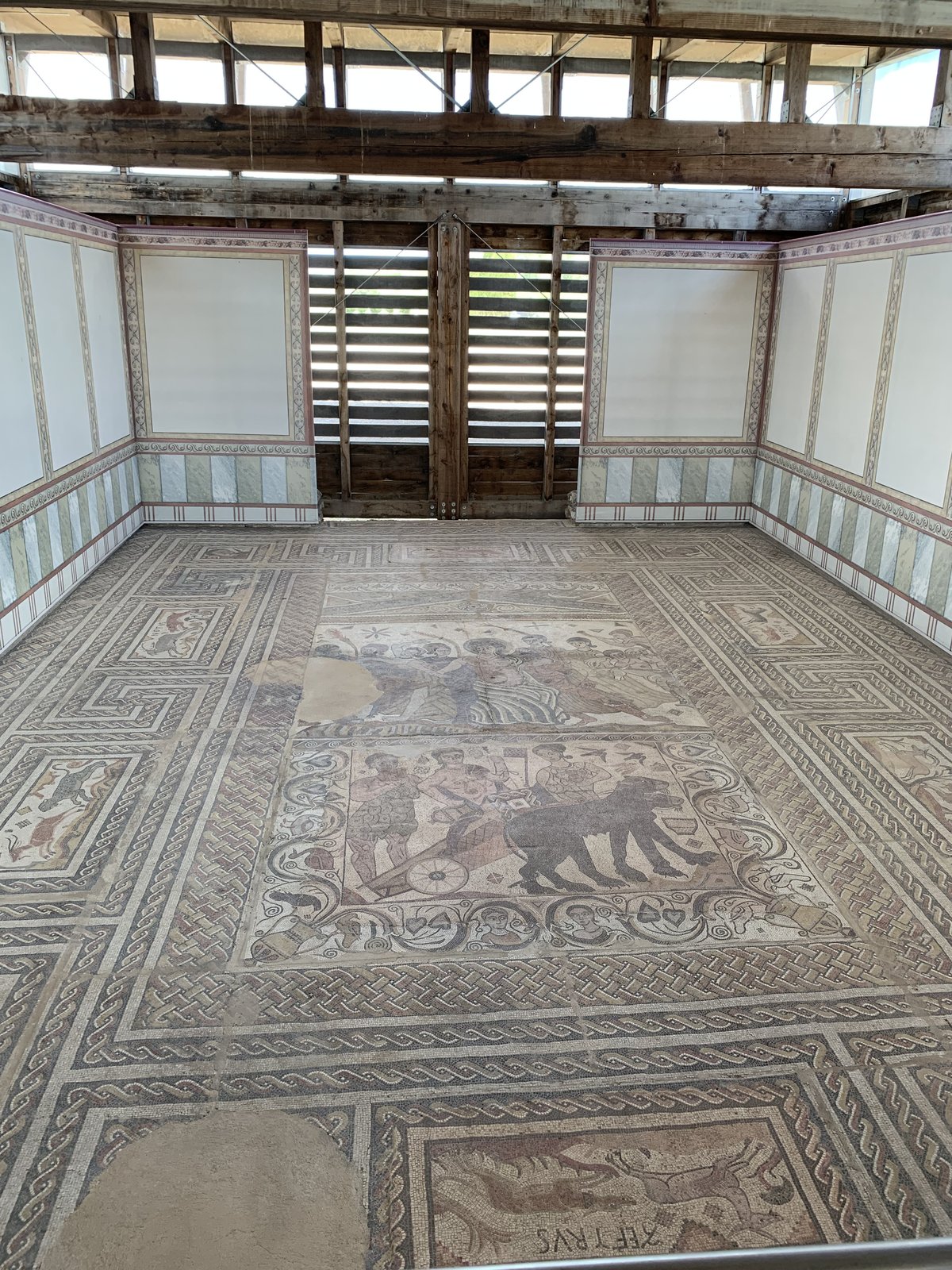

The Villa de Santa Cruz is located in Baños de Valdearados, in the Ribera del Duero region of Castilla y León. The site sits near the Bañuelos river along the road from Aranda de Duero to Caleruega, close to the ancient Roman road that ran between Caesaraugusta (Zaragoza), Asturica Augusta (Astorga), and Bracara Augusta (Braga). This late Roman villa, dating from the 4th and 5th centuries, was located in the territory of Clunia Sulpicia.
The site was discovered by chance when mosaics and ceramics were uncovered during land leveling work. Excavations led by José Luis Argente between 1973 and 1978 revealed a large villa of ten rooms and four corridors, reflecting the wealth and splendor of its owners. While the excavated area covers just over 1,000 square meters, the remains suggest a previous building from the 1st to 2nd centuries was reused for the construction of the Santa Cruz villa.
The villa features a complex radial water supply system and rooms equipped with hypocaust heating. Its most notable features are the mosaics found in three rooms. The main hall, or oecus, contains a 66-square-meter mosaic depicting the triumphal procession of Dionysos returning from India. The scene shows the god, appearing intoxicated, accompanied by his companion Ampelos and Ariadne, with the lower panel showing Dionysos on a chariot pulled by panthers.\n In 2011, thieves entered the site and used rudimentary methods to extract three pieces from the oecus mosaic. One was a large central piece representing the arrival of Dionysos with a thyrsus and a crater. Two smaller pieces were also taken, featuring the names of the wind gods Euro and Céfiro. The site remains under the management of the Junta de Castilla y León.
Sources: Wikipedia, OpenStreetMap, Wikidata, Wikimedia Commons
Written by Nicolo Ciampini
Discuss this with the author and others
No comments yet. Be the first to start the conversation.