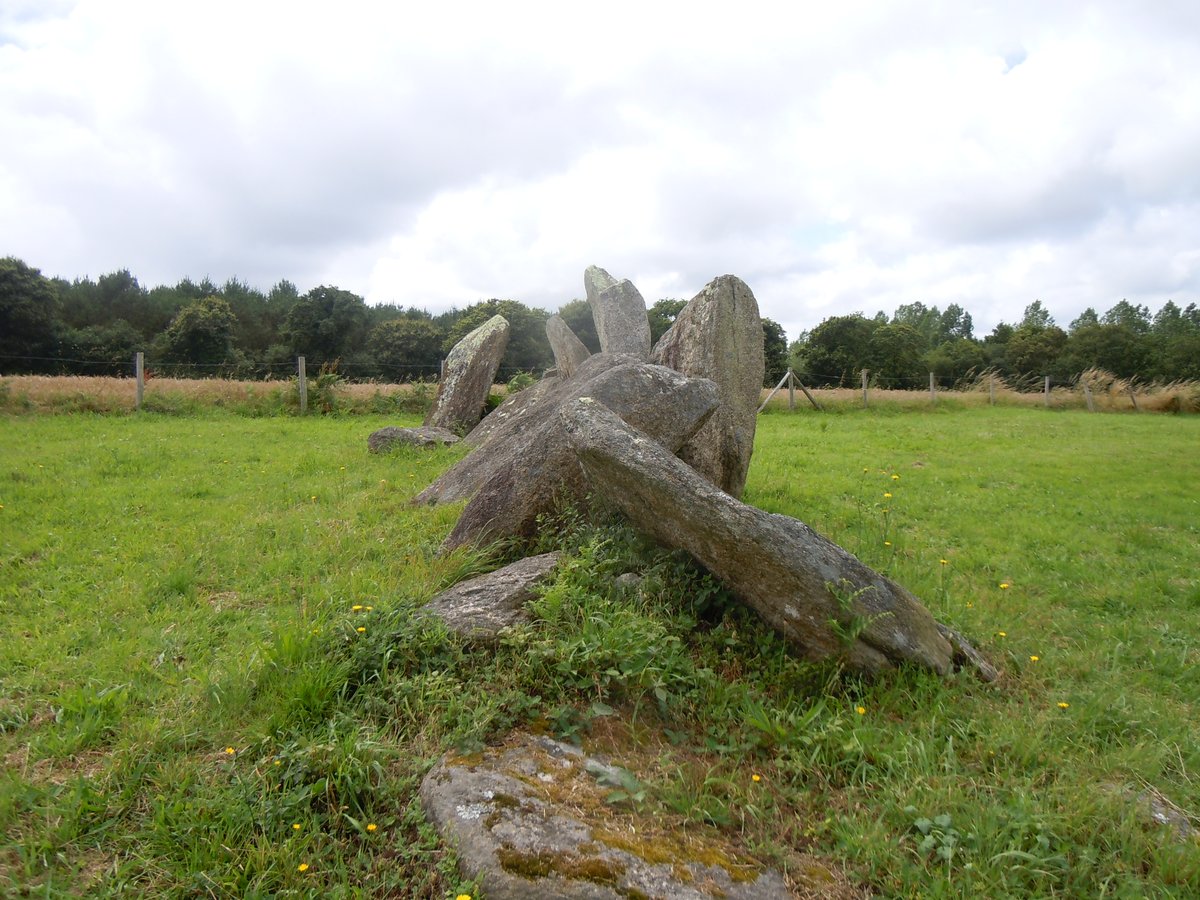

Kerantiec, located in Riec-sur-Bélon, France, is a Neolithic monument that dates back to the early Neolithic period, around 5,000 years ago. The monument, classified as an historic monument by decree on December 16, 1953, is unique for its key architectural feature: an arc-shaped design. Although arc-shaped Neolithic monuments are rare, examples do exist in the south of Finistère (Lesconil, Castel-Ruffel) and in Morbihan. The monument is estimated to measure 9.50 meters in length.
Its architectural design was economical, as one wall of the burial leans on the other, reducing the need for cover stones and significantly reducing the funeral chamber’s volume. The eight pillars forming the southern row are heavily leaned and lean on the northern pillars, which stand almost vertical, with two reaching or exceeding a height of 2 meters. Other pillars have fallen horizontally. The slab of the grave is relatively small but remains upright.
The entrance was on the east. The internal width of the chamber does not exceed 1 meter. The stones used for the construction of the monument are almost every one of granite of Moëllan, sometimes migmatized, except for one pillar, which is of gneiss oöillé, local rocks. Yohann Sparfel and Yvan Pailler mention it in their Inventory of the monuments of the Neolithic and of the Bronze Age in Finistère, Volume II, published in 2011.
Sources: Wikipedia, OpenStreetMap, Wikidata, Wikimedia Commons
Written by Nicolo Ciampini
Discuss this with the author and others
No comments yet. Be the first to start the conversation.