


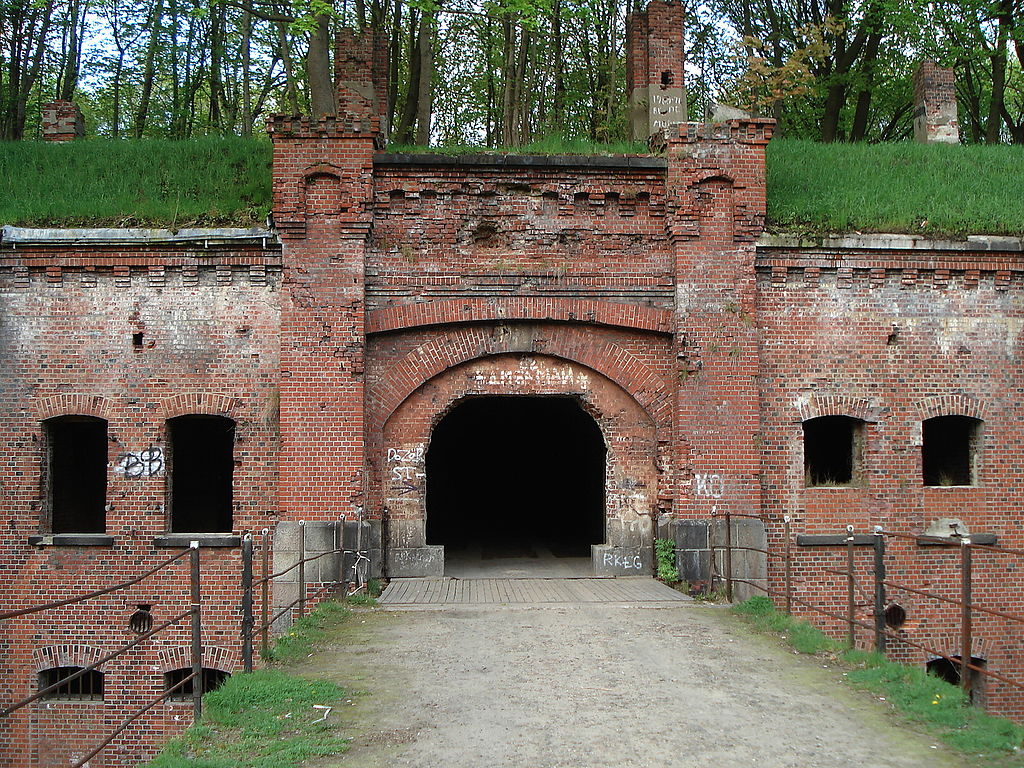
Originally, Fort No. 9 was named after the nearby settlement "Hoch-Karshau," and was renamed in 1894 in honor of the representatives of the famous von Don family. In some sources, the fort is called "Ponart." From the mid-1880s until the 1930s, Fort No. 9 underwent several modernizations, including the construction of a cofferdam.
Fort No. 9 was an elongated hexagon along the front, measuring 360 by 180 meters, and consisted of the following main structures: a water moat; a cofferdam; an embankment; a counterscarp caponier; a central structure; two side half-caponiers; two inner courtyards; two barracks; a gorge caponier; and a firing point to protect the entrance from the gorge side of the fort.
The caponiers and half-caponiers were connected through the courtyards by underground passages. A bridge was thrown over the moat on the gorge side. For camouflage, the fort was planted with trees. The approaches to the fort were covered by artillery and rifle-machine gun fire from open positions. The counterscarp and gorge faces of the moat were covered by rifle-machine gun fire from the caponiers, while the side faces of the moat were covered from the half-caponiers. The moat surrounded the fort along its entire perimeter. The width of the moat was 25 meters on the counterscarp side, 20 meters on the sides, and 10 meters on the gorge side. The moat was 7 meters deep, with 2 meters filled with water.
The cofferdam was designed to protect the approaches to the counterscarp caponier and had two embrasures for rifle-machine gun fire. The cofferdam was embedded into the moat wall, isolated from the other fort structures, and had an entrance from the glacis surface. The walls and combat cover of the cofferdam were made of reinforced concrete.
The counterscarp caponier was intended to cover the counterscarp faces of the moat and consisted of two side casemates, each with two embrasures for rifle-machine gun fire. One exit from the caponier, closed by a metal door, led to the moat; the other led to the central underground passage.
The central structure was three stories high and made of brick. On the first floor was a corridor connecting the inner courtyards and having exits to the central underground passage, which connected the counterscarp and gorge caponiers. The first floor housed casemates for storing ammunition. The second and third floors each had two isolated rooms: one for service and one for ammunition supply. The floors of the second and third floors in the ammunition supply rooms had oval openings. The service room on the second floor was connected to the first floor by a spiral staircase. The third-floor room was connected to the far right casemate on the first floor (bypassing the second floor) by a straight staircase. The protective layer thickness of the upper floor consisted of 1.5 meters of brickwork and 4-5 meters of earth.
The half-caponiers were three stories high, made of brick with wall thicknesses of 1.2-3 meters. On the first floor of each half-caponier were combat casemates with five embrasures for rifle-machine gun fire along the side faces of the moat. One exit from the casemate led to the moat, the other through an underground passage to the inner courtyard. Both exits were closed by metal doors. At the exit leading to the moat, there was a protective embrasure. The second floor was for ammunition storage and connected to the first floor by a spiral staircase and an elevator. The third floor housed an artillery casemate for flanking fire across the moat. By early 1945, the embrasure of the artillery casemate was bricked up, and the room was used to house personnel. The wall facing the fort’s rear had windows and an exit with double-leaf metal gates leading to the upper platform.
The inner courtyards were intended to shelter artillery and connect the half-caponiers with the central structure. Ramps were installed in the courtyards for rolling out guns to combat positions. Each courtyard had two staircases leading to the surface of the fort.
Each barracks consisted of twelve rooms connected by a common corridor. Each room had two windows facing the rear of the fort.
The gorge caponier was designed to protect the approaches to the gorge wall of the fort and consisted of two combat casemates. Each casemate had two embrasures for rifle-machine gun fire. One exit from the caponier, closed by a metal door, led to the platform near the gorge wall; the other led to the central underground passage.
The firing point to protect the entrance from the gorge side of the fort was located outside the moat, isolated from the fort, and had two embrasures for rifle-machine gun fire.
Near the current settlement of Novodorozhnoye, which before the war was called Hoch-Karshau, one can still see the cyclopean ruins of one of the fortifications that once formed a unified defensive ring. Fort No. 9 "Dona" (often also called "Ponart") covered the southern approaches to the capital of East Prussia. It was stormed on the night of January 29-30, 1945, by soldiers of the 1st Guards Moscow-Minsk Rifle Division of the 11th Guards Army. During the assault, the fort was blown up by sappers, resulting in the destruction of the barracks, part of the inner casemates, and the gorge caponier; the directed explosion of the counterscarp in the moat created an earthen causeway. This causeway is linked to a mysterious story that still provokes heated debates among both professional historians and amateur local historians.
Version 1. The Perfect Assault
"The stone mass of the fort with its sheer walls three meters thick seemed impregnable. Through the dark eyelets of the embrasures, machine guns and cannons glared menacingly, and access to them was blocked by a 12-meter-wide water-filled moat." This is how Lieutenant General Pavel Kuznetsov describes the scene that appeared on January 29, 1945, to the soldiers of the 1st Guards Moscow Proletarian Rifle Division, which was closing the ring around Königsberg from the south, in his book "Guardsmen-Muscovites." According to brief staff reports, Fort No. 9 was captured as a result of a "short assault." Kuznetsov recounts how it happened based on the words of "combat participant N. Vorontsov."
After a powerful artillery preparation, assault groups of the 169th Guards Rifle Regiment approached the moat, and Guards Captain Mozzhukhin, together with sappers Kalinin, Shusharin, Gorbachev, and others, blew up the sheer granite bank. After that, an assault bridge was thrown over the moat, across which a group led by "Officer Rogozin" crossed. Another group, led by "Officer Kotelovsky," swam across the moat and engaged in battle at the walls. The first to break inside were the submachine gunners under the command of Guards Lieutenant Leppo.
"They attacked the Germans guarding the entrances to the underground structures, drawing all enemy attention to themselves," Kuznetsov writes. "Kotelovsky took advantage of this. His fighters broke into the casemate and engaged in underground combat. They fought with bayonets, grenades, and sometimes strangled the Germans by hand."
Soon the fort was captured, and as trophies, our troops seized four 210-millimeter and six 280-millimeter artillery guns, dozens of machine guns, ammunition depots, and food supplies.
Version 2. Incredible Luck
A somewhat different version of the assault was revealed much later. Former scout of the 3rd Artillery Division of the 1st Guards Moscow Proletarian Rifle Division, Lev Polonsky, claims that the fort was captured not as a result of a carefully planned staff operation, but rather thanks to a fortunate coincidence.
- We approached the fort on a dark night, first, together with the division reconnaissance company, - recalls Lev Markovich. - And then either God or chance helped us. When we broke into the fortifications in front of the fort, we saw a steep slope ahead, and beyond it, a deep water-filled moat. The Germans, right in front of our position, forgot to remove the temporary bridge! It made no sense to try to run across it; the bridge almost abutted a blind wall and was well covered by fire from the side casemates. Then some daring sergeant, either from the reconnaissance company or the sappers, appeared, who rolled a small barrel of dynamite with detonators and fuses. The barrel rolled exactly along the bridge and exploded right at the wall.
But most surprisingly, a moment later, another explosion thundered, much more powerful than the first. The shockwave threw the scouts to the ground, and when they, stunned and shell-shocked, finally got up, they saw that the ill-fated moat was more than half-filled with debris. Quickly orienting themselves to the changed situation, the guardsmen ran across this spontaneous crossing and burst inside through the huge breach gaping in the wall.
- Throughout the fort, we encountered stunned and crazed Germans from the explosion who did not even try to resist, - testifies Polonsky. - They were simply shot on the run; there was no time to take anyone prisoner.
Version 3. Heroic Germans
The last commandant of Königsberg, Otto Lyash Lyash, offers his version of the fall of "Dona." "Fort No. 9 was surrounded by the Russians on the night of January 29-30," confirms the infantry general in his memoirs. "When, despite courageous resistance, the defenders saw that Russian tanks were already on the casemates demanding surrender, the entire fort garrison (two companies of convalescents, a Volkssturm platoon, a radio-telephone platoon, led by one captain and a non-commissioned officer) blew themselves up."
It must be said immediately that the story of the Hitlerite commander raises serious doubts. The very idea of "tanks on the casemates" is questionable... Most likely, Lyash is simply trying to justify his own mistakes and failures in defending the city-fortress entrusted to him. But what really happened at Fort No. 9?
Lev Polonsky is convinced that the explosion of the dynamite-filled barrel, which the resourceful sergeant rolled along the bridge to the wall, caused the detonation of ammunition stored in a depot located just behind that wall. Incidentally, after the assault, scouts found another such depot intact at the opposite end of the fort.
- Simply put, we were very lucky that night, - sums up Lev Markovich.
INSTEAD OF AN AFTERWORD
Called fire on themselves six times
How Captain Yakovlev’s battalion defended itself in German encirclement
With the fall of Fort "Dona," Soviet troops (even Otto Lyash admits this) gained an extremely advantageous flank position. The Germans decided to retake it during the well-known southern breakout of Königsberg, which the Wehrmacht managed to carry out briefly on January 30. The main blow of the enemy fell precisely on the 1st Moscow Division. During these battles, another remarkable episode took place.
One of the battalions of the same 169th Guards Rifle Regiment, under the command of Guards Captain Yakovlev, deeply penetrated the enemy defense, capturing a tactically important fortification with four firing points and a large reinforced concrete bunker in the center. After the start of the German counterattack, the guardsmen found themselves completely surrounded. A fierce battle ensued, lasting almost continuously for three days. During this time, Captain Yakovlev called artillery fire on himself five times (!) — three times from guns and twice from rocket mortars. The last radio message from the commander was: "Only 23 men left in the ranks. The Germans are laying charges to blow me up." After the sixth strike by Soviet artillery on the known coordinates, communication was lost.
The command considered Yakovlev’s fighters dead, but eight hours later, the battalion’s Komsomol organizer arrived at the division observation post with a report. Under cover of darkness, the young man managed to leave the bunker unnoticed, bypassing German checkpoints and then the enemy front line. It turned out that all 23 surviving guardsmen had survived again and were waiting for help. The relieving strike was successful — the remnants of the battalion safely reached their regiment’s location. All the heroes were later awarded orders and medals.
The Germans stubbornly continued to break through to Fort No. 9, and the commander of the 11th Guards Army, General Galitsky, decided to stop the senseless struggle that only exhausted the soldiers of the 1st Division (there was already a lull on other parts of the front). It was decided to blow up the remains of "Dona," and soon the fortification was shaken by the third powerful explosion, after which the once mighty fortress lost all its significance.
The early capture of Fort No. 9 allowed Soviet troops to study the fort’s structure, which later greatly facilitated the capture of other forts from the "Night Pillow of Königsberg."
Today, the fort is a sorry sight. Many buildings are cluttered and ruined. Local entrepreneurs have set up greenhouses on the fort’s territory. The entrance to the fort is closed, but, as is common in Russia, one can negotiate with the guards.
Sources:
https://www.kaliningrad.kp.ru/daily/27395.5/4591187/
https://www.prussia39.ru/photo/show_photos.php?phid=8979
https://www.tourister.ru/world/europe/russia/city/kaliningrad/placeofinterest/32297



Written by Jermaine
Discuss this with the author and others
No comments yet. Be the first to start the conversation.