

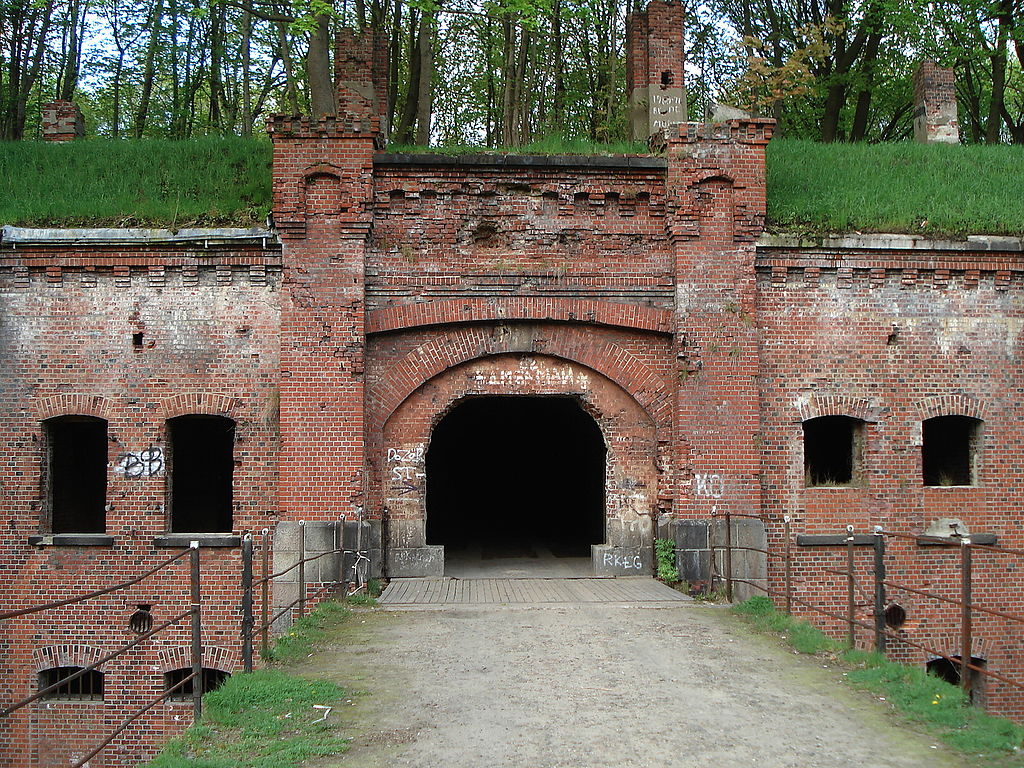
Fort No. 8 was built between 1878 and 1882 and is named after the first King of Prussia, Frederick I. The construction dates are still visible, engraved above the entrance. It is a two-tiered fort with a dry moat (currently flooded due to drainage system failure), covering an area of 205 by 135 meters. It protected the Königsberg-Heiligenbalg-Elbing railway and highway. It could partially support Fort No. 9 Dona and adjacent sectors with its fire.
The fort has the shape of an elongated pentagon, 205 meters long and 135 meters wide, surrounded by a dry moat up to 10 meters wide and 7 meters deep. The fort’s defensive structures, besides the main two-story building, include a ground caponier and two half-caponiers. Two internal courtyards are divided by a central passage. During construction and subsequent use, it underwent multiple reconstructions and modernizations. Later, a pillbox was built to cover the fort’s entrance. Like other forts, it was equipped with sewage, autonomous ventilation, heating, water, and electricity systems, and had everything necessary for prolonged defense.
Fort No. 8 differs from its sister forts in the defensive fort belt around Königsberg. It lacks a casemated traverse (an opening for hoisting operations using blocks or a tackle hoist) of oval shape in the central passage.
The traverses are located on two opposite sides of the central passage at the transitions to the side galleries.
They are built in two tiers, a rare structural design. The ground caponier (a structure for firing) consists of two rectangular casemates adjacent to each other, flanking the moat in all directions (allowing fire along the sides). The outer wall of the fortification (counterscarp) is a brick hemisphere, while the inner wall (glacis) is made of hewn stone. The transitions from the glacis (rear) part to the first tier are spiral half-turn stairs. The well shafts for water supply are larger in diameter and differ from the usual forms found in other forts. During the battles for Königsberg, the garrison of Fort No. 8 refused to surrender when offered. Preliminary estimates put the garrison at about 400 men.
The artillery of the 329th Separate Artillery Battalion of special power fired 78 shots at the fort, with only 8 penetrating hits recorded. Traces of these hits can still be seen today. The assault on Fort No. 8 and the capture of the surrounding territory was assigned to the 243rd Guards Rifle Regiment of the 84th Guards Rifle Division.
The 243rd Regiment was prepared for a breakthrough and capture of the heavily fortified defense for a month before the offensive. Approaching the fort with two companies on the morning of April 7, they blocked it from the north and south and took initial positions. The 1st and 2nd companies began the assault on the fortification. Meanwhile, the garrison, taking cover in the casemates and firing from embrasures, resisted and prevented the assault groups from descending into the moat and advancing inside the structure.
Smoke grenades were thrown into the moat on the northern side from the ground caponier. The filling smoke hindered the enemy from aiming accurately at the advancing units.
Pre-prepared flamethrowers, arranged in a fan pattern, began firing at the embrasures of the ground caponier. The enemy ceased resistance, the assault groups descended into the moat, and rushed to the combat rampart (the upper part). Taking positions there and using breaches created by artillery strikes, they were able to control the enemy. From the rear side, exploiting the enemy’s confusion during the flamethrower attack and suppression of the ground caponier’s firing points, a second group descended into the moat from the rear and, under cover of machine-gun and sniper fire, advanced toward the central entrance. While moving along the moat, the attackers threw grenades into the windows of the fort’s first tier, suppressing all resistance.

The assault troops who penetrated through the upper breaches began advancing toward the attackers from the rear. Unable to withstand the intensity of the attack from two sides, the enemy ceased resistance, and the Nazis began surrendering.
At 11:00 on April 7, 1945, Fort No. 8 was completely captured. 100 prisoners were taken.
Among them were:
- The fort commander, a captain,
- 3 junior officers,
- 6 senior non-commissioned officers,
- 3 sergeants (ranks as per German report).
In the battle, 250 enemy soldiers were killed. There were 38 wounded in the barracks.
Trophies captured:
- Guns: 6;
- Machine guns: 38;
- Rifles: 200;
- 81.4 mm mortars: 4;
- A depot of fuel, food, and ammunition (a month’s supply for the garrison).
Sources:
https://day-off39.ru/otdykh-v-kaliningrade-i-oblasti/kaliningrad/7932-fort-8-korol-fridrikh-i
https://gid39.su/fort-8/ Blog by Nikita Zagorny



Written by Jermaine
Discuss this with the author and others
No comments yet. Be the first to start the conversation.