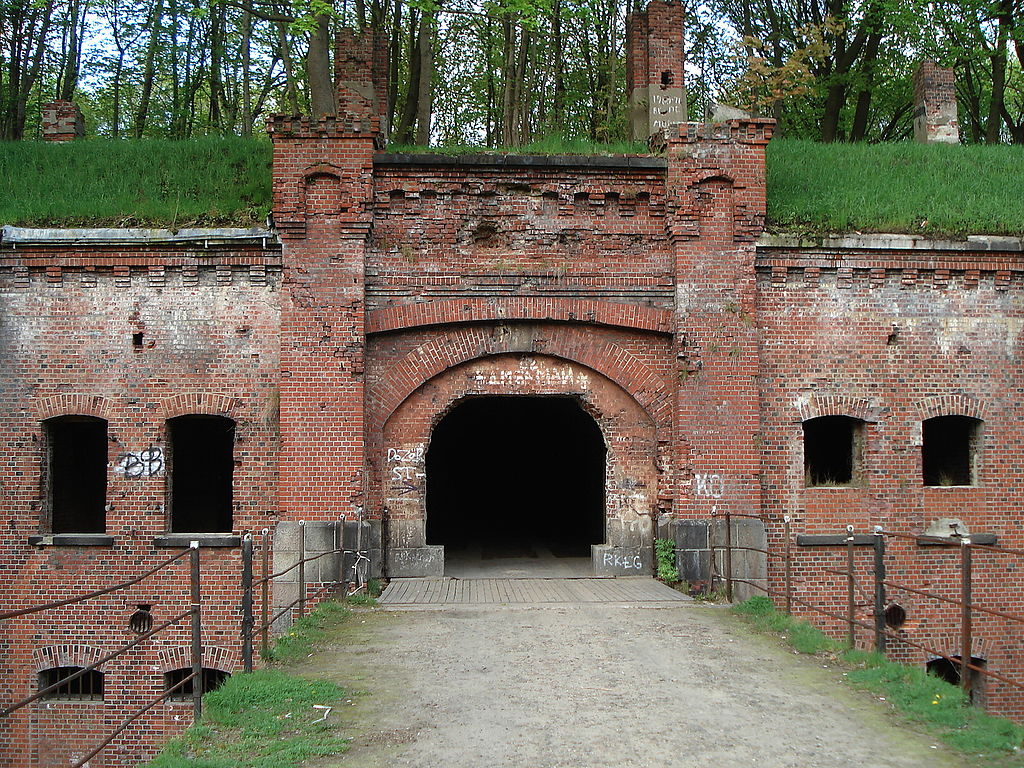
Fort No. 1 "Stein"

PJ43+FR Bolshoye Isakovo, Kaliningrad Oblast, Russia

Fort No. 1 "Stein" (German: Stein am Lauther Muhlenteich) is a military fortification located in a suburb of Königsberg, built between 1875 and 1879. Originally, the fort was called Laut, after the nearby former German settlement (German: Lauther; now the village of Bolshoye Isakovo). Since 1894, the fort was renamed in honor of Baron Heinrich Friedrich Karl von Stein, a prominent Prussian political figure of the early 19th century.


Fort No. 1 "Stein" (German Stein am Lauther Muhlenteich) is a military fortification located in the suburbs of Königsberg, built between 1875 and 1879. Originally, the fort was called Laut, after the nearby former German settlement (German Lauther; now the village of Bolshoye Isakovo). Since 1894, the fort was renamed in honor of Baron Heinrich Friedrich Karl von Stein, a prominent Prussian political figure of the early 19th century. Heinrich Friedrich Karl von und zum Stein – this is the full name of the Prussian statesman after whom Fort No. 1 "Stein" is named, which recently opened its doors to guests and residents of the Amber Region.

It is known that the Königsberg forts mostly bear the names of Prussian kings, generals, and statesmen from the Napoleonic Wars era. The Prussian Minister of Finance, Baron von Stein, was one of them. He abolished serfdom in Prussia and, during the difficult time after Prussia's defeat by Napoleon in 1807, headed the Prussian government. Respect for Baron von Stein in Russia was so great that Emperor Alexander I entrusted him to represent Russia at the Congress of Vienna in 1814-1815 as part of his delegation. This congress established a Europe-wide peace after the prolonged and bloody Napoleonic Wars. He was awarded the Order of St. Andrew the First-Called – the highest state award of the Russian Empire. Such an interesting crossroads of history: a German statesman and recipient of Russia's highest state award, whose name is borne by a Prussian fort in the now Russian city of Kaliningrad.


Fort No. 1 "Stein" is surrounded by a moat, to which bastion-like sections of the fort’s walls closely approach. The moat was up to two meters deep, and at the rear, a small bridge crossed it, connecting the fort with the adjacent territory.

During the storming of Königsberg by the Red Army from April 6 to 9, 1945, as part of the East Prussian operation during the Great Patriotic War, the fort was on a secondary axis of the Soviet troops' advance. As a result, the main Wehrmacht forces were redeployed to more important sectors. The forces withdrawn from this direction were used to break through German troops on the western front (Metgethen area). The fort’s garrison was significantly weakened and could not offer substantial resistance to units of the 44th Motorized Rifle Brigade of the 51st Rifle Division and the 58th Reserve Army Regiment.

By the morning of April 9, 1945, the fort and the surrounding areas were captured. The commandant of Fort No. 1, reserve Major Vogel, was shot by his own sergeant for refusing to surrender.

Due to weak resistance in 1945, Fort No. 1 "Stein" suffered the least damage from military actions.

In Soviet times, Fort No. 1 "Stein" was used as a vegetable storage facility for the Kaliningrad "Gorplodoovoshtorg" (City Fruit and Vegetable Trade). Since 1994, the casemates of Fort No. 1 "Stein" have been home to the family of Stanislav and Svetlana Laurushonis with their three children, who were born and raised in the fort. According to Svetlana Laurushonis, her family leased the fort back in 1991 for a term until 2058. Since then, family members have maintained the fort at their own expense, saving the building from looters and regularly conducting tours of the fort.

Sources:

https://ru.wikipedia.org/wiki/Fort_No._1_—_Stein


Follow us on social media

More stories from Kaliningrad: the ring of forts "The Night Featherbed of Königsberg"

Fort No. 1a "Gryoben"

PJM5+Q5 Kaliningrad, Kaliningrad Oblast, Russia

Fort No. 1a "Gröben" (German Groeben) is a fortification structure of the fortress city of Königsberg, one of the smaller forts, an intermediate fortification of the fort belt "Königsberg's Night Pillow," named after the Prussian General Karl von Gröben, a participant in the Battle of Preussisch Eylau in 1807.

Fort No. 2 "Bronzart"

PJX2+H9 Vasilkovo, Kaliningrad Oblast, Russia

Fort No. 2 Bronsart (German Bronsart bei Mandein) — a fort that protected the Königsberg-Tilsit highway, laid down in 1875 and completed in 1879. Named after General Paul Bronsart von Schellendorf. It was modernized in the 1890s. The garrison size reached up to 250 people.

Fort No. 2a "Barnekov"

QH4C+CJ Kaliningrad, Kaliningrad Oblast, Russia

The interfort or intermediate fortification 2a "Barnekov" served to support and cover forts No. 2 and No. 3. The well-fortified small fort has survived to this day in satisfactory condition. The structure and the surrounding area are slightly overgrown with bushes and trees. Until the beginning of the 20th century, its premises were used by a military unit, which was later disbanded.

Fort No. 3 "King Frederick III"

Alexander Nevsky St., 232, Kaliningrad, Kaliningrad Region, Russia, 236029

The correct and full name is Fort No. 3 "King Frederick the Third," sometimes referred to as "Kvednau" in certain documents or combat reports. It is the largest fort in Kaliningrad. Despite its ordinal number, it was built first. It faces northwest and was constructed between 1874 and 1879. Fort No. 3 impresses with its grandeur and carefully designed fortification elements.

Fort No. 4 "Gneisenau"

QF7Q+M6 Kaliningrad, Kaliningrad Oblast, Russia

Fort No. 4 "Gneisenau" is named after August Wilhelm Antonius Graf Neidhardt von Gneisenau (Count August Neidhardt von Gneisenau, a German military commander). Gneisenau demonstrated his military skill in 1807. He was able to organize the defense of the fortress of Kolberg. The French troops were unable to capture it. He was an ally of Russia in the fight against Napoleon. The construction date of the structure could not be established. There is no information in the cultural heritage registers or in post-war publications.

Fort No. 5 — King "Friedrich Wilhelm III"

Fort No. 5 "King Friedrich Wilhelm III", Bulatova St., Kaliningrad, Kaliningrad Region, Russia, 236019

Fort No. 5 — King Friedrich Wilhelm III — a military fortification in Königsberg (now Kaliningrad), which protected the highway to Pillau. It is part of the ring of forts known as the "Night Quilt of Königsberg." Named after King of Prussia Friedrich Wilhelm III (1770–1848), who led the state during the war with Napoleon.

Fort No. 5a "Lendorf"

PCQG+PX Kaliningrad, Kaliningrad Oblast, Russia

Fort No. 5a "Lendorf" is one of the three small lettered forts that were part of the defensive belt known as the "Night Quilt of Königsberg." Built in 1888-1889, it was named after the Prussian general, Count Karl von Lendorf (1770–1854), a participant in the Napoleonic Wars. It is a monument of 19th-century fortification art.

Fort No. 6 "Queen Louise"

Fort 6 "Queen Louise," Kaliningrad, Kaliningrad Region, Russia, 236010

Fort No. 6 "Queen Louise" (Königin Luise bei Juditten) is one of the forts of the inner defensive ring of Königsberg. The fort protected the railway and highways to Pillau (Baltiysk). It was built in 1875 and was a small fortress surrounded by a dry moat, equipped with the necessary set of ravelins, escarps, counterscarps, and other fortification features that allowed it to withstand enemy attacks for several months. The site is architecturally interesting—the bastion "Queen Louise" is three stories high, constructed using red and yellow bricks. The structure suffered almost no damage during the assault and remains well preserved to this day.

Fort No. 7 "Duke of Holstein"

Pr. Pregolsky, 13 A, Kaliningrad, Kaliningrad Region, Russia, 236010

Fort No. 7 "Herzog von Holstein" — one of the forts that were part of the defensive system known as the "Night Quilt of Königsberg," a monument of 19th-century fortification art. Located just west of the Pregolsky district, the fort is perhaps the strangest and most mysterious of all its Kaliningrad counterparts.

Fort No. 8 "King Frederick I"

MC8J+3G Shosseynoye, Kaliningrad Oblast, Russia

Fort No. 8 was built between 1878 and 1882 and is named after the first King of Prussia, Frederick I. The construction dates are still visible, engraved above the entrance. It is a two-tiered fort with a dry moat (currently flooded due to a damaged drainage system), measuring 205 by 135 meters. It covered the Königsberg-Heiligenbeil-Elbing railway and highway. It could partially support Fort No. 9 Dona and the adjacent sectors with fire.

Fort No. 9 "Dona" ("Ponart")

MF3P+74 Novo-Dorozhny, Kaliningrad Oblast, Russia

Originally, Fort No. 9 was named after the nearby settlement "Hoh-Karshau," and was renamed in 1894 in honor of the representatives of the famous von Don family. In some sources, the fort is called "Ponart." From the mid-1880s until the 1930s, Fort No. 9 underwent several modernizations, including the construction of a cofferdam.

Fort No. 10 "Kanitz"

MG2H+8C Road, Kaliningrad Oblast, Russia

Fort No. 10 Kanitz is located in the southwestern part of the fort belt of Königsberg / Kaliningrad. The construction date is 1877-1881. It is named after Major General Christoph Albert von Kanitz. It has a water moat. The bastion blockhouse is made of brick. It has not undergone significant modernization, except for the installation of additional exits from the barracks section to the inner courtyard.

Fort No. 11 "Dönhoff"

Fort Dönhoff, Energetikov Street, Kaliningrad, Kaliningrad Region, Russia, 236034

Fort No. 11 was built between 1877 and 1881. Originally, the fort was called "Seligenfeld," but in 1894 it was renamed in honor of Count Friedrich von Dönhoff (1639–1696), the governor-general of Memel (now the city of Klaipėda, Lithuania) and the owner of the Friederichstain estate (now the village of Kamenka). According to other sources, the fort was named after the entire Dönhoff family, which included many members who left a significant mark on the history of Prussia. Above the entrance to the fort, one can see a well-preserved coat of arms of the Dönhoff family featuring a boar's head.

Fort No. 12 "Oylenburg"

MHCX+JX Kaliningrad, Kaliningrad Oblast, Russia

Fort No. 12 — Eulenburg, originally had a different name – "Neudorf." It was also named after the nearby settlement. It is located on the shore of Engineer Lake, near the left branch of the Pregolya River. It is built almost to standard, without any design features.