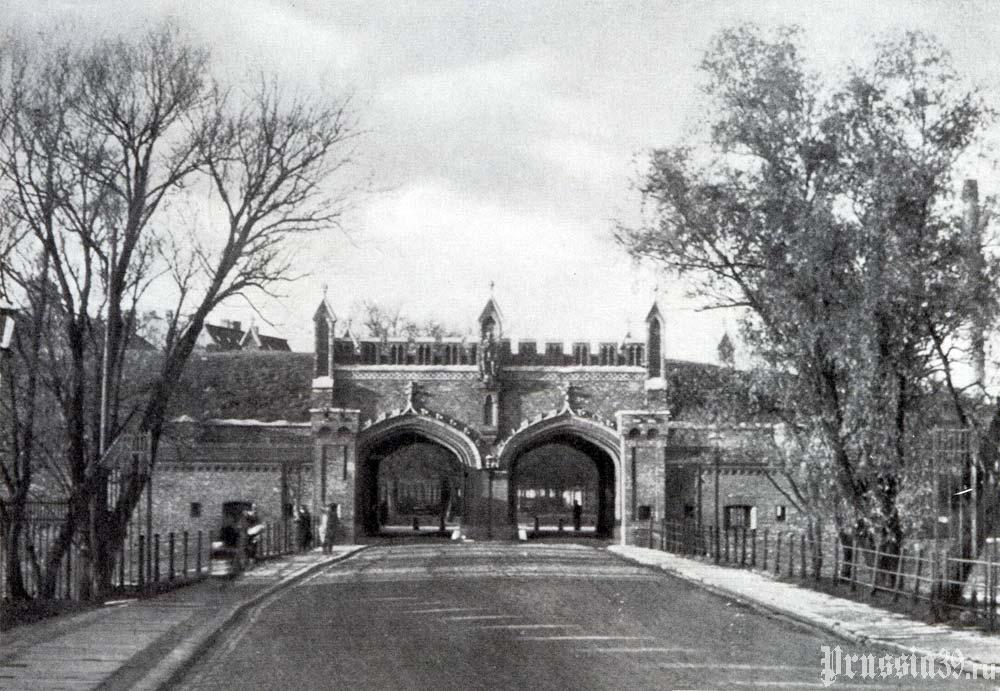
Friedland Gate

30 Dzerzhinsky Street, Kaliningrad, Kaliningrad Region, Russia, 236004

One of the eight surviving city gates of Kaliningrad. Located at the intersection of Kalinin Avenue and Dzerzhinsky Street, adjacent to Yuzhny Park (formerly the 40th Anniversary of the Komsomol Park). The gates house a museum.


Friedland Gate (German: Friedländer Tor) is one of the eight surviving city gates of Kaliningrad. It is located at the intersection of Kalinin Avenue and Dzerzhinsky Street, adjacent to South Park (formerly the 40th Anniversary of the Komsomol Park). A museum is housed within the gate.

The very first city gates on the road to Friedland were built in the 17th century, although they stood in a different location. The gates that have survived to this day were constructed between 1857 and 1862. History has not preserved the exact date of construction nor the name of the architect who designed the project. Some researchers attribute the authorship to the 19th-century Berlin urban planner Friedrich August Stüler, but there is no evidence to support this.

The name of the gate is connected to the city of Friedland, now known as Pravdinsk. The first Friedland Gates were built in the 17th century, but they were not located where the current ones stand. The presently preserved Friedland Gate became the last gate of Königsberg (meaning it was the last to be built). The exact date of their construction is unknown, with approximate dates being 1857–1862. The architect is also unknown. At the beginning of the 20th century, the outdated gates, having lost their military significance, along with the entire second defensive belt, were sold by the military ministry to the city. At that time, traffic through the gates was stopped because part of the now unnecessary defensive rampart was dismantled, and the road to Friedland (now Dzerzhinsky Street) began to pass beside the gate.

After the war, the gate stood empty for a long time, then it was used as a warehouse. In the late 1980s, workers clearing South Park and cleaning artificial ponds found many rare artifacts. To allow as many people as possible to see these curious items, a museum was established, with its collection based on the rarities discovered in the park.

The facade of the gate facing the city is divided into six parts by five buttresses. The buttresses are topped with pointed gable decorative towers that rise above a decorative battlemented parapet. All the external openings of the gate (passages, windows, doors) are made in the form of pointed arches and decorated with perspective portals. The two central parts of the gate are occupied by passages. The dimensions of the passages are 4.39 meters wide and 4.24 meters high. The sections at the edges are occupied by casemates.

The surface of the gate’s facade is decorated with a kind of net, representing a rhombic pattern. The “threads” of this net are laid out with bricks of a different color.

The facade of the gate was decorated with a statue of the Grand Commander Friedrich von Zollern, which has not survived (disappeared after the war). Another statue, depicting the Grand Master Siegfried von Feuchtwangen—the founder of the Middle Castle in Marienburg (now Malbork, Poland)—is located on the outer side of the gate. The sculptor of these statues was Wilhelm Ludwig Stürmer. Currently, the sculptures have been restored (the Feuchtwangen statue in 2005, the Zollern statue in 2008).

On the outer side of the gate is a guardhouse.

Sources:

https://ru.wikipedia.org/wiki/Friedland_Gate_(Kaliningrad)

https://www.prussia39.ru/sight/index.php?sid=544


Follow us on social media

More stories from Kaliningrad: the ring of Königsberg fortifications in the mid-19th century

Zakkhaim Gates

Litovsky Val St, 61, Kaliningrad, Kaliningrad Oblast, Russia, 236006

The Sackheim Gate (German: Sackheimer Tor) is one of the eight surviving city gates of Kaliningrad. It is now the site of the contemporary art platform "Vorota" at the intersection of Moskovsky Prospekt and Litovsky Val. The gate was originally part of the First Rampart Fortification of Königsberg, built in the early 17th century according to a design by Professor Strauss of Königsberg University. The Sackheim brick gate was constructed by order of King Frederick II between 1750 and 1755. From 1860 to 1865, during the modernization of the fortifications, the Sackheim Gate was rebuilt according to a design by Ernst Ludwig von Aster. In the early 20th century, the rampart was dismantled, and the gate was sold by the military department to the city.

Don Tower

Marshal Vasilevsky Square, 1, Kaliningrad, Kaliningrad Region, Russia, 236029

Part of the surviving defensive rampart structure of German construction in Kaliningrad is named after the Prussian General Field Marshal Friedrich Karl zu Don, who is one of the authors of the project for building the defensive ring around the fortress city of Königsberg.

Friedrichsburg Gate

30 Dzerzhinsky Street, Kaliningrad, Kaliningrad Region, Russia, 236004

The Friedrichsburg Gate is the only surviving element of the fortress (later a fort) in Königsberg (now Kaliningrad) Friedrichsburg, which is now one of the city's landmarks.

Royal Gates

Frunze St., 112, Kaliningrad, Kaliningrad Region, Russia, 236038

One of the seven gates that were part of the fortification line of the fortress city of Königsberg. King of Prussia Friedrich Wilhelm IV took part in its foundation on August 30, 1843.

Brandenburg Gate

Bagration Street, 137, Kaliningrad, Kaliningrad Region, Russia, 236039

One of the eight surviving city gates of Kaliningrad. Located at the end of Bagration Street, which continues as Suvorov Street (formerly Berlin Street), on the border of the historic city district of Haberberg.

Rosgarten Gate

Marshal Vasilevsky Square, 3, Kaliningrad, Kaliningrad Region, Russia, 236035

One of the eight surviving city gates of Kaliningrad. Located at the intersection of Chernyakhovskogo and Alexander Nevsky streets, near Vasilevsky Square and the Amber Museum.

Tragheim Gate

Victory Square, 1b, Kaliningrad, Kaliningrad Region, Russia, 236029

They were located in Königsberg (Prussia) in the Traghaym district. The Traghaym Gate stood on Melnichny Lane, which ran along Valgasse and led to Palvehof and Maraunenhof.

Ausfahl Gates

Monument to 1200 Guardsmen, Kaliningrad, Kaliningrad Region, Russia, 236006

Ausfal Gates (also: exit gates, from German Ausfalstor, gates for sorties) are one of the eight surviving city gates of Kaliningrad. They are located in the southwest corner of the intersection of Guards Avenue and General Field Marshal Rumyantsev Street, in close proximity to the monument to the 1200 Guardsmen.

Railway gates

St., Guards Avenue, 51a, Kaliningrad, Kaliningrad Region, Russia, 236006

One of the eight surviving city gates of Kaliningrad. The gate is located beneath the roadway of Gvardeysky Prospekt, next to the monument to the 1200 Guardsmen. A pedestrian path passes through the gate, leading to the park located behind the monument.

Wrangel Tower

2 Proletarskaya St., Kaliningrad, Kaliningrad Region, Russia, 236029

The tower was built in 1853 as part of the fortifications of Königsberg and was named after General Field Marshal Wrangel. The project was designed by Ernst Ludwig von Aster. Similar towers of precisely round shape began to be used as early as the early Middle Ages. Many ideas of fortification architecture trace back to the 18th-century French reformer Marc René de Montalembert, who proposed the design of the famous Montalembert towers.

Bastion Grolman

21 Litovsky Val St., Kaliningrad, Kaliningrad Region, Russia, 236038

The Grolman Bastion (German: Grolman Bastion) was constructed between 1851 and 1860 based on the design of Ernst Ludwig von Aster as part of the fortifications of Königsberg. It was named after the reformer of the Prussian army, General Karl von Grolman, who distinguished himself in battles against Napoleon. It is the central part of the Grolman Upper Front, occupying the area from Alexander Nevsky Street to Frunze Street and consists of the "Oberteich" and "Kupferteich" bastions, the main rampart (Lithuanian Rampart) between the bastions, and a moat filled with water. Inside the rampart are casemates and caponiers.

Astronomical Bastion (Sternwarte Bastion - Bastion Observatory)

3A General Field Marshal Rumyantsev Street, Kaliningrad, Kaliningrad Region, Russia, 236022

The bastion got its name (German Sternwarte) from the adjacent Königsberg Observatory, founded in 1813 by the outstanding German astronomer and mathematician Friedrich Bessel (1784–1846). The observatory itself was destroyed in 1944 during the bombing of Königsberg by the British Royal Air Force, but the bastion was not damaged.

Bastion Kronprinz

38 Litovsky Val St., Kaliningrad, Kaliningrad Region, Russia, 236038

The "Kronprinz" bastion was built in the first half of the 19th century. At that time, military barracks were located inside the bastion. The building itself has four floors. Special attention was given to the construction of the cellars: they were made particularly deep. All the underground passages are connected to each other through a special tunnel system. A large moat surrounded the bastion. To enhance protection, a row of sharp battlements was placed on the roof. There was a large courtyard on the barracks' grounds.