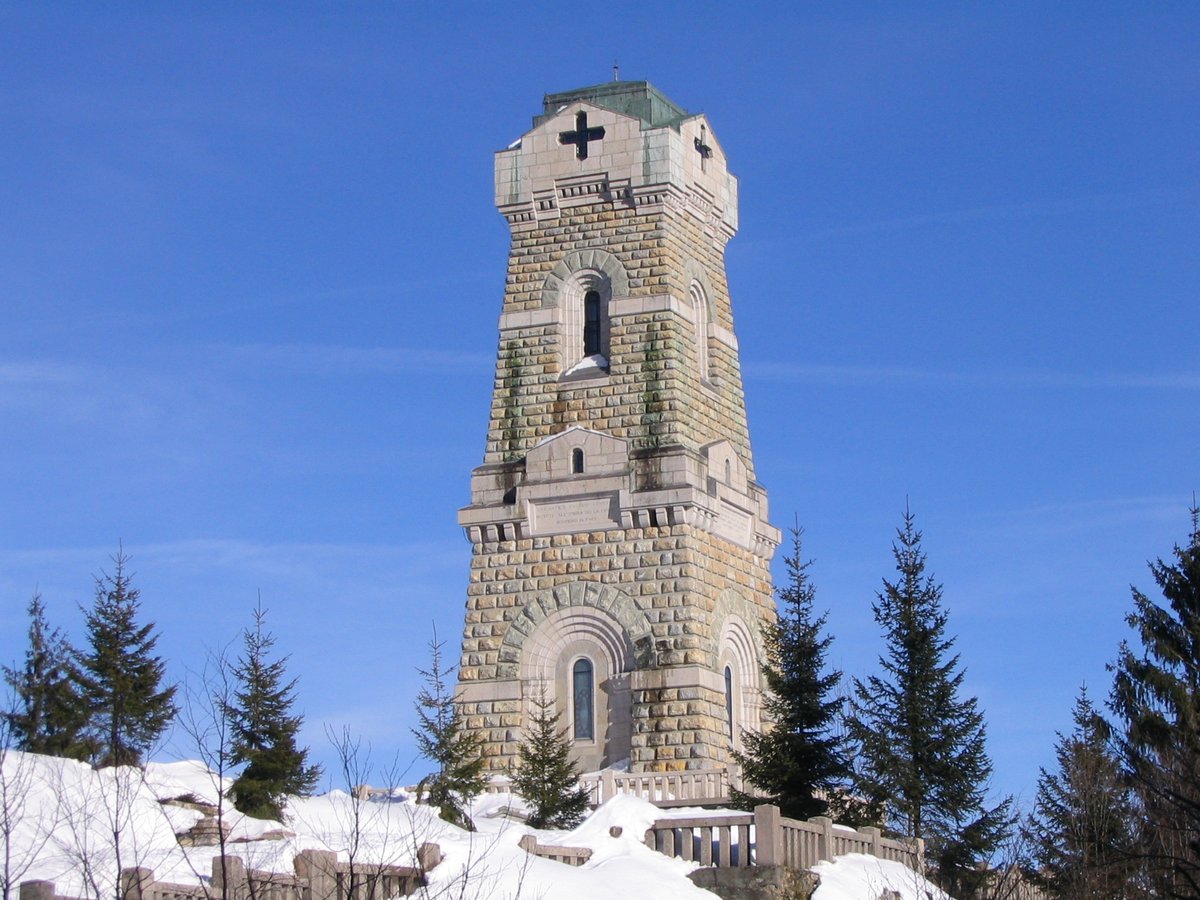

The military shrine of Valli del Pasubio, also known as the sacello-ossario of Pasubio or the ossary of Pasubio, is a monument dedicated to the fallen soldiers of World War I. It is located on the Bellavista hill overlooking Val Leogra, about 2 km from Pian delle Fugazze, connected to the pass itself through the diversion of the state highway 46. The position chosen allows the shrine to be seen from the subordinate valley of Vicenza. The shrine of Pasubio, Tonezza del Cimone, Monte Grappa, and Asiago appear on one of the four quarters of Vicenza's coat of arms.
The shrine was built between 1920 and 1926 by the Fondation '3 Novembre 1918 pro combattenti della 1ª Armata', inaugurated on August 29, 1926. The shrine stands at 35 meters tall with a luminous lantern on its summit. It consists of two parts: the ossuary and the sacellum. The ossuary, located in the base of the tower, houses a central crypt and two concentric galleries. Seventy decorated soldiers' remains are collected in the ossuary, and the remains of General Guglielmo Pecori Giraldi are buried there.
The sacellum is located at the top of a wide staircase that leads to a terrace with a balustrade. The crypt, the small chapel on the ground floor, and all the floors of the sacellum are decorated with artistic glasses and frescoes of Fornaci San Lorenzo, Manifattura Chini of Borgo San Lorenzo, which were designed by Tito Chini.
The Fondation '3 Novembre 1918', proposed by Guglielmo Pecori Giraldi and dedicated to the memory of the fallen soldiers of the Great War, erected this sacellum-ossuary, whose internal decorative painting was entrusted to Tito Chini. The Fondation '3 Novembre 1918' also decorates the cemeteries of war in Treviso, Schio, Verona, Trento, and the temple ossuary of Bassano del Grappa. Every year, the last Sunday of June, there is a celebration in memory of the fallen soldiers in correspondence with the anniversary of the bloodiest battle that took place on the nearby massif, the 2nd of July 1916.
Sources: Wikipedia, OpenStreetMap, Wikidata, Wikimedia Commons
Written by Nicolo Ciampini
Discuss this with the author and others
No comments yet. Be the first to start the conversation.