


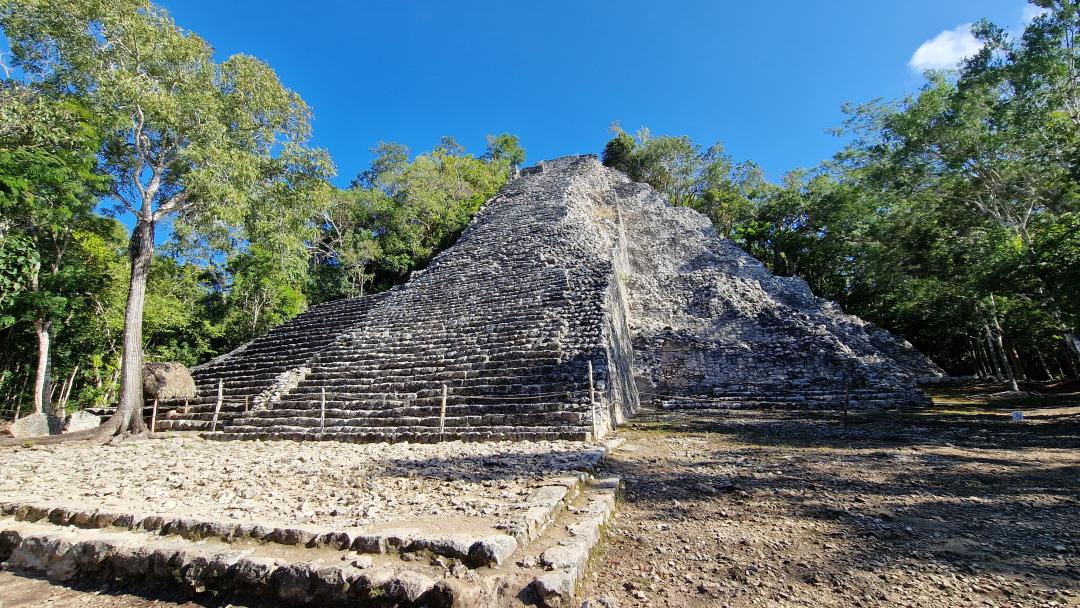
The central element of the Maya ruins in Coba is the Ixmoja (Ixmoja) pyramid, also known as Nohuch Mul, or the Great Pyramid. It is believed that the base was built in the Early Classic period (250 - 550 AD), and the temple at the top during the Late Classic period (1200 – 1539 AD). Its name means “big hill” or “great mound.” However, some archaeologists distinguish between the mound on the right, which they call the Great Platform or Monjas, and the Great Temple on the left, built on this stone mound. The steepness of the Nohuch Mul pyramid and the construction techniques used here are characteristic of the Petén region in Guatemala. It has been compared to the pyramids of Tikal, where the tallest Maya pyramids are located. Judging by the variety of influences visible in its architecture (Teotihuacan, Petén, and Toltecs), Coba apparently was a very cosmopolitan city. People often associate Maya pyramids with Egyptian pyramids. Some, like Thor Heyerdahl, even suggested that Egyptians made transatlantic voyages and brought the idea of pyramid building to Mesoamerica. Although there is a superficial similarity in shape between Egyptian and Mesoamerican structures, their cultural purpose, meaning, and social functions differ greatly, making the idea of Egyptian influence very unlikely. One of the most fundamental differences is that Egyptian pyramids are tombs, usually located in a necropolis and built in a single burst of activity for a specific individual. Maya pyramids, with rare exceptions (e.g., Pakal in Palenque), are not tombs but temples. Instead of being in remote peripheral areas, Maya pyramids are located in the urban centers of their cities. They served the same functions as cathedrals in European cities. They were not built by a single massive effort but are the result of centuries of accumulation. Like a set of nesting dolls, each new iteration of the temple buries the previous version. Inside the pyramid, many previous versions are buried. This may date back to the earliest Preclassic structure, which was just a raised platform with wooden walls and a thatched roof.
The pyramid is 42 meters high, making it the second-largest Maya structure on the Yucatán Peninsula (Calakmul II, at 45 m, is the tallest). Climbing the old steps can be intimidating for some. Two images depicting a descending god, painted in blue and red, are carved above the temple doorway at the top (built in the Postclassic period, 1100-1450 AD), similar to sculptures in Tulum. Little is known about this god, and his image appears in only a few places on the Yucatán Peninsula. The most famous of these places is Tulum, located east of Coba on the coast. It is believed that in the Postclassic period, when Coba had become a shadow of its former self, Tulum became a regional power and took control of the city. There are several temples and buildings that seem to have been “renamed” after the deities of the new power in an attempt to assert their authority. These projects were the last major works carried out in the city before it was completely abandoned and fell into decline. This temple once had a “crest” or “comb-like” structure on top, which has since collapsed. Inside this temple is a small room that has been restored; there are no traces of any frescoes or carvings.
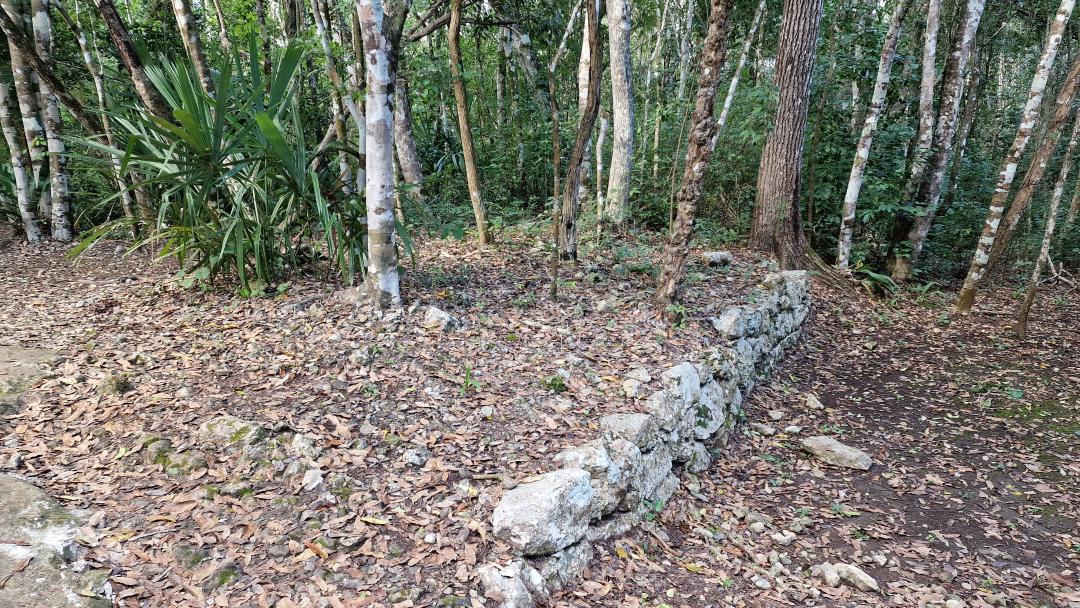
Another distinctive feature of the pyramid is the presence of three temples located on three levels — at the base of the pyramid, midway up, and directly at the summit — as well as two parallel staircases, central and northern, leading to Temples I and II respectively — an extremely atypical architectural solution for the Classic Maya period. Beside the main staircase is another staircase leading to a vaulted chamber, inside which a fragment of a stela carved on both sides has been preserved. On the other side of the central staircase, two adjacent rooms were built at different foundation levels; one is at the same level as the plaza, and the other at the level of the first structure. Unfortunately, only the main staircase has been cleared and reconstructed. The rest of the pyramid looks like a hill covered with trees and shrubs.
What is definitely known is that temples like this were covered with thick layers of painted and molded plaster. Most of the pyramid would have been brownish-red (ochre being the most common pigment) with details highlighted in bright green, yellow, black, and blue tones. There is evidence that mica and other reflective stones were ground and mixed with the plaster. This would have made the pyramid dazzling by day in sunlight and glowing at night under bright moonlight. Being the tallest pyramid on the Northern Yucatán Peninsula, it must have served both as a beacon and a landmark visible for many miles in all directions. Today, looking at the bare stones, it is hard to imagine its former splendor, but tiny traces of color that remain help to restore the past.
The Nohuch Mul complex does not have a clear orientation to the cardinal points — however, it likely aligns with the line of the spring and autumn equinoxes, since all buildings in the complex, except for the Nohuch Mul pyramid itself, are positioned with slight deviations at the same angle as the E-group.
Climbing this pyramid is thrilling, despite not being an easy task. To reach the top of Nohuch Mul, you have to conquer 120 uncomfortable narrow steps. As you ascend, closer to the summit, a slight nervousness sets in, as the staircase narrows and there are no railings. However, from the platform at the top, a breathtaking panorama of dense endless jungle dotted with ancient Maya structures unfolds. Photos do not fully convey the beauty and grandeur of this “Great Pyramid.” To truly appreciate this climb, you have to do it yourself.
It is worth noting that the hardest part of this climb is the descent. Going up you can somehow manage, but coming down is a challenge! Many tourists simply sit down and slowly slide down the steps to return. Descending is indeed scary, uncomfortable, and dangerous. The stone slippery steps are so small that you can easily slip and tumble at any moment. Therefore, it is better to be patient, not rush, and slowly pass step by step, holding onto special rope handrails. However, due to COVID-19, access to the pyramid remains closed.
From the top, you can see many square kilometers of flat low forest with glimpses of lakes. As in most of the Yucatán Peninsula, the terrain here is flat. From the pyramid’s summit, you can see for many miles in all directions. It is hard to believe that you are looking at the ruins of a huge city that once covered about 25 square miles. The jungle completely hides almost all its traces.
Sources:
https://meksika.info/strana/dostoprimechatelnosti/piramidy-goroda-koba-v-meksike/#i-6
https://www.boundlessroads.com/coba-ruins/


Written by Jermaine
Discuss this with the author and others
No comments yet. Be the first to start the conversation.