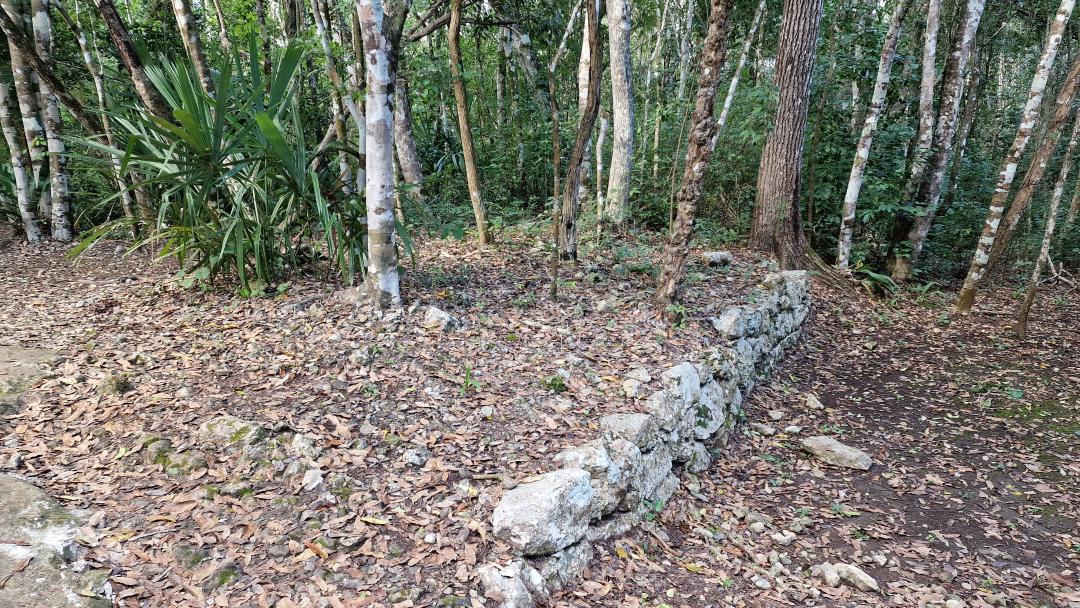
Hieroglyphic slab - Hieroglyphic slab

F7VG+46 Monte Carmelo, Quintana Roo, Mexico

A large hieroglyphic slab is installed in the center of the northern slope; it has 74 glyphic images that record historical events that took place during the Early Classic period.

A large hieroglyphic stone slab is installed in the center of the northern slope; it contains 74 glyphic images that record historical events that took place during the Early Classic period. It is mentioned that in the year 465 AD, the local ruler with the title Kalomte—one of the most outstanding representatives of the classical dynasties—celebrates the completion of a ten-year cycle, and that 108 days later another noble dedicates a stone monument to the ballgame. The third inscription refers to the construction of a ballgame court in Cobá.

Sources:

https://pueblosoriginarios.com/meso/maya/sitios/coba_coba.html


Follow us on social media

More stories from Maya Cities of Mexico: Coba

Koba - one of the largest Maya cities, an ancient logistics center

Quintana Roo Nuevo Durango - Coba 175, 77793 Q.R., Mexico

Koba is located in the western part of the Mexican state of Quintana Roo, near the border with Yucatán. The city clusters its architectural ensembles around five lakes, two of which (Koba and Makanshok) are in its central part, while the other three (Shkanha, Sakalpuk, and Yashlaguna) border it from the outside. The first mention of Koba belongs to Stephens and dates back to 1842; however, the famous traveler was unable to visit the ruins of the ancient city. Between 1926 and 1932, a series of studies of the monument were conducted by the Carnegie Institute in Washington under Thompson's leadership. However, a full-scale investigation of the ancient city began in 1974 with the work of the National Institute of Anthropology and History of Mexico and continued until the early 1980s, which saved the city from early unprofessional excavations and the removal of finds to the USA.

Pyramid of Nohoch Mul or Ixmoja (Nohoch Mul or Ixmoja)

F7VH+RV Monte Carmelo, Quintana Roo, Mexico

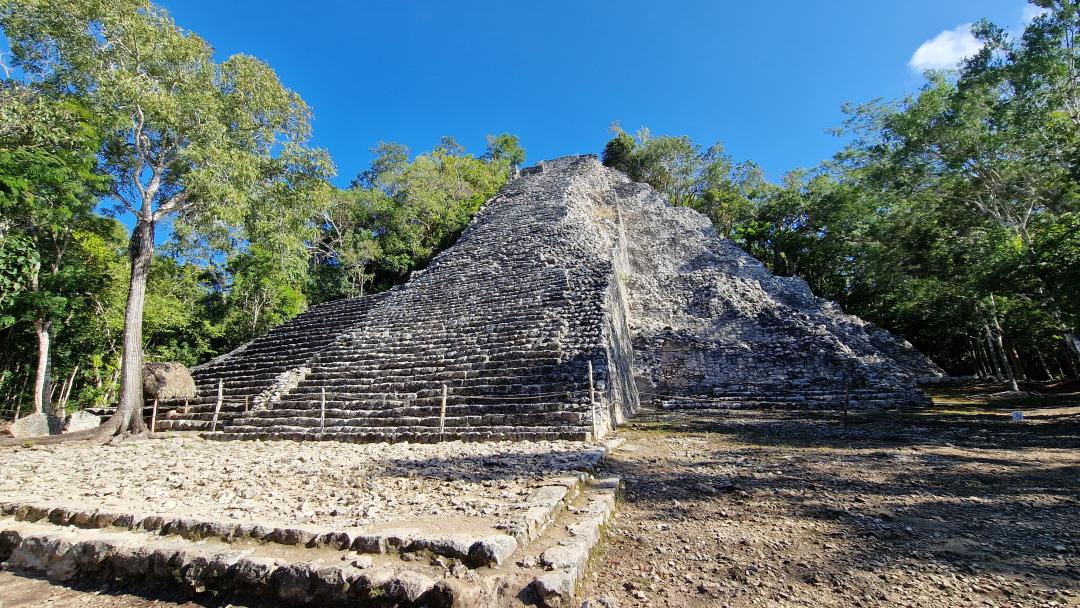
The central element of the Maya ruins in Coba is the Ixmoja Pyramid, also known as Nohoch Mul, and also known as the Great Pyramid. It is believed that its base was built in the Early Classic period (250 - 550 AD), while the temple at the top was constructed in the Late Classic period (1200 – 1539 AD). Its name means "big hill" or "great mound."

Maya Roads (Sacbe)

F7VH+P7 Monte Carmelo, Quintana Roo, Mexico

All sacbeob (roads of the ancient Maya) apparently had not only a utilitarian but also a ritual or religious significance for pilgrimages. The writer-traveler and early Mayanist John Lloyd Stephens reported that some local Maya inhabitants in Yucatán still recited a short ritual prayer when crossing a sacbe in the early 1840s, even though by that time they had been overgrown by jungle for centuries.

Pyramid Church - La Iglesia

F7Q9+X7 Coba, Quintana Roo, Mexico

The building known as the Church has a foundation consisting of nine blocks with rounded corners. It is made up of several construction phases that overlap each other. Its construction began in the Early Classic period (300-600 AD), and the last modification was made in the Postclassic period. It is the second tallest building on the site, standing 24 meters high, with windows facing the Coba lagoon.

Set of Paintings

F7RF+3V Monte Carmelo, Quintana Roo, Mexico

The temple in the Group of Paintings (Painting Complex) has preserved traces of hieroglyphs and frescoes above the door, as well as remnants of richly painted plaster inside. The Painting Complex, in turn, stands out for its pyramid (the smallest in all of Coba) and the frescoes that once covered its walls, from which the remains of beautiful paintings from a distant and enchanting era can still be distinguished.

Ballgame court - Juego de Pelota in Cobá

F7VG+48 Monte Carmelo, Quintana Roo, Mexico

One of the two ball games of Koba from the late classical period. It consists of two parallel buildings, between which there is a court. Each building is unique: the building on the eastern side has two staircases, one at the back and one on the northern side, both leading to a taller building with vaulted rooms. On the west, there is no staircase leading to the upper structure, which was probably covered with leaves.

Perekrestok - Xaibé

Coba archaeological site, 77793 Q.R., Mexico

Next to Nohoch-Mul is a beautifully restored conical structure that archaeologists have named Xcaibe, which in the Yucatec Maya language means "crossroad," due to the fact that sacbe 1, 5, 6, and 8 converge near the building. For the same reason, archaeologists believe that it may have served as a watchtower.