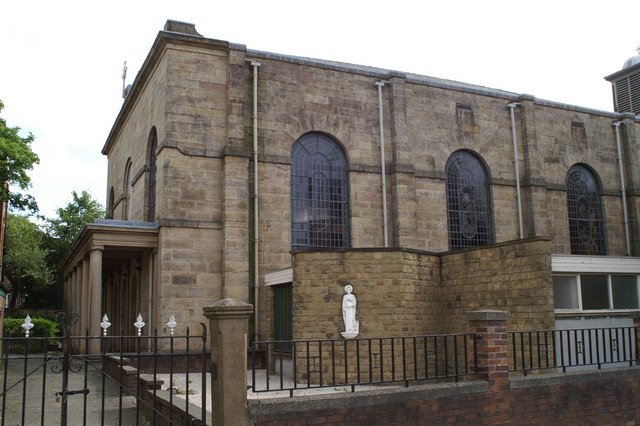
In Standishgate, Wigan, stands St John's Church, a Grade II² listed building built in 1819. However, this Catholic church was not the first place of worship in the area. There was a chapel or chapels before the construction of St John’s. The story of St John’s, and its competition with St Mary’s next door, began in 1623 when the Jesuits divided the country into 'residences'. St John’s was named after the 'residence' that covered Lancashire, St John’s.
It was Fr Charles Brockholes SJ, who arrived in Standishgate in 1740, who first connected to the mission of St John's. Fr Brockholes paid for the building of a house in 1740 with a chapel upstairs. This house, now hidden, houses a priest's hole above a fireplace – a relic of an age when Catholic priests had to hide from persecution. The house was built between Dicconson Street and Powell Street, and for centuries, it has been an important center of local Catholic life.
In 1817, the increasing Catholic population of the town meant that there were calls for a larger place of worship to be built. A plot of land behind the chapel was used for construction and the foundation stone was laid on 27 January 1818. The church was opened on 24 June 1819. The new church cost £9,000 and could accommodate a congregation of 1,000 people. It was 120 feet long, 50 feet wide and 50 feet high, with room for the parishioners in the organ gallery.
Over the following decades, the church was extended and renovated. In 1849, the interior of St John's was again decorated at a cost of £400. In 1933, the Jesuits relinquished the church to the Archdiocese of Liverpool, so both churches were staffed by diocesan priests. Today, St John's is part of St William's parish and still serves the Catholic community of Wigan.
Sources: Wikipedia, OpenStreetMap, Wikidata, Wikimedia Commons
Written by Nicolo Ciampini
Discuss this with the author and others
No comments yet. Be the first to start the conversation.