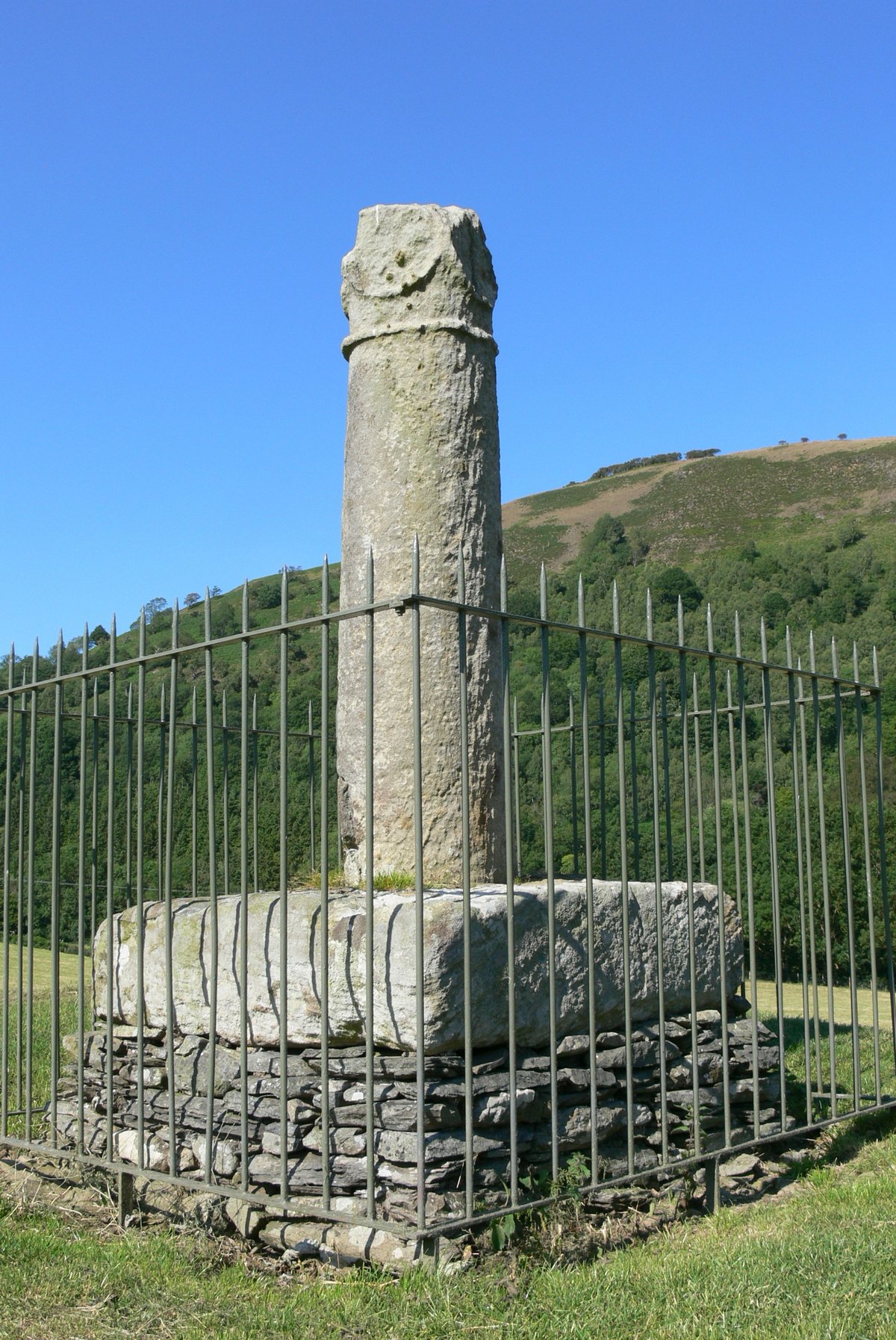

Near Valle Crucis Abbey in Denbighshire, Wales, stands Eliseg's Pillar, a monument erected by Cyngen ap Cadell to honor his great-grandfather Elisedd ap Gwylog. While the pillar itself dates to the 9th century, it stands upon a large artificial mound thought to be significantly older, probably from the Early Bronze Age. The monument bears a Latin inscription in insular script that mentions several individuals described in the Historia Brittonum and remains one of the longest surviving inscriptions from pre-Viking Wales.
The pillar has a long history of upheaval and preservation. It was thrown down by the Roundheads during the English Civil War, opening a grave beneath it. In 1696, the antiquarian Edward Lhuyd examined the pillar and copied the inscription, which was remarkably accurate. While the lower half of the pillar disappeared over time, the upper half was re-erected in 1779. The original inscription is now illegible.
Archaeological excavations conducted by Project Eliseg between 2010 and 2012 revealed the complex history of the mound supporting the pillar. The earliest phase of construction was a kerbed platform cairn dated by type to around 2000 BC, which contained a small cist with evidence of burnt human bone. A second phase, from the Early Bronze Age, included a large cist and another containing 7 kg of cremated bone from various age groups, along with a flint knife and a bone pin. A final phase of construction appears to be relatively modern, likely occurring after the re-erection of the cross.
Sources: Wikipedia, OpenStreetMap, Wikidata, Wikimedia Commons


Written by Nicolo Ciampini
Discuss this with the author and others
No comments yet. Be the first to start the conversation.