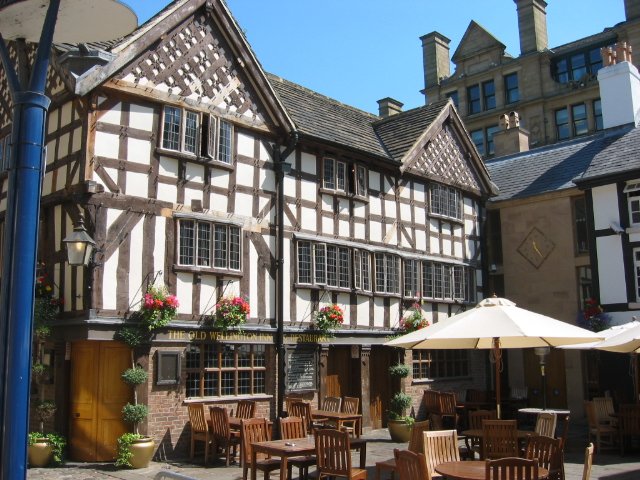

The Old Wellington Inn is the oldest half-timbered pub in Manchester city centre. Built in 1552 next to a market in what was known as the Shambles, it has spent nearly five centuries trying to stay standing while the rest of the city was torn down or blown away.
In the 18th century, it served as a punch house for High Tories and potential Jacobites. The landlord, John Shaw, was a stickler for discipline. When the clock struck eight, he would announce the closing time with the crack of a horsewhip. If the guests did not leave, his maid, Molly Owen, was instructed to use a mop bucket to "expedite the movement of the loiterer." I have to wonder if she was a very efficient woman - or just a very wet one.
By the 1970s, centuries of settling had left the building so crooked that the floors and ceilings were all awry. To save it, engineers underpinned it with a concrete raft and used hydraulic jacks to lift the entire structure five feet into the air over three months. They stripped the interior to a steel bracing framework, essentially leaving the original Tudor curtain walling as a shell for a modern interior.
After a bombing in 1996, the pub faced its final relocation. It was dismantled and moved 300 metres toward the cathedral to form Shambles Square. Today, it stands as a survivor - a piece of 16th-century timber held up by 20th-century engineering.
Sources: Wikipedia, OpenStreetMap, Wikidata, Wikimedia Commons

Written by Nicolo Ciampini
Discuss this with the author and others
No comments yet. Be the first to start the conversation.