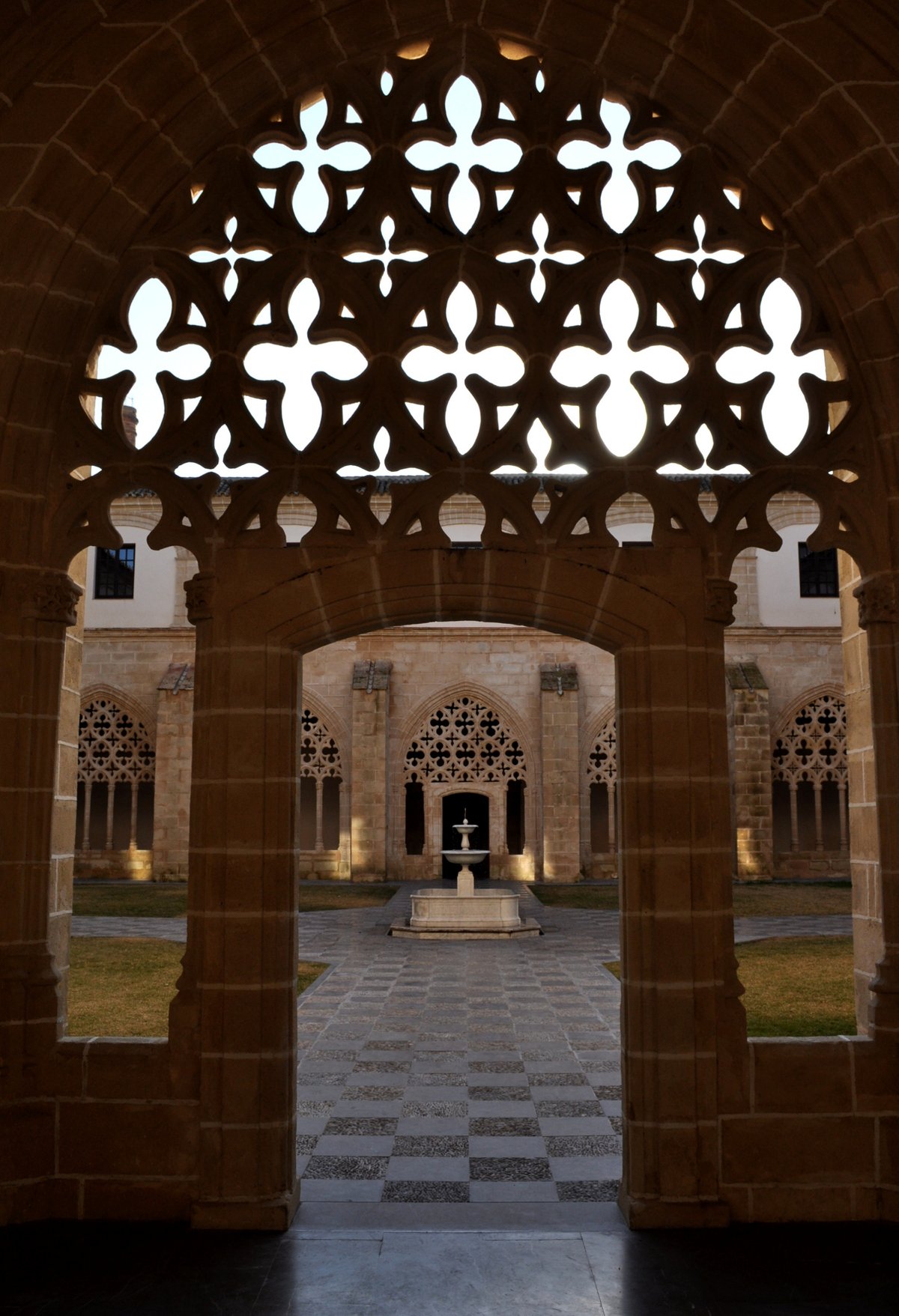

The labyrinthine Cloisters of Santo Domingo in Jerez de la Frontera are shrouded in mystery. Originally built by the Almohads and later donated to the Dominicans by King Alfonso X in 1264, the Cloisters were expanded by the Dominicans, completing construction in 1595. However, a 14th-century document claims that the Dominicans forged a document to claim ownership over lands beyond the city limits, including a field and an orchard intended for the construction of the monastery.
By the 18th century, the Dominicans were expelled, and the monastery fell into a state of decay. It wasn't until 1908 that Salvador Díez y Pérez de Muñoz, a local businessman and historian, purchased the monastery and began its restoration. Today, the Cloisters are a popular cultural and architectural destination in Jerez de la Frontera, featuring a deambulatorio, original walls from the 13th century, and a grave from the 16th century. The Cloisters are organized around a central courtyard, with two-story-tall passages covered by simple cruceria vaults.
The Claustro Alto dates from the 18th century, while the Dormitorio Bajo is from the 16th century, housing the monks' sleeping quarters. A Renaissance-style vault can be found in the refectorio, while the Oratorio de Diego de Ribadeneira, with a grate from 1572, provides a glimpse of its history. The Portada Almohade, the only visible remnant of the original Islamic building, was given to the Dominicans after the conquest of the city in 1264.
Sources: Wikipedia, OpenStreetMap, Wikidata, Wikimedia Commons
Written by Nicolo Ciampini
Discuss this with the author and others
No comments yet. Be the first to start the conversation.