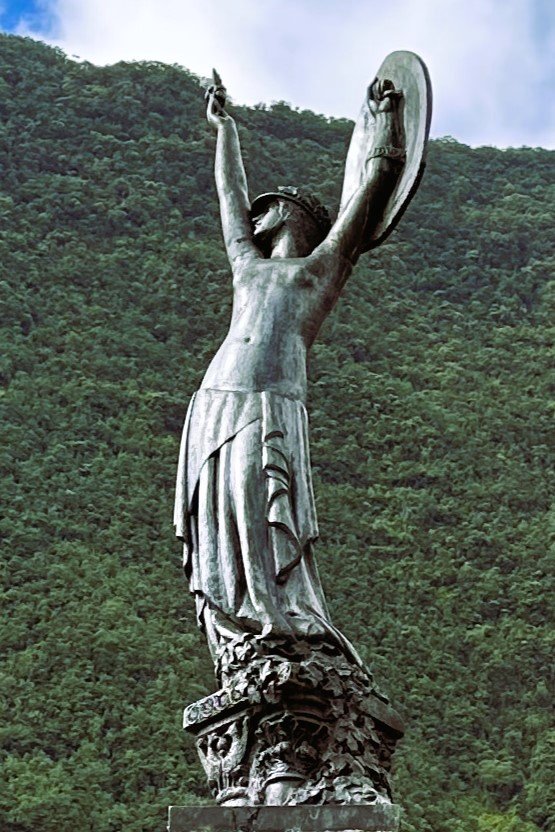

Once called 'The Soul of France', this title was bestowed upon it by French sculptor Carlo Sarrabezolles, who crafted three identical sculptures during the interwar period. One of these masterpieces finds its home in Hell-Bourg, on the island of Réunion, cast in 1930, and depicting a fearless warrior woman. But her avant-garde features - exposed breasts - made her a peculiar choice for some. When presented to the commune of Salazie in 1931, the statue became the subject of a politico-religious battle led by Father Gabriel Bourasseau, a young, passionate priest.
He began to mobilise the faithful in favour of its destruction. In an attempt to defuse the situation, inhabitants proposed covering the statue's naked breasts with clothing, but mayor Didier Fontaine rejected this solution. Several years later, they finally resorted to dynamite which succeeded in bringing it down, breaking its arms in the process. The debris was kept in a hangar behind a hairdresser's shop in Salazie.
After the Second World War, the bronze L'Âme de la France was rehabilitated as a war memorial and its arms were welded back on. It was moved out of Salazie centre toward Hell-Bourg, where it was set up in a little garden. Today, the statue serves as a memorial symbolising 'the victory of a France grateful to her dead' - specifically the soldiers who fell during World War I.
Sources: Wikipedia, OpenStreetMap, Wikidata, Wikimedia Commons
Written by Mutabor
Discuss this with the author and others
No comments yet. Be the first to start the conversation.