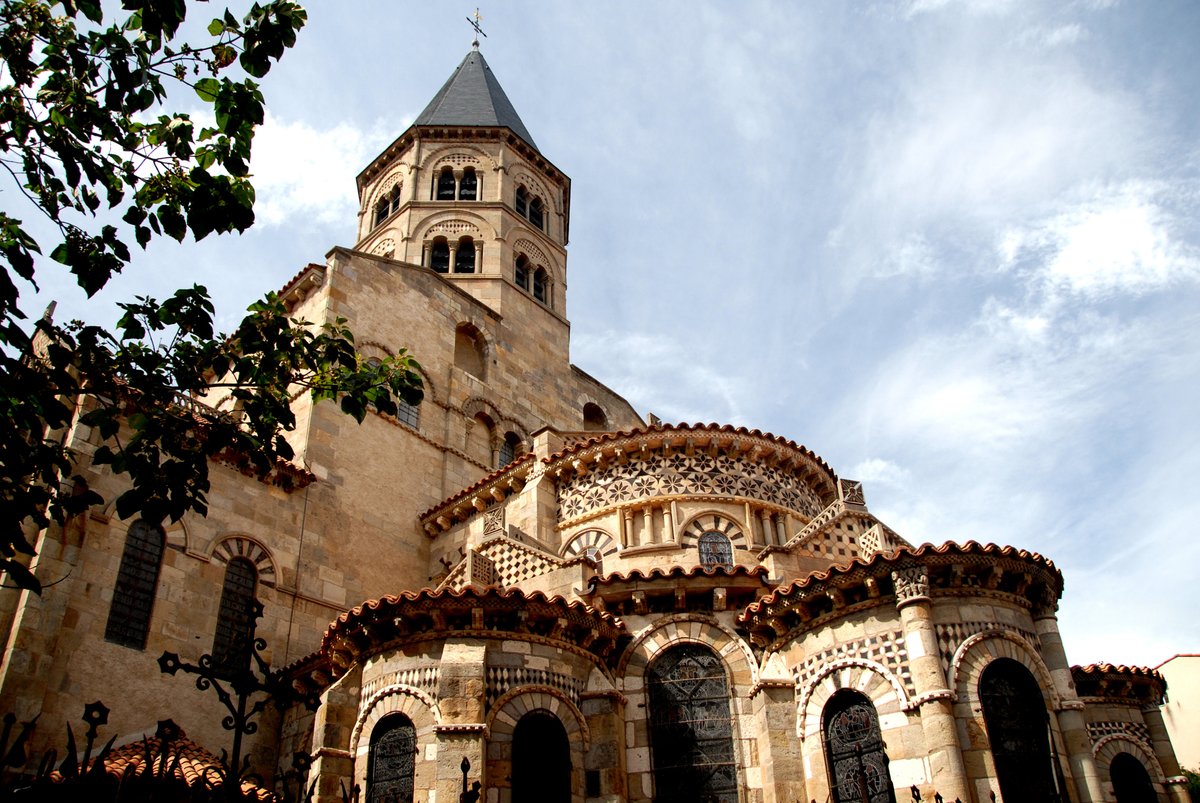

The Basilica of Notre-Dame du Port, located in Basse-Auvergne, France, is a gem of Romanesque architecture. Built by Saint Avit, the bishop of Clermont, in the 6th century and rebuilt in the 11th or 12th century after being destroyed by the Normans, it once served as a collegiate church for a community of canons. The name 'du Port' comes from its location in the market district. The community of canons was established no earlier than the middle of the 10th century. The basilica was declared a basilica minor on 3 May 1886. A bell tower was added in the 19th century, and the Romanesque roof tiles were replaced. They were later removed and the roof restored.
The basilica is one of the five Romanesque churches in Auvergne known as the 'greater' churches. It is built of arkose, a sort of sandstone, and has an almost perfect harmony, resulting from the application of the ratio of the Golden Number. The church has a Latin cross ground plan with a nave of six bays, two low side aisles, a transept with a semi-circular chapel on each arm, an ambulatory, four radiating chapels, and a chevet with fine mosaics, all examples of Romanesque art in Auvergne.
Today, the Basilica of Notre-Dame du Port stands as a striking example of Romanesque architecture and design.
Sources: Wikipedia, OpenStreetMap, Wikidata, Wikimedia Commons
Written by Nicolo Ciampini
Discuss this with the author and others
No comments yet. Be the first to start the conversation.