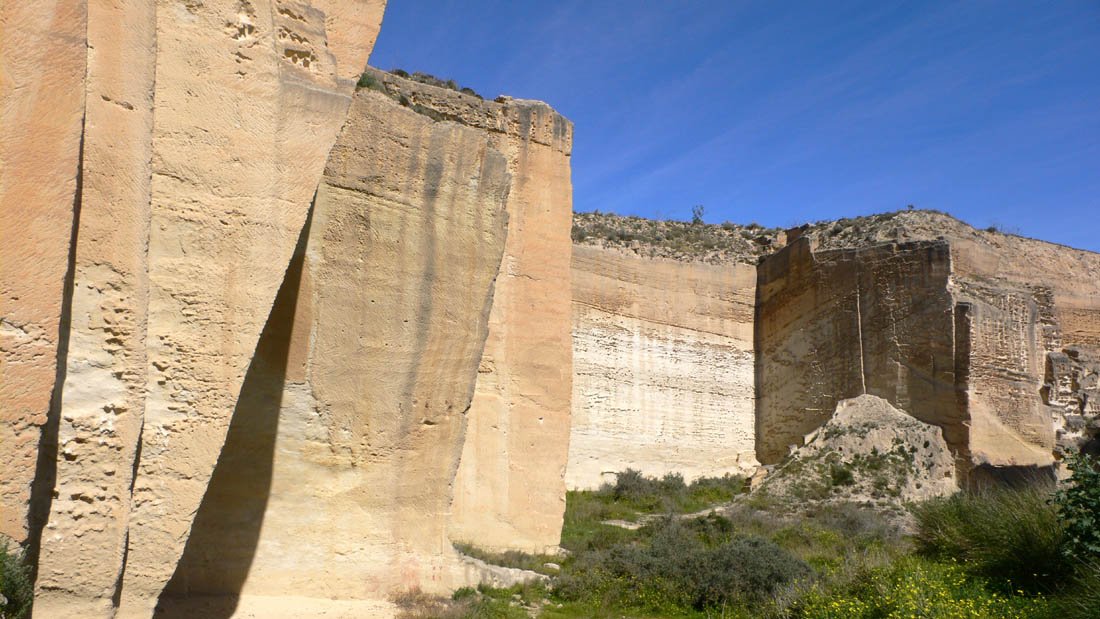

The Canteras Romanas are an archaeological site located in the Canteras district, about 4 km west of the Spanish city of Cartagena. These quarries feature sandstone and marl from the Miocene period, which was extensively exploited as construction material for the city of Carthago Nova as early as the 3rd century BC. The local name for this sandstone is tabaire, and its use is well-documented throughout the ancient urban area.
The material was utilized in significant structures such as the Punic wall, the Roman forum, and the Roman theater. Due to the porous and fragile nature of the stone, it was often covered with grey marble from the Cabezo Gordo in Torre-Pacheco. Today, a large quarry face remains, showing clear marks from ancient stonemason tools.
Because of their monumental scale and landscape value, the quarries were declared a Bien de Interés Cultural by a 2001 decree from the Government of the Region of Murcia. The site is currently surrounded by traditional dryland crops like almonds and carob trees, while the interior remains inhabited by native wild vegetation.
Sources: Wikipedia, OpenStreetMap, Wikidata, Wikimedia Commons

Written by Nicolo Ciampini
Discuss this with the author and others
No comments yet. Be the first to start the conversation.