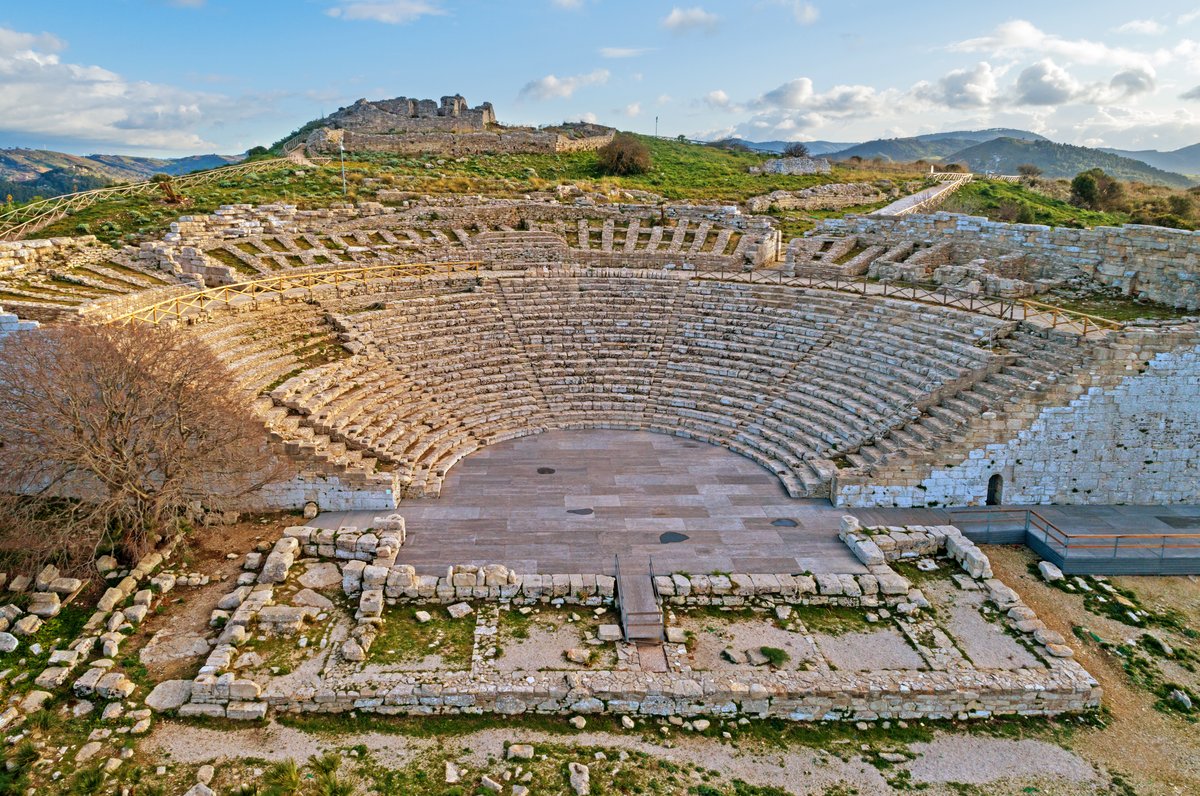

The Greek theatre of Segesta is located in the archaeological area of Calatafimi Segesta in the province of Trapani, Sicily. Built in the second half of the II century in a period when the city, of Elime origins, was under the influence of Greek culture, the theatre is situated on the northern acropolis of Monte Barbaro. It is oriented to the north, facing the sea and the hills, using the landscape as a backdrop. Some scholars believe the building was modeled after an existing theatre in another city.
Unlike typical Greek theatres, the cavea of Segesta does not rest directly on the rock but was specifically built and supported by retaining walls of local limestone. The theatre could accommodate up to 4,000 spectators. The cavea has a diameter of 63 meters and is divided by a central corridor, the diazoma, into a lower section with 21 rows of seats and an upper section with seats featuring backrests. It also features underground corridors used for the passage of actors, which were restricted to those who were not foreigners or the poor.
To the west of the theatre, a paved road leads to a natural cave containing a sacred spring. This spring was used during the Bronze Age and was later incorporated into the wall of the cavea's retaining wall. Between the 12th and 13th centuries, the theatre area and the leading road were occupied by a large residential sector. The structure underwent significant renovations in the 19th century.
Since 1997, the theatre has been reused for plays and performances, including classical works. In 1999, theatrical dawns were conceived, launching Segesta into international recognition. Today, it remains a significant historical site within the Calatafimi Segesta archaeological area.
Sources: Wikipedia, OpenStreetMap, Wikidata, Wikimedia Commons
Written by Nicolo Ciampini
Discuss this with the author and others
No comments yet. Be the first to start the conversation.