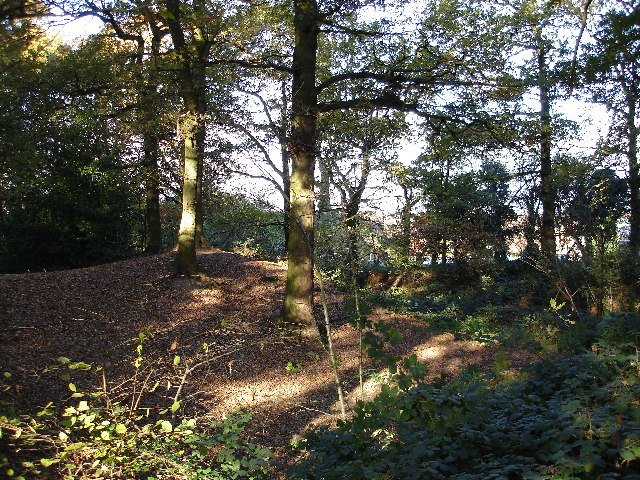

Tucked away in the heart of Solihull's Olton, Hobs Moat is a ruined 12th-century castle. Today, only the earthworks remain above the ground level, representing the site of the fortified manor house of Ulverli, built by the de Odingsells family. In 1656, antiquary Sir William Dugdale visited the site and found only a large moat, noting that the castle had long since been removed.
Archaeological inspections have uncovered evidence for a collapsed sandstone wall, with pottery suggesting a late-13th-century date for its construction. While a late medieval or early post-medieval shed-like structure was found, indicating the site was used for agriculture after the castle was ruined, a later survey concluded this was probably a hunting lodge. The castle would have stood on a large rectangular earthwork platform, encased by a rampart, a wide ditch, and a counterscarp bank.
The moat was spring-fed, with the northern boundary of the moat situated on a spring line. Immediately alongside the north side of Hobs Moat are the earthwork remains of a medieval hollow way, which is thought to have run westwards to connect Hobs Moat with Castle Lane.
Sources: Wikipedia, OpenStreetMap, Wikidata, Wikimedia Commons



Written by Nicolo Ciampini
Discuss this with the author and others
No comments yet. Be the first to start the conversation.