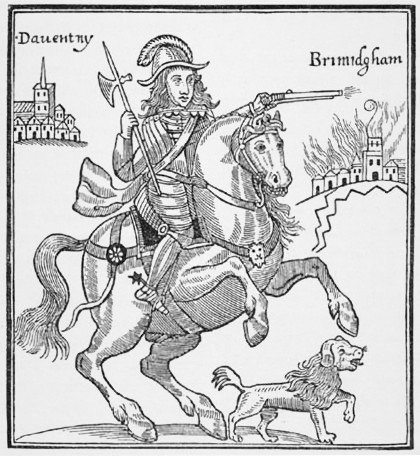

The Battle of Camp Hill took place on 3 April 1643, during the First English Civil War. In this skirmish, a detachment of 1,400 Royalists under the command of Prince Rupert attempted to pass through the unfortified parliamentary town of Birmingham. They were met by a company of Parliamentarians from the Lichfield garrison, supported by some local townsmen, totaling approximately 300 men.
The Parliamentarians put up a stout resistance, shooting at the Royalists from houses as the small force was driven out of town and back towards Lichfield. To suppress this musket fire, the Royalists torched the houses from which they thought the shooting was coming. After the battle, the Royalists spent the remainder of the day pillaging the town and set fire to many more houses the following morning. While pillaging an unfortified town in retaliation for resistance was common in Continental Europe, it was unusual in England, providing the Parliamentarians with a propaganda weapon to disparage the Royalists.
Captain Richard Greaves commanded the Parliamentarian troops. Some described the defenders as an armed mob that twice checked the Royalist cavalry. The Royalists eventually pushed into the town, setting fire to houses in several places. The fight continued until Captain Greaves rallied his troop of horse at the Lichfield end of the town and charged the scattered Royalists, forcing them to give way.
Sources: Wikipedia, OpenStreetMap, Wikidata, Wikimedia Commons
Written by Nicolo Ciampini
Discuss this with the author and others
No comments yet. Be the first to start the conversation.