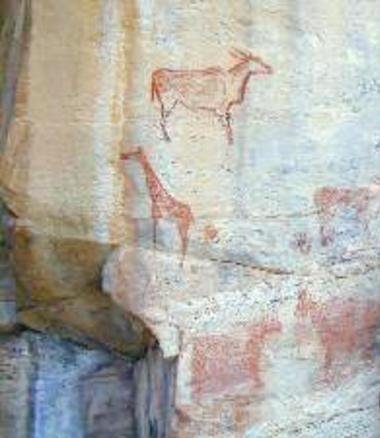

The Tsodilo Hills (Tswana: Lefelo la Tsodilo) are a UNESCO World Heritage Site in Botswana, consisting of rock art, rock shelters, depressions, and caves. The site gained its listing in 2001 because of its unique religious and spiritual significance to local peoples, as well as its unique record of human settlement over many millennia. UNESCO estimates there are over 4500 rock paintings at the site, which is believed to contain 500 individual sites representing thousands of years of human habitation.
People have used the hills for painting and ritual for thousands of years. The rock art has been linked to local hunter-gatherers, with evidence suggesting that ancestors of the San created some of the paintings and inhabited the caves and rock shelters. There is also evidence that Bantu peoples were responsible for some of the artworks. Some of the paintings have been dated to be as early as 24,000 years before present. White-colored rock art, which depicts animals and human-like figures, is associated with the Bantu people, while many red paintings depict cattle and geometrics.
These hills are of great cultural and spiritual significance to the San peoples of the Kalahari. They believe the hills are a resting place for the spirits of the deceased, and that these spirits will cause misfortune and bad luck if anyone hunts or causes death near the hills. Local San groups, such as the Zhu people, have oral traditions of using rock shelters for protection or as ritual areas. One tale claims that hunters would enter these shelters to contact ancestors to ask for a good hunt, returning to cook for their ancestors when successful.
Local San people believe Tsodilo is the birthplace of all life, and that the trails and grooves in the earth are the footprints of the first animals making their way to the first watering hole. A natural water spring near the Female Hill is used as a sacred site for cleansing, healing, and protection. While some scholars have debated the age of specific artifacts in Rhino Cave, the site remains a significant location for rain-making prayers and a testament to the long history of human interaction with the landscape.
Sources: Wikipedia, OpenStreetMap, Wikidata, Wikimedia Commons

Written by Mutabor
Discuss this with the author and others
No comments yet. Be the first to start the conversation.