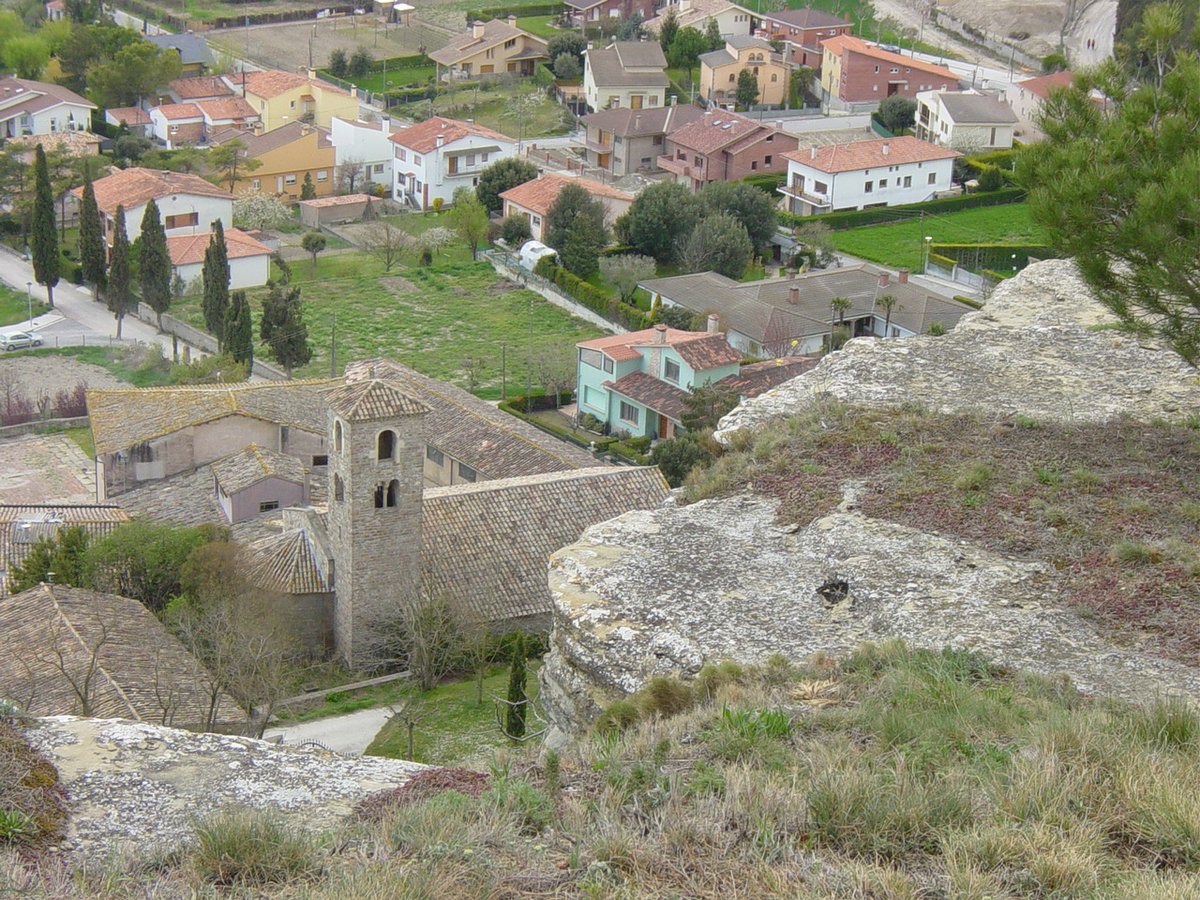

Sant Andreu de Tona is a Romanesque church located in Tona, a municipality in the Osona region of the province of Catalonia, Spain. The church's history and architectural features are intertwined with the story of Abbot Oliba, a significant figure in the spread and development of Romanesque art in Catalonia during the 11th and early 12th centuries. The church was likely built in the 11th century, with the first documented mention of it dating back to 889 when it was consecrated. The current building is believed to date from this period. [1]
Built in the Romanesque style, this church is characterized by its stone construction, thick walls, and small windows. The prototype of Romanesque churches was non-rural, medium-sized, and had the floor plan of a basilica with three naves containing three semicircular apses and a transept. Over time, church plans were adapted to meet the needs of growing numbers of canons or friars. The temple of the First Romanesque was simple, with a single nave topped by a semi-circular apse without a transept. [1]
During the 11th century, a significant patron and promoter of Romanesque art was Abbot Oliba. In 1008 he was appointed abbot of the monasteries in Ripoll and Cuixá, and ten years later he was appointed bishop of Vich. Oliba traveled to Rome in 1011 and 1016 and was influenced by Franco-Italian monasticism, which accounted for his knowledge of the Roman liturgy and its introduction into the Catalan Church. [1]
Under Oliba's patronage and direction, major reforms were carried out at the monasteries of Cuixá, where Oliba was heavily involved in important construction projects, such as the church of Sant Vallí de Vic. The Abbot also endeavored to be present at consecrations, which were discussions regarding a particular construction or project. [1]
Sources: Wikipedia, OpenStreetMap, Wikidata, Wikimedia Commons
Written by Nik Frost
Discuss this with the author and others
No comments yet. Be the first to start the conversation.