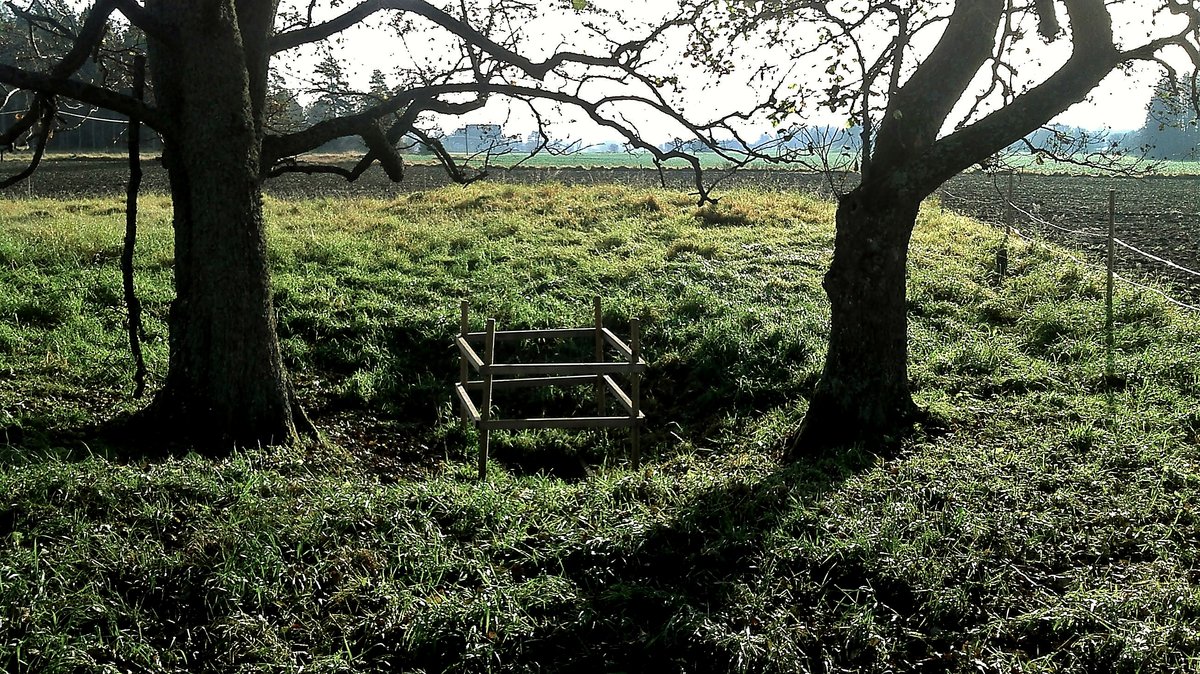

Gödåker’s grave field in Gödåker, Uppsala municipality, is an archaeological site dating back to the Roman Iron Age, approximately 100-400 AD. The grave field consists of 26 fornlämningar, including three grave mounds, 14 round stone settings, and nine standing stones, with the largest mound measuring 14 meters in diameter and 1.8 meters high. In the grave field’s southwestern corner, there is an offering well with(*) well-defined wooded sides and stone edges.
In the early 1900s, cleaning the well revealed remains of woven baskets and bones from a dog, cattle, and human.Excavations were mainly conducted in 1915 and 1924, during which archaeologists found golden ring pendants, a Roman-imported wine vessel, and a larger so-called Hemmoorskärl of bronze. In 1924, medical doctor Herbert Rettig bought 70 acres of the archaeological site and donated it to Tensta parish. Today, Tensta parish owns the grave field and the Tensta local history association is responsible for its care.The name Gödåker had the form ’Gydakrum’ in 1492, whose original form is believed to have been ’Gudhiuaker’, meaning ’Goddess’ field’.
A rare meadow vegetation, abundant with sparse dry meadows, dry meadows, and knylhavre meadows, can be found at the site. The meadow teems with diverse species, including darrgrass, flock fennel, cow vetch, yarrow, and hedgenettle, which grow prolifically, while black clover, sand violet, cow violet, wood sorrel, and heath speedwell appear sparsely. In 1986, the endangered species toppjungfrulin was also observed. The meadow is grazed annually, and the hay is removed.
Sources: Wikipedia, OpenStreetMap, Wikidata, Wikimedia Commons
Written by Nik Frost
Discuss this with the author and others
No comments yet. Be the first to start the conversation.